
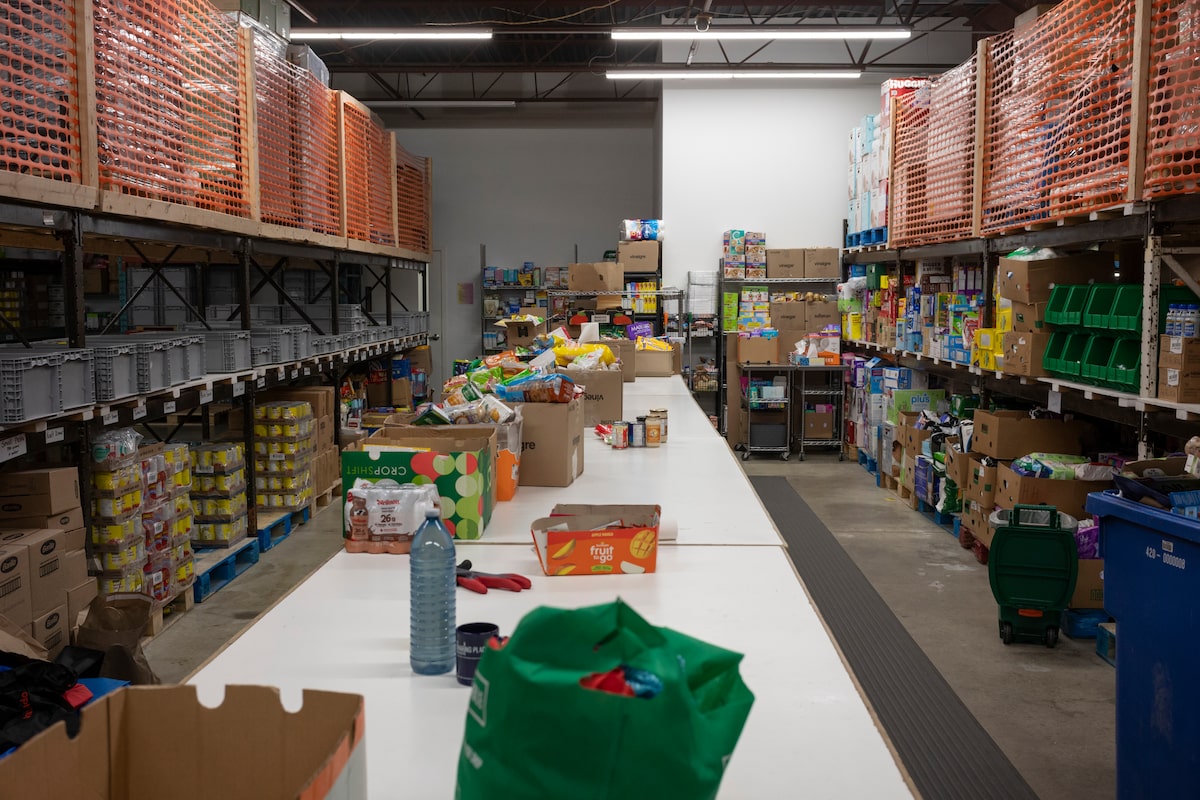
Food in storage at The Sharing Place food bank in Orillia, Ont., in October. Demand for food banks has grown in Canada since the onset of the COVID-19 pandemic, according to Food Banks Canada.Ian Willms/The Globe and Mail
Shannon Moneo is a writer living in Sooke, B.C.
When I posted a Facebook Marketplace ad to give away a seven-and-a-half-year-old double mattress, I never expected to get 14 replies within five hours from readers in Sooke, B.C., and the Greater Victoria Area. After 24 hours, I’d amassed 21 requests for an item visible in one photo.
Those replying seemed to form a microcosm of the current hardships in Canada. One woman was sleeping on a couch at a friend’s house; one man was sleeping in an RV; three inquirers were recent arrivals in Sooke from outside of Canada; one person was Indigenous, from a reserve.
It’s presumptuous to draw conclusions from sparse social-media comments, given that the truth may not be there or that even half-truths could be buried in the messages. But in the case of a free mattress, it’s pretty safe to say that people were not replying with the intention of reselling it and that their own need was driving the response. Even with the risks of bedbugs, lice, dead skin cells and stains, people were willing to take an item that had been slept on for about 2,100 days. (I guess we don’t hesitate to sleep on a much-used hotel-room bed – but at least there’s the guise of routine cleaning by staff.)
Opinion: Income inequality is our greatest threat, for it’s fuel for many other threats
Granted, I’m a clean bug. I always wiped the mattress down with detergent and baking soda once a year, and dutifully rotated it each time I changed the bedding. When the mattress was stripped, it looked pretty good, so shipping it to the dump seemed wasteful. When I bought my new mattress, the salesperson told me I could pay $15 to have the Sealy product brought to Victoria’s Hartland Landfill, a transaction most customers opt for.
But I’d heard about problems with the disposal of used mattresses in B.C. and across Canada. Notoriously hard to deal with (a dumped mattress is a common sight in my bedroom community), the springs, foam and wood of a mattress take up an estimated 400 per cent more space in landfills than most other waste products.
In 2024, Metro Vancouver spent more than $3.5-million to transport and handle almost 90,600 mattresses and box springs, costing the city about $38 per item – more than double the $15 fee charged to individuals who send these items to waste centres. When additional regional costs to cover illegal dumping and large-item residential waste pickup were factored in, the expense of mattress disposal to the public purse in Metro Vancouver was estimated to be more than $6-million in 2023.
I couldn’t help but think back to the intense days of COVID-19 lockdowns. Offering a free mattress during those panic-stricken years would likely have been met with a blanket of silence or finger-wagging invectives. Fast forward to 2025, and much has changed as the middle class continues to be hollowed out. Since the onset of the pandemic, the appetite for food banks in Canada has soared. Between 2019 and 2025, demand has grown by 79 per cent in B.C., 134 per cent in Alberta, 125 per cent in Ontario and 116 per cent in Quebec, according to Food Banks Canada. Homelessness has also become more widespread. In 2018, the Sooke Shelter Society counted 38 homeless people in our town, which is 40 kilometres from Victoria. Today, the shelter society serves up to 200 people each month.
Sooke Food Bank president Kim Metzger told me that since she began volunteering at the service in 2012, requests have jumped almost 70 per cent. On the first three Thursdays of each month, about 125 food boxes are distributed. In 2012, it was 75. (One caveat is that Sooke’s population has grown from about 11,400 people in 2012, to 17,500 in 2025.)
Opinion: A quarter of Canadians are food insecure. Addressing this must be a national priority
Like most food banks, Sooke’s relies on donations. “But now we’re seeing people who were small donors, like $50 a few years ago – they’re now coming in for help,” Ms. Metzger says. Every day, she gets a crisis call from someone needing a hamper. The need arises from three substantial expenses in this region: Transportation, rent and utility costs. Increasingly, those who own vehicles cannot pay for repairs; the prevalence of non-functioning headlights and tail-lights, bald tires, and squealing brakes are just a few signs around town. Many of the food bank’s customers are seniors or people in poverty who are working two or three jobs, Ms. Metzger says.
Nevertheless, in my desirable West Coast community, there’s no shortage of people with money living amongst those without. Perched on vista-giving cliffs sit $3-million oceanfront dwellings. Just five kilometres away sit dilapidated mobile homes, plunked down into compounds with no view of the water.
My comfortable life and complacency have been shaken by the mattress episode. This holiday season, I realized I can help more where it’s needed. Maybe instead of spending $200 on a frivolous night out with friends, that money could be donated instead. Maybe I can give away another piece of furniture I don’t need. And that vehicle I was going to get $5,000 for on a trade? Perhaps it would be more valuable as a donation to someone who can’t afford to replace the car they need to get to work.
So, who got my mattress? I had to juggle between first-come-first-served, and the ability to collect the mattress. A few people were willing to pay me a small amount to deliver it. In the end, a young woman from Victoria came with her family in their van and strapped the mattress to the roof on a day when it poured rain.
Wanted, sight unseen, a seven-and-a-half-year-old soft mattress: a metaphor for hard times?