
Tom’s Hardware Premium Roadmaps
(Image credit: Future)
Edit 12/25/2025 5:45am PT: An Nvidia spokesperson has sent the following statements to Tom’s Hardware Premium:
“We have repeatedly visited Megaspeed’s facilities and observed a cloud service permitted under the export rules, with no evidence of diversion. Our visits confirmed the GPUs are where they are supposed to be. We will continue spot‑checks consistent with our practice.”
“By design, the export rules allow clouds to be built and operated outside controlled countries. Winning those clouds will decide the AI race and bring tens of billions of dollars and high‑paying jobs home. Export controls forfeited the world’s second‑largest commercial market to foreign competitors—America cannot afford to lose all of Asia next.”
You may like
Original coverage follows:
When U.S. lawmakers tightened export controls on advanced AI processors, their goal was straightforward enough: slow China’s access to cutting-edge compute hardware by restricting direct sales of the most capable GPUs. Three years later, the policy is colliding with the realities of globalized supply chains, reseller-driven distribution models, and explosive demand for AI accelerators.
Nothing has made that collision clearer than the scrutiny that Megapseed International is currently facing. Megaspeed — formerly 7Road International, a Chinese gaming company with ties to the state — describes itself as a “premier business partner of Nvidia” that specializes in AI computing resources.
The company has rapidly become Nvidia’s largest buyer in Southeast Asia, and U.S. officials and Singaporean authorities are examining whether Megaspeed acted as a conduit for restricted Nvidia AI chips ultimately destined for China. According to a special report by Bloomberg, the scale and speed of Megaspeed’s purchases, combined with gaps between its declared data center capacity and the volume of hardware imported, have raised questions about whether U.S. export controls are being circumvented through third-party jurisdictions.
While Nvidia has said it has found no evidence of chip diversion in the past, this latest episode concerning Megaspeed highlights the broader problem of export controls, which are stringent on paper but increasingly difficult to enforce in practice once hardware passes through layers of intermediaries.
Nvidia’s channel model complicates enforcement
Nvidia does not sell most of its data center GPUs directly to end users. Instead, it relies on a sprawling ecosystem of distributors, system integrators, cloud providers, and regional partners. This model scales efficiently in normal markets, but it complicates enforcement when export rules hinge on end use and final destination rather than the point of sale.
After the U.S. Commerce Department imposed controls on A100 and H100 GPUs in October 2022, Nvidia responded by creating lower-spec China-only variants such as the A800 and H800. When those too were restricted in late 2023, Nvidia introduced a new lineup of compliant parts, including the H20, L20, and L2. Each iteration was designed to remain below defined interconnect and performance thresholds while preserving software compatibility.
This approach allowed Nvidia to continue serving Chinese customers legally on paper; however, in practice, it also created a gray zone in which large volumes of AI hardware could be moved through third countries before regulators had clear visibility into where systems were deployed or how they were ultimately used. Once GPUs are installed in servers and shipped as complete systems, tracing individual accelerators becomes significantly harder.
You may like
Megaspeed managed to slot itself nicely within this gray zone. The company, which traces its roots to a Chinese gaming business that was subsequently spun out and rebranded in Singapore, reportedly committed to purchasing billions of dollars’ worth of Nvidia hardware over a short period. That drew attention, particularly when U.S. officials noticed discrepancies between the volume of chips imported and the capacity of Megaspeed’s disclosed data center footprint.
Singapore’s government has confirmed it is investigating potential export control violations, while U.S. agencies are examining whether restricted hardware was indirectly diverted to China.
A market ripe for smuggling
Unfortunately, the Megapseed situation is not an isolated incident. Over the past year, U.S. authorities have uncovered multiple schemes involving the illicit export of Nvidia GPUs to China, including instances in which companies misdeclared shipments, used shell entities, or physically removed accelerators from servers after inspection.
In late 2025, the U.S. Department of Justice shut down a major China-linked smuggling network that allegedly routed tens of millions of dollars’ worth of H100 and H200 GPUs to China by falsifying documentation and relabeling hardware. In a similar case, DeepSeek was accused of establishing “ghost” data centers in Southeast Asia to pass audits, then shipping GPUs onward.
These cases all highlight the difficulty of enforcing controls once hardware leaves Nvidia’s hands. Export rules are primarily enforced at the point of sale and shipment and rely heavily on declarations of end use and on downstream compliance by resellers and customers. When demand is strong enough, the incentives to circumvent those declarations multiply — and China’s appetite for AI compute remains enormous.
Domestic alternatives, including Huawei’s Ascend accelerators, have improved but still lag Nvidia in software maturity and ecosystem support. Even Chinese firms that publicly promote local silicon often rely on Nvidia hardware for training large models or running advanced inference workloads. That persistent demand has created a shadow market willing to pay significant premiums for restricted GPUs.
Policy goals vs supply chain vs Chinese demand
From Washington’s perspective, export controls are intended to impose real friction on China’s AI development by constraining access to the highest-end compute. The logic is that advanced model training scales with available GPU throughput, memory bandwidth, and interconnect performance. Denying that hardware should slow progress in both commercial and military AI applications.
The problem is that for China, which is so far behind the West in real terms, partial access is still extremely meaningful. Even a modest influx of smuggled or otherwise indirectly routed GPUs can support the likes of research projects and inference deployments. While it’s estimated that illicit imports account for only a fraction of China’s total compute capacity, even marginal gains can make a big difference at the frontier of model development.

(Image credit: Getty Images / China News Service)
At the same time, aggressive controls carry trade-offs. They push Chinese companies to accelerate domestic chip development, fragment global supply chains, and incentivize exactly the kinds of gray-market behavior now under investigation. They also place companies like Nvidia in a difficult position, caught between compliance obligations and the commercial reality that much of their addressable market lies outside the U.S. and its closest allies.
In early 2025, the Commerce Department expanded controls to cover not just hardware but also certain AI model weights, while creating new licensing frameworks for trusted partners and data center operators.
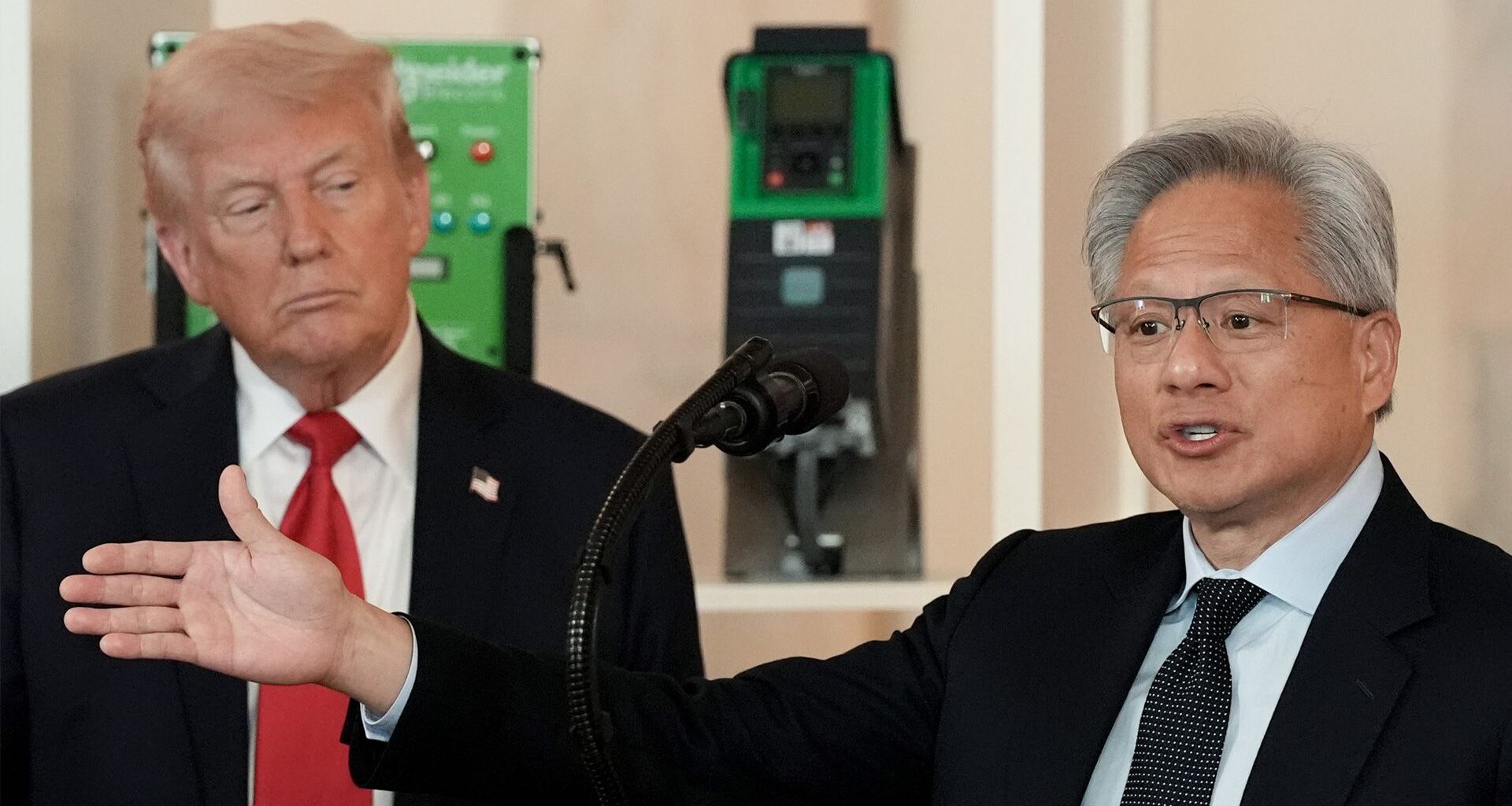
While some of these controls have been relaxed by President Trump, with H200 sales now permitted to vetted Chinese customers subject to a 25% import duty, the back-and-forth indicates clear uncertainty among decision-makers about what level of restriction, if any, will achieve the desired outcome. Indeed, it’s difficult to argue that allowing the H200, some of the most advanced silicon made by Nvidia, does anything to serve the U.S. goal of hindering China.
Whether or not investigators ultimately find evidence that Megaspeed violated export laws, there’s a structural weakness in the current system. Export controls assume that intermediaries can be trusted to enforce end-use restrictions at scale, across borders, and over time. As long as global demand for Nvidia-class AI compute outpaces legal supply to China, however, pressure will build on the seams of the system.

Follow Tom’s Hardware on Google News, or add us as a preferred source, to get our latest news, analysis, & reviews in your feeds.