
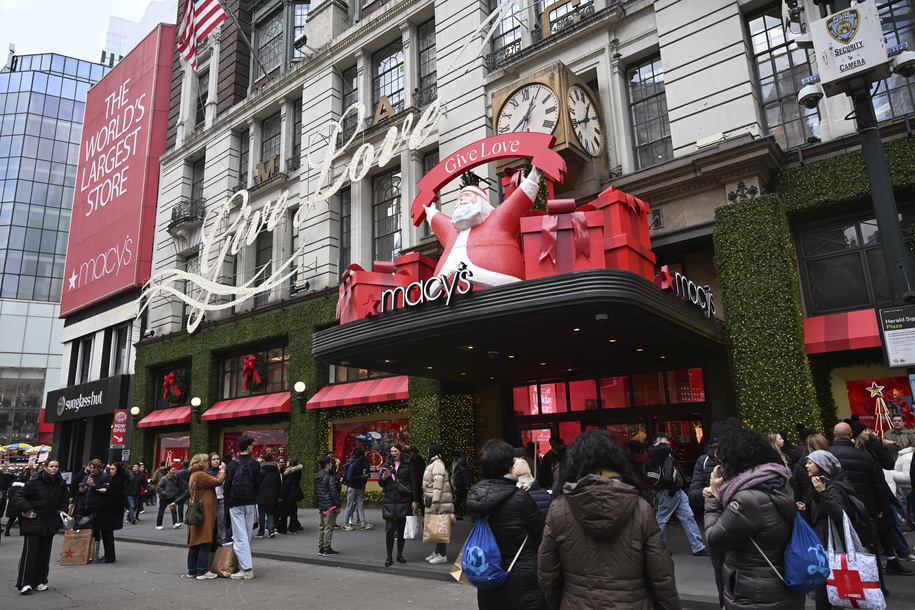
Americans are pulling back—and the holidays are paying the price.
New polling shows that growing economic anxiety under President Donald Trump is reshaping how people approach gift-giving this season. A series of polls conducted in the last two months of the year suggest that households are spending less, watching prices more closely, and trimming their expectations. And the shift isn’t subtle.
CNBC’s All-America Economic Survey, conducted in early December, finds that 41% of Americans plan to spend less on holiday gifts this year. That’s up 6 percentage points from 2024 and marks the biggest pullback since inflation spiked in 2022.
Among those cutting back, nearly half (46%) cite the high cost of goods, a 10-point increase from last year. Prices remain stubbornly high, and for many families, the math no longer works the way it once did.
Only 16% say they plan to spend more. Even then, the motivation isn’t confidence. In a telling reversal, 36% of those increasing their budgets say higher prices are the reason. CNBC notes this is the first time inflation has meaningfully driven both higher and lower spending.
That contradiction speaks to the moment. Americans aren’t necessarily bracing for collapse—but they don’t feel secure either. They’re still buying gifts, just with more hesitation, more calculation, and more anxiety about what comes next.
Other surveys reinforce the picture. Data from the Associated Press-NORC Center for Public Affairs Research shows consumers are becoming more deliberate as the season begins.
About half of Americans say they’re spending more time hunting for deals and putting off big purchases. Nearly as many—48%—say they’re buying nonessential items less often, while just 13% report shopping more than usual. Worse, 4 in 10 say they’re leaning more heavily on savings.
What’s striking is how this compares with earlier inflation scares. More Americans say they’re tightening their belts now than they did in December 2021, when prices were just beginning to climb due to recent inflation troubles. And while supply-chain disruptions have seemingly faded as a concern, affordability has not.
The issue isn’t availability. It’s price—especially for lower- and middle-income households, which say the gap between what they want to give and what they can reasonably afford keeps widening.
That unease is evident in broader confidence measures. Gallup’s Economic Confidence Index slid sharply in November, reaching its lowest level since mid-2024. Just 21% of Americans now describe economic conditions as excellent or good, while 40% say the economy is in poor shape.
Optimism about the future is slipping as well. Only 27% tell Gallup the economy is improving. Meanwhile, 68% say it’s getting worse.
And those attitudes are reshaping holiday budgets. Americans now expect to spend an average of $778 on gifts this season, down sharply from October’s estimate of $1,007 and well below last year’s November estimate of $1,102. Gallup notes that consumers often revise expectations downward as December approaches—but this year’s decline is the largest midseason drop the firm has ever recorded, surpassing even the pullback during the 2008 financial crisis.
The retrenchment isn’t confined to one corner of the economy. Gallup finds that households earning more than $100,000 have scaled back their holiday budgets by several hundred dollars since October. Lower-income Americans are pulling back even more sharply. Middle-income households, for now, appear to be holding steady—less a sign of confidence than of limited room to cut further.
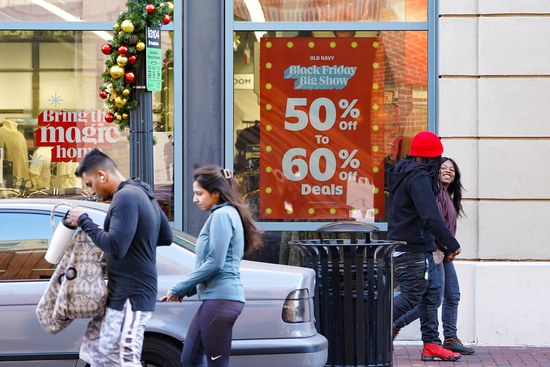
Shoppers browse for deals in Atlanta in November.
What makes this moment politically fraught is not just inflation fatigue but also a broader sense of instability tied to Trump’s second term in the White House. For many voters, the concern isn’t tied to a single policy but to a broader sense of unpredictability. Economic debate has once again become volatile and personalized, with fewer clear signals about where things are headed.
The shift shows up in subtle ways. Americans aren’t scrapping the holidays—they’re downgrading them.
Think: fewer gifts, lower price points, more hesitation at checkout. Taken together, the polls suggest holiday spending has become less about celebration and more about minimizing risk.
In short, restraint—not abundance—is setting the tone this season. An October YouGov poll found that most Americans (56%) planned to set spending limits, and a notable share (14%) said they would not shop at all this year, though the poll didn’t dive into whether that was by choice or necessity.
Taken together, the data point to an economy that feels fragile at the household level. Americans may still show up for the holidays—but they’re doing so with tighter budgets and a growing sense that even familiar rituals now require caution.
Holiday spending has long been a barometer of consumer confidence. This year, it’s measuring something else: how uneasy Americans feel living under Trump’s economy.