
‘It will make or break some businesses,’ fears Brechin man; Legion official said ‘non-profits are also caught in the squeeze’ of new regimen
When new provincial recycling legislation comes into effect Jan. 1, 2026, the County of Simcoe will cease to collect recyclable materials.
The county will continue to manage garbage and organics, but Circular Materials will be responsible for managing and collecting recyclable materials — and only from residential properties — across the province.
The industrial, commercial and institutional (ICI) sector — which includes not-for-profits and small businesses — is exempt from the collection service under the new legislation.
“We had numerous meetings with the minister over this, saying it’s a step backwards for Simcoe County if you’re not going to (include small businesses),” said Ramara Mayor Basil Clarke.
“I understand why they did it. They’re trying to standardize the entire province of Ontario. If you can believe it, there were still municipalities that weren’t recycling at all,” he explained.
Despite lobbying the province to include the ICI sector in the recycling collection program, the County of Simcoe was unsuccessful. With no room in the county’s 2026 budget to absorb extra costs, fees related to recyclable materials will fall to small business owners.
“Losing the recycling aspect of it, it’s actually costing us more to operate our landfills now,” said Clarke.
He laments that small businesses will soon need to pay for and manage their recycling.
“I’m definitely going to have to pay somebody to take it away, or make a trip up to the dump once a month or something,” said Michael O’Donnell, owner of Mike’s Autobody & Tyre on Concession Road in Brechin.
“Our blue box is over full every two weeks,” said O’Donnell, who believes some of the recycling will end up in the garbage come the new year.
“It’ll end up in the streets and the ditches, you name it,” he said.
Many large scale industrial businesses in Ramara don’t use the service provided by the county. As Clarke pointed out, it’s based on what can fit into the 360-litre cart.
It will be “the little mom and pop stores” that are most affected by the changes.
“It’s unfortunate because these businesses wanted to take part in that program,” he noted.
Recyclables may be brought to county waste facilities. But it will be subject to a fee, which covers haulage, transfer, and processing costs, at $200 per tonne with a minimum charge of $10, according the county website.
“It will make or break some businesses,” said Bill Smith, a retired mechanic who helps at Mike’s Autobody & Tyre.
The costs aren’t just financial, there is also the time and labour involved with managing and dropping off recyclable materials appropriately. These are added responsibilities for the small business owners and staff, he explained.
Neal Jolly, owner of Jolly Automotive Services, described the amount of recycling the parts he orders can come with.
One tire, he said, is wrapped in a plastic bag, then packed with insulating cardboard and paper within the larger box it comes in. Ordering a new set of tires for someone produces a substantial amount of recyclable material, he explained.
Can some of it be eliminated? Will manufacturers minimize it?
As a small business owner, Jolly is uncertain. His family-run business diligently takes part in the recycling program offered by the county. When the provincial changes come into effect, he said it’s hard to predict how it will impact the business.
Jolly was told a commercial bin rental can be anywhere from $300 to $500 a month, depending on the size, plus the costs of regular collection and tipping fees.
For now, he is undecided how his business will move forward.
“You still want to do as much as you possibly can,” he said, but he wouldn’t be surprised if some recycling ended up in the garbage.
O’Donnell said the provincial legislation will “not at all” change how or what he orders and from who. His suppliers ship things how they do regardless of where he gets it from.
Jolly is also skeptical of the legislation’s effectiveness. He said once manufacturers ship the items it’s not their problem anymore.
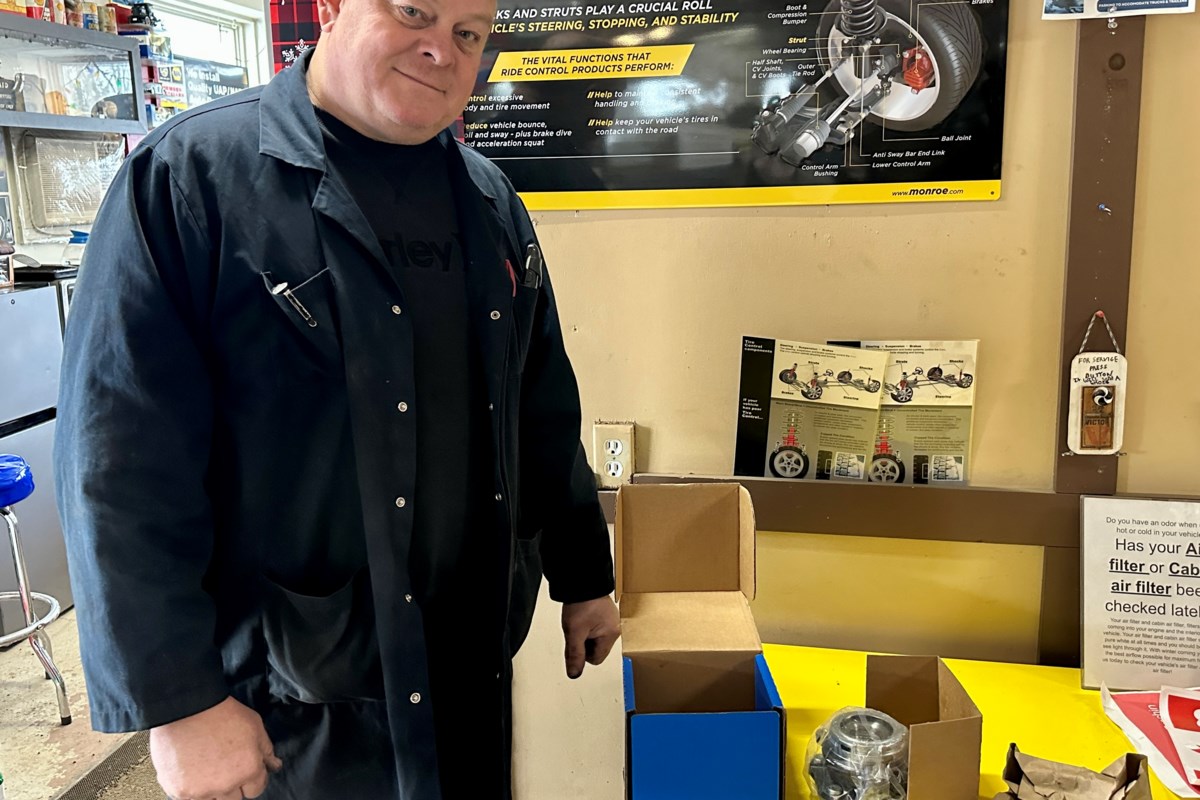
Unpacking a metal wheel bearing, Jolly showed how much plastic and paper components are added. A business like his, he said, can sell anywhere from 50 to 100 of this item alone, within a year.
Keeping waste out of landfills is important to many community groups. Some, like the Rescue Lake Simcoe Coalition, fear the new legislation could reverse years of progress.
For O’Donnell and Jolly, shifting costs onto small businesses does not sound like a way to improve recycling practices.
Not-for-profit organizations will also be impacted.
“I don’t think they realized what they were doing,” said Jane Ste. Marie, president of the Women’s Auxiliary at the Brechin-Mara Legion.
She and the team of volunteers are considering their options, such as hiring a waste management company, if they can afford it.
Some volunteers are willing to divide the materials amongst themselves and recycle it at their homes, but it’s only a temporary solution.
“We believe in recycling. We want to be good stewards of the ecosystems. We’ll try and find some method where we’re still recycling,” she said.
The Legion is also a drop-off centre for the Good Food Box program, it accepts donations for the Feeding Families campaign, and the hall is used for many events, including celebrations of life and dinners where food is the biggest source of waste.
Composting and using real dishes are ways the Legion members keep waste low. Ste. Marie says they also purchase items in bulk and portion things themselves for events.
“I hope they make some changes for places like Legions and stuff. Because we don’t produce … the legislation was aimed at manufacturers… I think the non-profits got caught in the squeeze,” said Ste. Marie.
“We’re concerned, but not sure yet how we’ll be affected.”