
Breadcrumb Trail Links
SportsHockeyJunior HockeyLocal Sports
There’s no saying categorically that Bill Taugher never filled in for Georges Vezina. There’s no doubt, however, about his bravery in the face of ordeals that would have broken almost anybody else. Nor is there any doubt he too often got a raw deal, in a tough game, in a dirty business and ultimately in life, cruelly brief
Published Dec 26, 2025 • Last updated 1 hour ago • 21 minute read
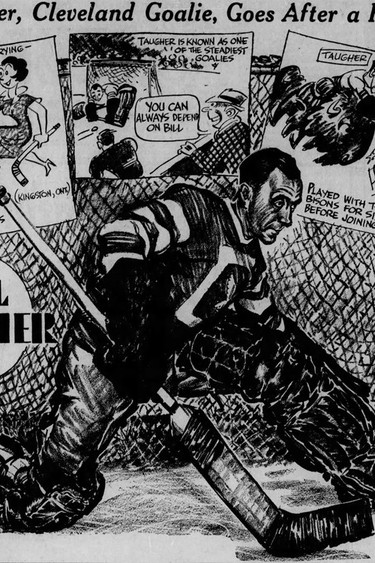 This illustration appeared in the Whig-Standard on Jan. 14, 1936, along with an account of Bill Taugher landing with the Cleveland Falcons after he thought he landed a job with the Stanley Cup champion Montreal Maroons in the previous fall. Photo by file from Kingston Whig-Standard /jpg, KI, apsmcArticle content
Advertisement 2
This advertisement has not loaded yet, but your article continues below.

THIS CONTENT IS RESERVED FOR SUBSCRIBERS
Subscribe now to read the latest news in your community.
Unlimited online access to all articles on thewhig.com.Access to subscriber-only content, including History: As We Saw It, a weekly newsletter that rips history from our archives, which span almost 190 years.Enjoy insights and behind-the-scenes analysis from our award-winning journalists.Support local journalism and the next generation of journalists.
SUBSCRIBE TO UNLOCK MORE ARTICLES
Subscribe now to read the latest news in your community.
Unlimited online access to all articles on thewhig.com.Access to subscriber-only content, including History: As We Saw It, a weekly newsletter that rips history from our archives, which span almost 190 years.Enjoy insights and behind-the-scenes analysis from our award-winning journalists.Support local journalism and the next generation of journalists.
REGISTER / SIGN IN TO UNLOCK MORE ARTICLES
Create an account or sign in to keep reading.
Access more articles from thewhig.com.Share your thoughts and join the conversation in the comments.Get email updates from your favourite journalists.
THIS ARTICLE IS FREE TO READ REGISTER TO UNLOCK.
Create an account or sign in to continue with your reading experience.
Access articles from across Canada with one accountShare your thoughts and join the conversation in the commentsEnjoy additional articles per monthGet email updates from your favourite authorsSign In or Create an Account
or
Article content
If Bill Taugher didn’t fill in for Georges Vezina with the Montreal Canadiens back in 1925, how did the apocryphal legend get started?
Article content
Recommended Videos
Article content
In Part One of this series, hockey historians and internet sleuths searched for hard evidence that the 19-year-old son of a Kingston blacksmith played for the Canadiens and, like me, they found nothing to back up the story, other than a couple of lines of type buried in a pair of not wholly reliable reference books published decades later.
And in Part Two, I laid out how in that season when he was supposed to have stepped in for Vezina in Montreal, Bill Taugher was double-booked 180 miles away, playing for Regiopolis-Notre Dame in Kingston’s city league and for the Combines team that won the Ontario Hockey Association title. Forensic accounting further suggested another goaltender named Taugher who played in the Montreal junior leagues might have been Vezina’s fill-in.
In this concluding instalment, I’ll provide an Occam’s Razor treatment, the simplest explanation for the garbling of the story, the crossing of wires that put him in the Canadiens’ net.
At the end of the Combines’ season in Part Two, Taugher and his teammates were on a platform at Winnipeg’s Union Station waiting for an eastbound train, starting their trip home to Kingston after coming so close to the Memorial Cup. And at an important juncture years later, Taugher will again be in that platform, clutching a ticket for a train bound for Montreal, presuming he was getting his long-awaited shot at the NHL, with a Stanley Cup champion, no less.
Advertisement 3
This advertisement has not loaded yet, but your article continues below.
Article content
At the risk of spoiling the payoff, I’ll tell you this: He didn’t make it.
Let’s pick up his story in the aftermath of Kingston’s loss to the Calgary Canadians.
*
When Taugher left Winnipeg on March 27, 1926, his Combines had played their last game together, the short life of their thrilling bond being nothing that has ever occurred to even the most thoughtful teenage hockey player until after the fact. Doubtlessly, though, it landed with Taugher how very different his life was that his teammates’.
The others had career paths. Queen’s players like Carl Voss headed back to their campus, their friends and fraternities, and three would land in med school. Those from RMC like Hartland Molson likewise had their studies, duties and subsequent commission scripts ahead.
Already out of school and working for his keep, Taugher would go back to his father’s blacksmith shop at 232 Wellington Street and during the summer he’d book work on a freighter. Taugher’s circle more circumscribed than theirs. Put it down to class—the gentlemen collegians and heroic soldiers would light out to see the world, leaving behind the humble tradesman, already out of school and wielding a blowtorch and hammer eight, 10 and 12 hours a day two doors down from his family’s home.
Advertisement 4
This advertisement has not loaded yet, but your article continues below.
Article content
That summer, though, Taugher learned that glorious run with the Combines had changed his career prospects more than he dared to dream. He had been on a track to play in the senior division of the city league the next winter, but five OHA sides were breaking away from the association to form an independent professional league. Teams in London, Niagara Falls, Stratford, Windsor and Hamilton bristled at the OHA’s draconian enforcement of residency requirements—eight Windsor players were denied eligibility on those grounds. So it was that the Canadian Professional Hockey League was born, and three teams were bidding for Taugher along with Combines teammate Paddy Patterson. From a story on May 6, 1926 in the Standard: “Cool under fire and possessed of remarkable agility, Taugher made a name for himself in junior hockey and a bright future in the game was predicted for him.”
While Patterson and Buster Hartley soon confirmed their signing with the Hamilton Tigers, Taugher’s intentions were uncertain for weeks. He’d be away all summer, escaping the heat of the forge in his father’s unventilated shop by signing on with Canada Steamship Lines and working aboard the Walter B. Reynolds, a freighter, in the upper Great Lakes. When he disembarked in Kingston on Oct. 26, 1926, he collected his belongings and goaltending equipment and packed off to Hamilton. The Standard lamented his departure for the pro ranks (“Taugher will be greatly missed.”).
Advertisement 5
This advertisement has not loaded yet, but your article continues below.
Article content
Taugher went on to play to glowing reviews through two seasons in the nascent league. In his rookie campaign, the Hamilton Tigers lost to London in the final like the Combines had to Calgary, by a game and a goal in a tight contest. The Tigers weren’t as competitive in their second season—crowds of 5,000 for the team’s launch dwindled to half that number and the franchise was sold to an interest in Buffalo, with the league expanding to eight teams.
Playing out of Fort Erie’s Peace Bridge Arena, the team, renamed the Bisons, staggered out of the blocks, dropping their first five games, falling into last place. As spring neared, the team rallied but missed out on a playoff berth on the last day of the season. By accounts in the Buffalo papers, Taugher was despondent, his selection as the league’s all-star netminder being no consolation.
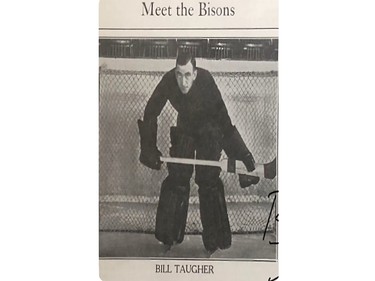 This photo illustration of Bill Taugher appeared on the front page of the Peace Bridge Arena News, the Buffalo Bisons’ official publication, on December 12, 1931. Photo by from collection of Bob Fretz
The CanPro League rebranded as the International Hockey League and expanded with the Bisons earning the reputation as the IHL’s elite defensive team, winning championships in 1932 and ’33. By the time of that second championship, Bashful Bill became the most beloved Bison, the lone holdover from Hamilton days, while many moved up to the NHL. He missed four games in Buffalo’s first season, and then played every game for the next five years.
Advertisement 6
This advertisement has not loaded yet, but your article continues below.
Article content
He was taciturn, yet on rare occasions poetic. He once described the lot of a goaltender with shots whizzing by his head by drawing on his experience aboard the steamships: “You hear the whistling of a mournful note, sorta like the wind whistles out of the fo’castle.”
He was cool, even fearless. Five minutes into a game in Detroit in 1930-31, Taugher took a shot from Frank Steele in his unprotected face. In the retelling, Taugher credited his teammates for bailing him out against the Olympics. Yet the Bisons said his nose wasn’t just broken, but spread across his face, leaving him insensible and wracked with pain. They couldn’t convince him to get off the ice to receive treatment. Bisons trainer Jimmy Mack, a boxing cornerman, called Taugher’s performance “one of the greatest exhibitions of bravery he’d ever seen.”
He was also in demand, but ultimately unavailable. In 1930 several newspapers reported the Montreal Maroons’ manager Jerry LaFlamme made an offer to purchase Taugher’s contract and the Kingston papers announced the deal was done. In fact, Bisons’ coach Mickey Roach balked, telling reporters Taugher was worth $10,000, which might have been an attempt to talk up an asking price. The Maroons’ interest in Taugher persisted for seasons thereafter, nonetheless.
Advertisement 7
This advertisement has not loaded yet, but your article continues below.
Article content
Article content
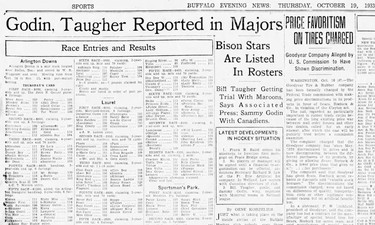 In the Oct. 19, 1933 edition of the Buffalo Evening News, Taugher’s departure from the Buffalo Bisons to the Montreal Maroons was reported as a finished deal along with other roster moves sending his teammates to the NHL. Courtesy of the Buffalo News.
On Oct. 19, 1933, Taugher’s departure for the Maroons was again reported a fait accompli: The lead item in the Buffalo News (“Godin, Taugher Reported in Majors: Bison Stars Are Listed In Rosters; Bill Taugher Getting Trial With Maroons, Says Associated Press; Sammy Godin With Canadiens”) detailed the dismantling of the Buffalo roster after back-to-back championships. The Bisons were in financial disarray and their arena’s mortgage was under foreclosure. Taugher and Godin were only the most prominent names mentioned. Other regulars on the move included Lloyd Gross to NY Americans and Lorne Carr to Rangers.
Godin was in Kingston when contacted by the News and in a telegram, he confirmed his commitment in Montreal: “Have agreed to play with Canadiens this coming winter if I can make a position.” In contrast, Taugher’s wire to the News was non-committal and terse, as if the telegraph company charged by the word: “Nothing definite.”
Godin did play with Canadiens that season, Gross with the Americans, and Carr with the Rangers. Others left the Bisons for the NHL ranks. Yet Taugher reported to Buffalo’s training camp. Within days, he was back in net for a watered-down Bisons team in 5-2 exhibition loss to the Toronto Maple Leafs at the Peace Bridge Arena. The Bisons had to borrow Leafs farmhands to fill out a makeshift line-up. From the Courier-Express: “Billy Taugher proved that he is the same eagle-eyed goaltender of old as he turned a finished performance between the posts. Bill made several sparkling saves, once robbing Conacher at the right-hand post after Charlie and Hap Day were all the way through and had him completely at their mercy.”
Advertisement 8
This advertisement has not loaded yet, but your article continues below.
Article content
Taugher didn’t miss a game that season and neither he nor the team explained how the Maroons’ deal fell through. Roach had left the Bisons and his successor Frank Nighbor would have had final say-so on roster moves. There’s no knowing how Taugher felt about being locked in with the Bisons: either flattered to be so valued; or annoyed by his contract’s reserve clause binding him to a minor-league team. Did he want to leave and couldn’t? Did he choose to stay?
“A lot of players in those days were happy to stick with their minor-league teams,” hockey historian Eric Zweig says.
True, the NHL might have been a step up in the quality of game but not necessarily in quality of life and not even that much of a material improvement in pay grade. While Taugher might have thought as much, that would be hard to square with his reverent tone when talking about Georges Vezina—he seemed more likely to have embraced a chance to play in Montreal, even if it were for the other city’s other team.
The comforts of status quo were sustainable for only so long, however. Injuries were starting to take their toll on Taugher’s game and eventually the Bisons would move on from their franchise player. Hockey has ever been a cold game.
Advertisement 9
This advertisement has not loaded yet, but your article continues below.
Article content
*
In the summer of ‘35, the St Louis Eagles, the last-place finishers in the NHL’s American Division, purchased Taugher’s rights from the Bisons. At 29, the minor-league journeyman was finally going to get his shot at the NHL, or so it seemed.
Taugher’s acquisition turned out to be one of the Eagles’ final transactions. Their just-concluded first NHL season in St Louis was also the last. The franchise, previously the Ottawa Senators, had been a founding member of the NHL and a past champion. By the ’30s, though, they had fallen into financial hardship and landed as the Eagles on the Mississippi as a desperate bid to turn around their fortunes. The move to avoid dissolution in Ottawa only delayed it. The NHL Board of Governors bought out the failing franchise on Oct. 15, 1935, weeks away from the start of the season.
What looked like a crummy break for Taugher seemed for a time to present his greatest career opportunity. With the Eagles’ folding, the league put the team’s player contracts into a dispersal draft and Taugher was acquired by—finally—the long covetous Montreal Maroons, who had won the Stanley Cup the previous spring.
The Maroons’ interest in Taugher spiked with a development on the day of the draft. The dispersal of the Eagles was buried in the Gazette’s sports page, beneath the headline story: “Alex. Connell, Great Enigma of Pro Hockey, Announces Retirement.” Connell advised the Maroons of his intentions to walk away from the game to assume a management position with Ottawa’s fire department. His nickname, the Fireman, was in no way metaphorical.
Advertisement 10
This advertisement has not loaded yet, but your article continues below.
Article content
Article content
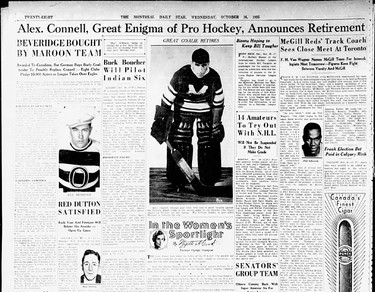 The Montreal Star’s Oct. 16, 1935 edition gave the most prominent play to the retirement of Montreal Maroon’s Stanley Cup-winning goaltender Alex Connell (pictured centre). Lesser play was given to the Maroons purchase of netminder Bill Beveridge (pictured, left) from the Montreal Canadiens after the draft of the St Louis Eagles’ players. Beside the photo of Connell is a brief suggesting that the Buffalo Bisons try to reacquire Bill Taugher, whose contract was acquired first by the Eagles and then the Maroons.
Maroons’ GM Tommy Gorman wasn’t going to be caught flat-footed by the loss of his Cup-winning goaltender, one eclipsed only by Vezina in the NHL’s antiquity—Gorman had not only drafted Taugher that day, but also purchased the Eagles’ goalie Bill Beveridge from the Canadiens who had selected him in the dispersal draft before their crosstown rivals had their turn to pick. Effectively, Taugher was the uncontested No. 1 on the Maroons’ depth chart for an hour or so. Still, he’d soon be vying for the Maroon’s job, competing against Beveridge, whose 144 goals allowed with the Eagles in the previous season was second-worst in the NHL.
A week later, Taugher landed the Maroons’ training camp in Winnipeg, where the team was setting up shop with the aim to sell out their preseason exhibitions. Gorman hadn’t given up on getting Connell back into the fold—riding with the team to Manitoba, the GM met the Fireman on a train platform in Ottawa to pitch him on a return to the line-up. Gorman had even beseeched Ottawa’s mayor to have a word with the fire chief about granting Connell leave of absence, for naught as it turned out.
While Winnipeg dailies’ reports suggested Beveridge wasn’t in great shape and Taugher shone in scrimmages, Gorman gave Beveridge all four starts in exhibition play—two games against the Philadelphia Ramblers, the Rangers’ farm club, and then two against the New York parent club. The Maroons didn’t play well in Winnipeg, dropping the opening game to the minor leaguers and only looking like a championship team in the closing game against the Rangers. Clearly, once Gorman bought Beveridge from the Canadiens, the job was his to lose. Nonetheless, when Gorman announced the Maroons’ final cut at camp’s end, Taugher was on the roster, ostensibly as insurance for Beveridge.
Advertisement 11
This advertisement has not loaded yet, but your article continues below.
Article content
What happened when the team packed up from training camp was spelled out in a feature profile of Taugher in the Cleveland Plain Dealer in December 1935. By Taugher’s account, he was riding the train with the Maroons from Winnipeg to Montreal, but his trip was interrupted at a stopover “at a train station on the north shore of Lake Superior.” A telegram was waiting for him: The Cleveland Falcons, an unaffiliated minor-league club, had bought his contract from the Maroons. He’d been swapped out before he had a chance to step on the Forum ice for the first time since he faced the Young Sons of Ireland in the Memorial Cup playoffs.
In the story by sportswriter John Dietrich, Taugher talked about turns in his career, about the run with Kingston’s juniors, about the stitches and broken bones that went with playing his position, about brutal injuries including a cracked spine that landed him in a hospital bed in Windsor: “When I came to, I heard a doctor saying, ‘He won’t be able to walk for at least 90 days.’ Luckily, the team had a week off, but I was back the next Saturday night. I will say, however, that I sat down with extreme care for quite a while.”
Taugher also talked about his father’s shop on Wellington Street, about “standing at the wheel of cargo boats carrying wood pulp and other cargo all the way from the Gulf of St Lawrence to Duluth,” about being a few hours short of qualifying for his mate’s license, about the Depression being bad for the shipping business but having hopes that fortunes were turning around, about family and fishing and life beyond the arena.
Advertisement 12
This advertisement has not loaded yet, but your article continues below.
Article content
Nowhere did Taugher mention Georges Vezina and the Canadiens.
For Plain Dealer readers in Cleveland, the story would have been by turns insightful, amusing and terrifying, a glimpse of the interior life of a pro athlete in the most dangerous role in any sport that doesn’t involve mountains, horses or internal combustion engines. Taugher sounded nonchalant about the risks of standing in the net. His words registered bemusement rather than frustration about the vagaries of fortune, about getting close to championship in Kingston, about his shot at the NHL falling through with the Maroons.
Taugher didn’t talk hopes of a championship, about making it to the NHL someday, about extending his career. The only mention of the future was his hope to log the hours needed for full mate’s status. The image evoked isn’t Taugher sailing off into the sunset at the end of the day, but at the wheel of a cargo ship, going up-current to take on a load of iron ore.
With our foreknowledge of the course of his life, the profile reads as elegy. As it turned out, he’d play his last game less than four months later. He might have known as much.
Falcons owner Al Sutphin had purchased Taugher’s contract from the Maroons because a dispute with the incumbent goaltender on Cleveland’s roster, Moe Roberts, who had made headlines as the amateur emergency fill-in with the Bruins back in the 1925-26 season. An hour after Taugher’s train arrived in Cleveland, he was in the Falcons’ net, thrown into game action with teammates he’d never practiced with. Cleveland lost five of their first six games and he struggled like never before.
Advertisement 13
This advertisement has not loaded yet, but your article continues below.
Article content
In February, Sutphin brought Roberts back and sent Taugher to the Rochester Cardinals, the International League’s whipping boys that season. The deal was labelled a loan, but his ticket there amounted to exile—the Rochester franchise had gone into financial default and the league had taken over operations. After the Cardinals’ season-ending 5-3 loss in Windsor, the players were advised of their team’s folding in the dressing room, according to the Canadian Press story. Myriad indignities had visited him that season; the final one would have been having no ticket home.
One report weeks later in the Rochester Democrat and Chronicle suggested Taugher’s 1935-36 season ended as it started, catching on with a Stanley Cup champion. According to the Rochester paper Taugher crossed the Detroit River after the Cardinals’ last game and joined the Red Wings as a spare goaltender in the playoffs. If that did happen, the development was never noted in Detroit, Windsor or Kingston dailies. No sources suggest he saw action with the Wings. If Taugher had been on hand, he would have seen the Red Wings play the Maroons in the first round, Detroit’s Mud Bruneteau scoring in the sixth overtime period in Game 1. Tom Gorman had given up on Bill Beveridge in mid-season and acquired Lorne Chabot to stand in the Montreal net, but Detroit swept the Maroons in the first round. The Wings then rolled over the Maple Leafs three games to one in the Cup Final.
Advertisement 14
This advertisement has not loaded yet, but your article continues below.
Article content
If the Rochester report is to be believed, the last time Taugher donned skates and pads, he stepped onto the ice at the Olympia to practice with the soon to be crowned Stanley Cup champions. But then again, the Democrat and Chronicle report might be suspect–the story was loosely sourced and incorrectly suggested the Cardinals would be back in action the next fall. Like so much of his hockey life, Bill Taugher stood on the fringe of the big time, where stuff slips through the cracks in recorded history.
*
Bill Taugher returned to Kingston where his wife and children that spring. In the document submitted to the Kingston and District Sports Hall of Fame back in 2018, his son Art described the scene: “There was something different when he came home after that last season. He got out of the taxi and pulled his goal equipment out of the trunk, which itself was strange because he never brought his pads home. But he did that year. We didn’t know it yet, but he was done with hockey.”
Perhaps he knew it was his time. It might also be as easily explained as necessity: He could hardly leave his equipment in the trust of a team that ceased to exist after the final buzzer.
Taugher was returning to his wife and children he only knew from their summers together, but he’d be denied his hard-earned happily-ever-after. Taugher would live less than seven years after his last game. He soon developed chronic dizzy spells and later suffered seizures. In 1942 he was diagnosed with a brain tumor. His wife Doretta was sure the tumor was the byproduct of head trauma; he had broken his nose countless times and played through concussions, having been knocked unconscious, but returning to action with a wave of smelling salts to preserve his record of never missing a game. The surgeons who removed the tumor in a Toronto hospital might have had their doubts about Doretta’s conjecture, but decades later published research is shedding light on traumatic brain injuries as a possible inflammatory catalyst for tumors.
Advertisement 15
This advertisement has not loaded yet, but your article continues below.
Article content
In his final season he had played through pain, both physical and emotional. In a tribute that appeared in the Whig-Standard, Buffalo sportswriter Jack Laing described a haunting scene when Taugher returned to Buffalo with the misbegotten Rochester Cardinals: “The Rochester misfits couldn’t score—neither could the Bisons score on Bashful Bill and it wound up a scoreless tie … Bill went to the Rochester dressing room and wept for five minutes unashamed. It was one of his biggest moments in a career filled with thrilling achievements.”
It might seem odd that Taugher would find catharsis in salvaging a point for the Cardinals in a meaningless game, when he couldn’t even sure that his paycheque would clear. Laing intended to show the pride Taugher took in his performance, finding something approaching closure in recording a shutout in what would be his last game in the city where he spent most of his pro career. A darker reading would evoke profound grief: His time was winding down, and despite his commitment, excellence and sacrifice, this farewell tour could scarcely be emptier, a cruel fit for the professional journeyman. He might have also sensed his declining game was rooted in a physical cause less evident that an open wound, a fracture or other occupational costs.
Advertisement 16
This advertisement has not loaded yet, but your article continues below.
Article content
After his surgery, Taugher returned to Kingston to convalesce. Some reports suggested he was making a miraculous recovery. (William J. Walshe in the Whig-Standard on Apr. 17, 1942: “Bill is gradually regaining strength and the use of senses that were feared lost forever … Bill can see almost as well as ever. He is gradually regaining his speech and he can stand for a few minutes.”) This, however, was a polite gloss on his condition. He would be bedridden for the months he had left.
When he died in February 1943 at the age of 36, he left a wife, three daughters and a son. In Kingston and Buffalo, columnists penned tributes. In the Whig-Standard, Walshe recounted Kingston’s run to the Memorial Cup final, the subsequent NHL careers of the Combines alumni. Walshe wrote that Taugher had been “expecting a promotion to the National League,” but chose to retire instead. In the Buffalo Courier-Express, Laing mentioned the Maroons’ acquisition of Taugher’s contract, but the columnist lamented the fact that “Bill did not get his much-deserved shot at the Big Time.”
Stories noted that Maj. Tom Gelley, the Combines’ manager back in ’26, sang the requiem at Taugher’s funeral mass. Family and friends filled in the pews at St Mary’s and attended a wake that lasted three days at the Taugher family’s blacksmith shop. Reports didn’t mention any of his Combines teammates attending and none were among his pallbearers. Some couldn’t make it–Paddy Patterson was still playing in Indianapolis in the American Hockey League, Hartland Molson was seeing action in the R.A.F., having to bail out over London in the Battle of Britain and Dr. Thomas Orford, the goalie Bill had beaten out, was practicing medicine in Moose Factory.
Advertisement 17
This advertisement has not loaded yet, but your article continues below.
Article content
In none of the stories though, were the Montreal Canadiens ever mentioned.
There’s no saying categorically that Bill Taugher never filled in for Georges Vezina. There’s no doubt, however, about his bravery in the face of ordeals that would have broken almost anybody else. Nor is there any doubt he too often got a raw deal, in a tough game, in a dirty business and ultimately in life, cruelly brief. Even if he did stand in the Canadiens’ net for a night, though, he’d have told you that, to crib a line from Casablanca, the movie playing at the Capitol Theatre on Princess Street at the time of his passing, it wouldn’t amount to a hill of beans in this crazy world.
*
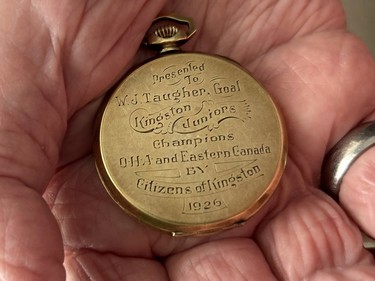 Art Taugher holds the watch given to his father in 1926 by the City of Kingston after the Combines won the Ontario Hockey Association junior championship and went to the Memorial Cup final in Winnipeg. The photo was taken in the home of Art’s son Jim in Kingston on Friday, Dec. 5, 2025. Photo by Gare Joyce /The Kingston Whig-Standard
This line of work sometimes requires difficult conversations. I was prepared for the worst when I paid a visit to Art Taugher’s ground-floor apartment in Barriefield. At 93, he’s the surviving child of Bill and Doretta, but sitting across from him with his trove of photos of his father in his lap, I could only see him as the 10-year-old who had taken his place beside his mother, his three sisters and his grandparents Jim and Catherine at St Mary’s in February 1943.
Yeah, I was telling a boy that his father didn’t play for the Montreal Canadiens like he was led to believe. I was prepared to be shown the door.
Advertisement 18
This advertisement has not loaded yet, but your article continues below.
Article content
Yet Art wanted to hear it all. He had known only what he had heard and almost all of it was years after the fact.
I went through the printouts of newspaper stories from the 1920s and ’30s, populated with long-gone teams like the Eagles and Maroons and leagues like the CanPro and International, situated in venues like the Jock Harty, demolished, and Peace Bridge Arena, burned to the ground.
“I didn’t know any of this,” Art said over and over, in variations of wonder that the past could be brought back together.
Then I hit the money line. Deep breath.
“The best I can figure, it was the Maroons, not the Canadiens, that’s the Montreal connection and the Hall of Famer was Connell not Vezina,” I said. “And Bill was right there and had it pulled out at the last moment.”
“Of all the dumb Irish luck,” Art said.
Art wanted to see the old newspaper stories, the photos and, yes, he wanted to hear what the historians had to say, what they knew and what can never be known.
Art said hockey was something Doretta didn’t want discussed in her home after Bill’s death.
“My mother hated hockey,” he said. “My father was away all season while she was back in Kingston raising us. She resented it. And because he was away playing I never saw him play. Even if I had, I’d have been too young to remember. Then when he passed, hockey became the thing that robbed her of husband.”
Advertisement 19
This advertisement has not loaded yet, but your article continues below.
Article content
And the game had robbed Art and his sisters of their father.
I showed Art the tributes to Bill after his death and write-ups of his father’s funeral service and his grandmother’s. I also showed him a feature from the fall of that year, 1943, on his grandfather’s blacksmith business, that last of its kind downtown, Jim Taugher insisting that at 67 he had no intention to slow down, never mind retire, a paternal template for Bill’s mindset. The story didn’t mention Bill’s death nor Catherine’s–she collapsed in St Mary’s a week after his son’s funeral and died days later. People in town would have known the backstory at the time. Art brushed a tear.
“If he didn’t play that game with the Canadiens, is that going to be a problem with the sports hall of fame?” Art asked.
Given how unfair the game was to Bill, Art might presume the byproduct of this story would be the worst possible outcome: a reconsideration of Bill’s worthiness for the hall of fame or even his removal.
“That one game with the Canadiens, even if he played it, wouldn’t compare to everything else he did,” I told him. “The run with the Combines and the championships with Buffalo–that’s what the hall should honour him for and they should have done it a long time ago.”
Advertisement 20
This advertisement has not loaded yet, but your article continues below.
Article content
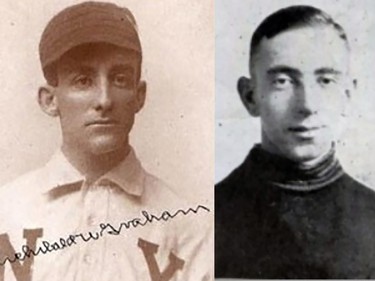 Left: A photograph of Archibald “Moonlight” Graham from his minor-league playing days was used in the promotion of the movie Field of Dreams. The real-life Graham played one game for the New York Giants, never coming to bat, in 1905. (Photo Courtesy of the Graham Scholarship fund in Chisholm, Minnesota.) Right: This photo appears on the plaque dedicated to Bill Taugher in the Kingston and District Sports Hall of Fame’s gallery at Slush Puppie Place. Taugher was inducted in 2018, more than 80 years after he played his last game. A goalie, he was the Kingston Combines’ most valuable player on the 1925-26 team that won the Ontario Hockey Association’s junior championship.
Art seemed comfortable with that, so all that was left was a graceful exit. I had saved one find that haunted me from the start.
“Do you know Field of Dreams and Moonlight Graham, that ballplayer who only got in one game?” I said. “Didn’t even get an at-bat.”
Thankfully, Art did.
“It was based on a real guy who became a doctor, practiced in Minnesota for years,” I said. “This is him in his younger days.”
I showed him the images of his father and a photo of Moonlight Graham from his playing days, and Art grabbed the sides of his chair, as if his laughter would slide him right onto the carpet.
“Could be the same guy,” he said. “They’re dead ringers.”

We apologize, but this video has failed to load.
Play Video
Article content
Share this article in your social network