
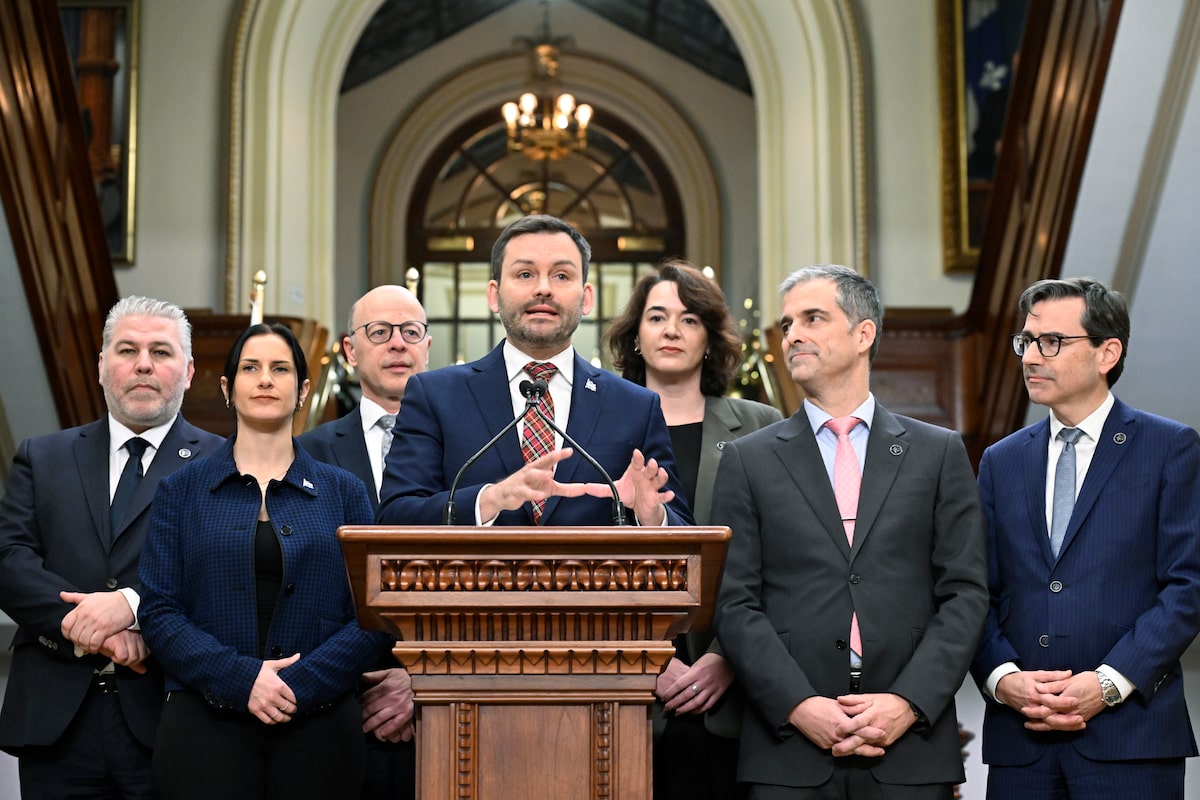
Parti Québécois Leader Paul St-Pierre Plamondon vows to hold another referendum on Quebec independence if his party wins next fall’s provincial election.Jacques Boissinot/The Canadian Press
As 1993 drew to a close, Canada was on the edge.
Two failed attempts at getting Quebec to sign the 1982 Constitution had put the Parti Québécois on the trail to a comeback. After floundering for eight years, the PQ led in the polls only months ahead of a provincial election. And under its hardline sovereigntist leader, Jacques Parizeau, it vowed to hold another referendum after 1980’s unsuccessful plebiscite on separatism.
Canadians old enough to remember that period need no reminding of what happened next. The PQ indeed won power in the fall of 1994, launching the province almost immediately into an all-consuming referendum campaign that resulted a year later in a razor-thin win for the federalist side. The country took years to recover from that near-death trauma, draining political attention away from pressing economic-policy matters.
The PQ, left for dead only a few years ago, sits once again atop the polls. And its hardline sovereigntist leader, Paul St-Pierre Plamondon, vows to hold another referendum on Quebec independence if his party wins next fall’s provincial election.
The question now is whether the coming year in Quebec politics will, like 1994, be a prelude to a third referendum, or a false start for the PQ, as was the case in 2012. The PQ that year won a bare minority of seats in a provincial election in a three-way race only to lose power 18 months later and fall back into its previous pattern of long-term secular decline.
Alberta and Quebec find common ground in opposing Ottawa
All that is certain right now is that the rest of Canada does not appear to care much about what happens in Quebec. Older voters who remember (or resent) when Quebec dominated the political agenda in Ottawa appear bound and determined not to let that happen again. Younger voters with no memory of the 1995 referendum are not particularly preoccupied with national unity.
The sovereignty movement that gets the most national attention these days is based in Alberta, where it seeks to force a referendum on the province’s secession from Canada in 2026. Yet, for all their grievances toward Ottawa, Albertans are still less inclined to separate from Canada than Quebeckers, at least if one considers the primary factors that have sustained secessionist movements elsewhere in the world.
A Léger poll conducted earlier this year found that support for Alberta sovereignty revolved primarily around economic issues. How much of that support would fade with the construction of another pipeline (or two) to the West coast and a removal of the Justin Trudeau-era environmental policies that strangled the oil and gas sector? Most of it, likely.
It is the opposite in Quebec, where culture and identity are at the core the sovereigntist project. Concerns over the survival of French language and Quebeckers’ collectivist values, particularly as they relate to secularism, are felt viscerally.
Opinion: The PQ’s postsecession currency proposal isn’t a bridge. It’s the abyss
The sociological concept of nationhood is deeply rooted in the Quebec psyche. Few Albertans think of their province as a nation; most Quebeckers agree that theirs is one. They are divided on the question of whether they need to form an independent country for the Quebec nation to survive, much less thrive.
A Léger poll last month found that just 37 per cent of all Quebeckers, and 44 per cent of francophone Quebeckers, would vote “Yes” in a third sovereignty referendum. Addressing the economic threat posed by U.S. President Donald Trump’s trade war remains a more pressing political priority for Quebeckers. Even Lucien Bouchard, the charismatic star of the “Yes” side in 1995, has warned that a third referendum now would be a loser.
Still, in late 1993, support for sovereignty also hovered around 40 per cent and most pundits predicted then that federalist side would easily win a second referendum if the PQ held one.
Events, and something deep within Quebeckers’ souls, proved them wrong. The PQ will be counting on a similar dynamic the next time around.
It has already denounced Prime Minister Mark Carney’s appointment of Mark Wiseman as Canada’s U.S. ambassador as a threat to Quebec’s interests. Mr. Wiseman previously pushed Ottawa to increase immigration levels over the objections of Quebec and slammed supply management in the dairy sector. Those are fighting words in Quebec.
The Supreme Court of Canada’s hearing of a constitutional challenge to Quebec’s secularism law, scheduled for March, could stir up nationalist sentiment, especially if Ottawa’s intervention in the case is seen as an attempt to constrain use of the Constitution’s notwithstanding clause. Quebec has relied on the clause to override the Charter of Rights and Freedoms and shield its secularism and language laws from the courts.
It would be foolish to write Quebec sovereigntists off. The rest of Canada may not care much now – but it will, if 2026 ends up becoming 1994 all over again.