
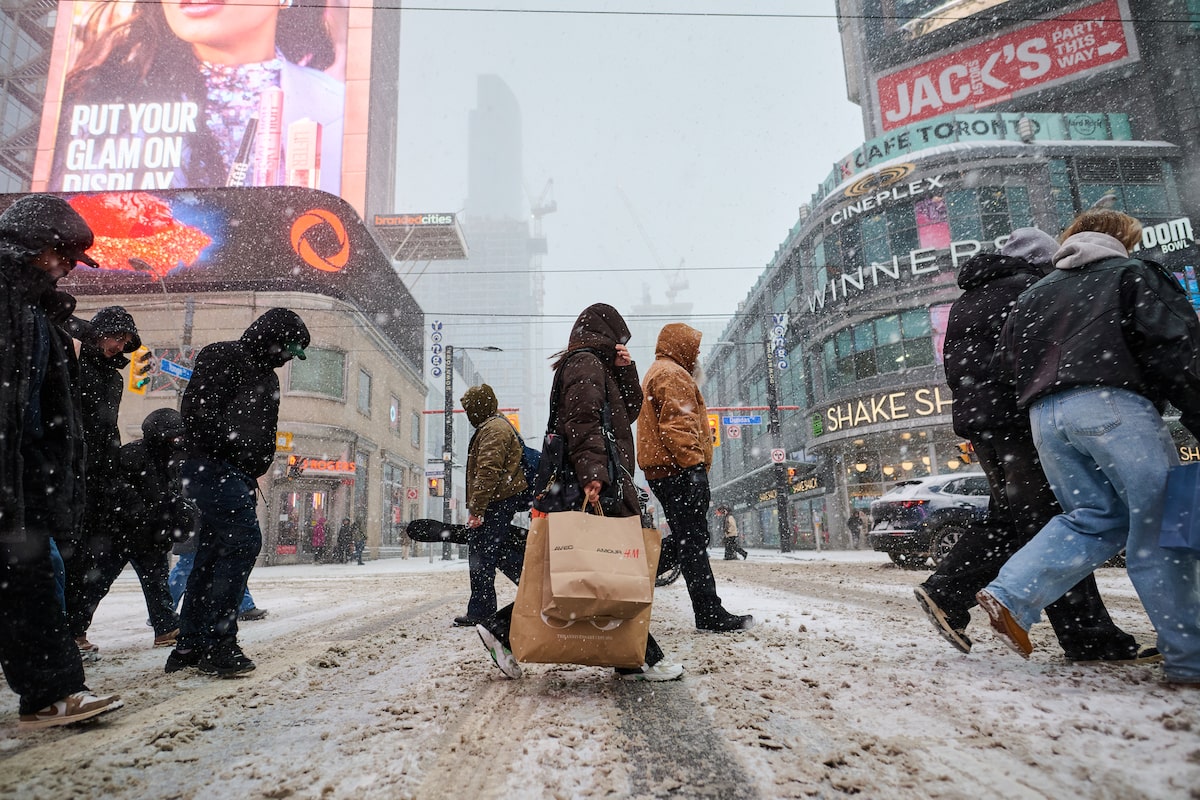
Shoppers exit the Eaton Centre in Toronto on Boxing Day. Younger consumers may cut back on overall spending and favour digital alternatives, a recent report predicts.Sammy Kogan/The Canadian Press
Standing in line outside an overcapacity Bath & Body Works outlet, Shayla Mitchelson was one of thousands of shoppers cashing in on Boxing Day sales at Winnipeg’s largest mall on Friday.
She braved frigid weather, struggled for nearly three hours to find parking at the Polo Park shopping centre, then navigated through a sea of customers inside.
“It’s not necessarily that there’s the greatest discounts happening this year. In fact, I love doing almost all of my shopping online,” said Ms. Mitchelson, 24.
“But some things – like candles and soaps and things of that nature – you really just have to get in person, especially when there’s holiday bargains involved.”
Holiday spending data points to a ‘K-shaped’ Christmas
The Globe’s Big Guide to Canadian Credit Cards
Preliminary market data suggest Canadians have been willing to spend more this holiday season than in previous years, as discretionary purchasing gradually returns to prepandemic levels, a trend that observers expect to be reflected in Boxing Day sales.
Amidst an inflationary environment, however, the divide between generations is widening. Younger consumers are expected to cut back on overall spending and favour digital alternatives in greater numbers, according to a report from accounting giant PricewaterhouseCoopers.
Investment researcher Morningstar said it anticipates revenue from Boxing Day retail sales to modestly grow year-over-year, while expecting overall volume, or the number of units sold, to be lower relative to 2024.
In an interview, Toronto-based retail consultant Bruce Winder said shoppers are becoming more strategic. Tighter household budgets, elevated unemployment rates and uncertainty because of trade disputes with the United States have caused consumers to be more cost-conscious with their purchasing, he said.
“Canadians appear to be sort of shopping almost only when things are on sale these days,” he said.
But Mr. Winder does not believe the Buy Canadian movement – which emerged in early 2025, encouraging the purchase of domestic products as a response to U.S. tariffs – has factored significantly into decisions at the checkout counter.
“It really is a bit of a luxury for some people,” he said, adding that older consumers are more likely to follow the trend than their younger counterparts.
“If you’re more on the downward slope of the economy, you might want to buy Canadian, but, unfortunately, you can’t. You have to buy the least expensive item regardless of where it is made.”
At the busy Stone Road Mall in Guelph, Ont., Chelsea Miller expressed similar feelings. The 33-year-old shopping at Bath & Body Works on Friday did not worry about it being the local outpost of an Ohio-based retailer.
“When I’m shopping sales, I don’t typically know if a product is Canadian until I’ve decided to purchase something,” she said as she came back from the store to rejoin her husband, Matt Miller, 36, who was minding their sleeping infant in a stroller.
The Isnor family, a mother-daughter-granddaughter trio in Guelph, felt the same way.
Vickie Isnor, 44, has held a Boxing Day shopping tradition with her mother, Lisa, 62, and daughter Brooke, 16, for years.
When asked what motivated them to make the trip to the mall despite particularly inclement weather in large parts of Ontario on Friday, the family, holding multiple shopping bags, replied in unison: “It is the sales.”
While the trio prefer to buy Canadian when possible, price is their ultimate deciding factor.
“It is nice to go into some stores that we don’t normally go into before Christmas, because we know how expensive they are,” Ms. Isnor said. “After Christmas, we get to go in, and a lot of the stuff will be on sale.”
For Ms. Mitchelson in Winnipeg, buying from Canadian stores has not been a priority either.
“Don’t get me wrong. It’s definitely a bonus,” she said. “But the thing is, when I came here today, I started seeing the bigger discounts at some very specific stores. And it just so happens that those stores are not selling Canadian stuff or are not actually Canadian-owned.”
A short distance away, inside the same mall, John Friesen, 42, disagreed. As he scoured the racks for discounted jackets at Sport Chek, which is owned by Canadian Tire, he said he was disappointed by some fellow shoppers.
“I’ve been guilty myself of this, even though at least my family and I keep trying with the trend,” Mr. Friesen said Friday.
“But for all that talk we had about buying Canadian and elbows up and all that, I think it’s funny that American stores can bring so many of us back so quickly by dangling just a few sales our way.”