
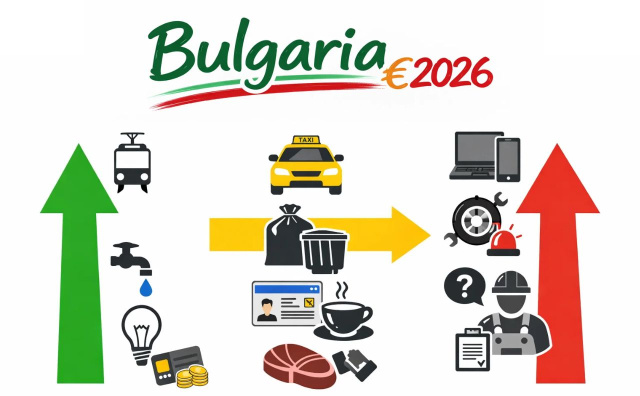
As Bulgaria prepares to adopt the euro on January 1, 2026, replacing the leva (BGN) at a fixed exchange rate of 1.95583 BGN = 1 EUR, the country faces a complex landscape of price adjustments across various sectors. This comprehensive analysis examines which prices are rising, which are falling, and which remain stable during this historic currency transition.
Transportation: Mixed Results with Public Transport Winners
Public Transport: Passengers Benefit from Rounding
Sofia’s public transport system emerges as one of the clear winners in the euro transition, with rounding adjustments resulting in lower fares for passengers across virtually all ticket types:
Single Trip and Short-Term Tickets:
“30 plus” ticket: reduced from 1.60 BGN to 0.80 EUR (≈1.58 BGN), saving approximately 0.04 BGN
“60 plus” ticket: drops from 2.20 BGN to 1.10 EUR (≈2.18 BGN), saving roughly 0.05 BGN
Single-trip tickets from offices or machines: decrease from 1.60 BGN to 0.80 EUR (≈1.58 BGN)
One-day cards: fall from 4.00 BGN to 2.00 EUR (≈3.96 BGN), a reduction of about 0.09 BGN
Night cards: go from 2.00 BGN to 1.00 EUR (≈1.98 BGN)
24-hour cards: decrease from 6.00 BGN to 3.00 EUR (≈5.94 BGN)
72-hour cards: drop from 15.00 BGN to 7.60 EUR (≈15.05 BGN)
Monthly and Annual Cards:
Monthly personalized cards for all lines: reduce slightly from 50.00 BGN to 25.50 EUR (≈50.55 BGN)
Annual personalized cards: converted from 365.00 BGN to 185.00 EUR (≈366.85 BGN)
Student and pupil monthly cards: go from 15.00 BGN to 7.50 EUR (≈14.85 BGN), saving around 0.33 BGN
Preferential Tariffs: For pensioners qualifying by length of service and age:
Monthly card for all lines: 25.00 BGN to 12.70 EUR (≈25.13 BGN)
Monthly card for single line: 11.00 BGN to 5.60 EUR (≈11.09 BGN)
For residents over 68:
Monthly card for all lines: reduced to 10.00 BGN to 5.00 EUR (≈9.89 BGN)
Non-personalized cards (more expensive options):
Monthly card for all lines: 70.00 BGN to 35.50 EUR (≈70.30 BGN)
Annual card: 600.00 BGN to 305.00 EUR (≈604.46 BGN)
Monthly surface line card: 28.00 BGN to 14.00 EUR (≈27.74 BGN)
Monthly metro card: 42.00 BGN to 21.00 EUR (≈41.61 BGN)
In Veliko Tarnovo, bus fares will similarly remain stable at 0.77 EUR (equivalent to the current 1.50 BGN), with New Year’s Day offering free public transport.
The Sofia Municipality has emphasized that the euro transition is designed as a technical conversion without financial strain, and the household waste fee will also remain unchanged after conversion.
Taxis: Sharp Price Increase Already Implemented
In stark contrast to public transport, taxi fares in Sofia increased by nearly 20% starting December 9, 2025, ahead of the official euro adoption:
Daytime fare: rose from 1.20 BGN (≈0.61 EUR) to 1.40 BGN (≈0.72 EUR) per kilometer
Nighttime fare: increased from 1.39 BGN (≈0.71 EUR) to 1.65 BGN (≈0.84 EUR) per kilometer
Standard call fee: went up from 1.00 BGN (≈0.51 EUR) to 1.20 BGN (≈0.61 EUR)
New out-of-town rate: introduced at 1.94 BGN (≈0.99 EUR) per kilometer for trips beyond city limits
This increase, prompted by taxi operators citing inflation, rising fuel costs, and higher wages, was officially scheduled for January 1 but implemented earlier by many companies, sparking public dissatisfaction.
Road Vignettes: Prices Remain Stable
The National Toll Administration has assured drivers that vignette and road fees will not increase with euro adoption. All tariffs will simply be converted at the official exchange rate:
Annual vignette: 97 BGN becomes 49.60 EUR (≈97.00 BGN)
Weekend vignette: 10 BGN becomes 5.11 EUR (≈10.00 BGN)
A new one-day vignette for passenger cars up to 3.5 tons will be introduced on February 3, 2026, priced at 4.90 EUR (≈9.59 BGN). The system will experience a brief technical pause from 21:00 on December 31 to 02:00 on January 1 for currency reconfiguration.
Emergency Services: Holiday Price Surges
Mobile tire services face dramatic seasonal price increases during the Christmas and New Year holidays:
Standard tire replacement: ranges from 150 BGN (≈76.71 EUR) for smaller tires to 200 BGN (≈102.28 EUR) for larger SUV tires in Sofia
Holiday pricing: can triple standard rates in some cities, particularly Plovdiv where prices can reach up to 900 BGN (≈460.26 EUR)
Regional variations: Ruse charges a flat 50 BGN (≈25.57 EUR) regardless of size; Varna reaches 180 BGN (≈92.05 EUR)
Christmas premium: customers pay approximately 20% more on Christmas Eve and Christmas Day
Roadside assistance pricing also varies significantly:
Plovdiv: minimum 200 BGN (≈102.28 EUR) for tow trucks
Sofia: minimum 120 BGN (≈61.37 EUR) for passenger cars, 150 BGN (≈76.71 EUR) for SUVs
Ruse: ranges from 80-100 BGN (≈40.91-51.14 EUR) for passenger cars, up to 180 BGN (≈92.05 EUR) for SUVs
Distance-based charges: typically 1.50-4 BGN (≈0.77-2.05 EUR) per kilometer outside urban areas
Notably, one Varna company offered a holiday promotion at 40 BGN (≈20.46 EUR) regardless of vehicle type, aiming to support customers rather than exploit the holiday demand.
Utilities and Municipal Services: Largely Frozen or Reduced
Water Prices: Government Intervention Freezes Most Increases
The Energy and Water Regulatory Commission (EWRC) initially approved water price increases of up to 14% across most settlements starting January 1, 2026. However, the Ministry of Regional Development and Public Works announced an indefinite freeze for nearly 90% of water and sewerage operators with state participation in regional centers.
Originally planned increases (now frozen):
Sofia: 11.8% increase to 4.10 BGN (≈2.10 EUR) per cubic meter (from approximately 3.67 BGN)
Kardzhali: nearly 14% increase to 5.17 BGN (≈2.64 EUR) per cubic meter
Burgas: 1.4% increase to 5.28 BGN (≈2.70 EUR)
Plovdiv: 4% increase to 3.73 BGN (≈1.91 EUR)
Vratsa: 8.9% increase to 5.48 BGN (≈2.80 EUR)
Veliko Tarnovo: 8.8% increase to 5.12 BGN (≈2.62 EUR)
Gabrovo: 8.4% increase to 4.93 BGN (≈2.52 EUR)
Varna: 6.6% increase to 5.92 BGN (≈3.03 EUR)
Most expensive locations (prices exceeding 6 BGN/≈3.07 EUR per cubic meter):
Silistra: planned 4.8% increase to 6.44 BGN (≈3.29 EUR)
Razgrad: planned 1% increase to 6.33 BGN (≈3.24 EUR)
Cities seeing planned reductions (proceeding as scheduled):
Yambol: 12% decrease to 4.52 BGN (≈2.31 EUR) per cubic meter (largest reduction)
Pazardzhik, Pernik, Dobrich, Sofia region, Shumen, and Sliven: various decreases
Shumen: reduction to 5.96 BGN (≈3.05 EUR)
The government emphasized that this freeze provides a transitional period for consumers to adapt smoothly to the euro adoption, though the halt is described as temporary.
Parking Fees: Potential Delay of Controversial Increase
The Sofia Municipal Council approved a controversial 100% increase in blue and green zone parking fees from 2 BGN (≈1.02 EUR) to 2 EUR (≈3.91 BGN), scheduled for January 1, 2026. However, the Consumer Protection Commission (CPCo) has signaled this increase may not proceed as planned.
CPCo Chairman Alexander Kolyachev confirmed that the commission formally requested all documentation from the municipality to assess whether the doubling of prices has a solid economic basis. The Euro Adoption Act mandates that price increases must reflect factors beyond service provider control, such as higher wages, taxes, or delivery costs.
If the commission determines the increase violates legal or economic guidelines, court proceedings could delay or prevent implementation. Kolyachev noted they are “entering an administrative spiral” and awaiting complete documentation to determine if a violation occurred.
Waste Collection: 19% Increase in Sofia’s Zones 1 and 7
Sofia Municipality signed contract extensions for cleaning services in Zones 1 and 7 with a 19% price adjustment compared to rates applied over the past five years:
Unit price for garbage collection: increased to 209 BGN (≈106.87 EUR)
Price for bulky waste removal: now 111 BGN (≈56.76 EUR)
This increase affects districts including Sredets, Lozenets, Studentski (Zone 1) and Vazrazhdane, Oborishte, Triaditsa (Zone 7). Mayor Vasil Terziev emphasized the extensions were necessary to ensure uninterrupted service while new procurement procedures are finalized.
Electricity: No Increase Confirmed
Deputy Prime Minister Ekaterina Zaharieva confirmed that no formal request has been submitted for electricity price increases starting January 1, 2026. Despite earlier concerns following a disrupted September 2025 public discussion about a 10% increase, State Energy and Water Regulatory Commission (SEWR) Chairman Svetla Todorova stated the commission has no plans to raise electricity prices unless new government directives are issued.
Todorova emphasized: “We have no plans to increase prices until the government and parliament indicate their approach to this sector. We did not create the problems, and we do not raise prices arbitrarily.”
Administrative and Government Services: Significant Increases
ID Cards: Nearly 60% Price Hike
Beginning January 1, 2026, personal document fees will rise sharply:
Adults (ages 18-70):
New ID card: increases from 18 BGN (≈9.20 EUR) to 30 BGN (≈15.34 EUR) – a nearly 60% increase
Minors:
Second ID card renewal (valid for four years): increases from 13 BGN (≈6.65 EUR) to 21 BGN (≈10.74 EUR)
First ID card for children over 14: remains free of charge
The Ministry of Internal Affairs explains these higher fees are linked to the introduction of a new generation of ID cards with updated design and features. Citizens had only December 29-30, 2025 (the final working days before the holidays) to apply under current lower tariffs.
Official data shows over 11,600 ID cards expire in December 2025 alone, while more than 21,000 are valid only until the end of January 2026. Citizens have a 30-day grace period after expiration to renew, after which fines apply.
Food and Beverages: Modest to Moderate Increases Expected
Beef: Continuing Upward Trajectory
Bulgaria has experienced steady beef price increases throughout 2024-2025, driven by broader European supply constraints:
2024 Annual increases:
Average purchase price of fattened calves: rose 6.7% year-on-year
Wholesale beef carcass meat: increased 5.1%
Wholesale beef shoulder: increased 7.2%
Retail bone-in beef: up 6.4%
Retail beef shoulder: up 7%
2025 Acceleration (through November):
Average purchase price of fattened calves: reached 5.43 BGN (≈2.78 EUR) per kg live weight, marking a 12.9% increase compared to the same period in 2024
Wholesale and retail prices for different veal cuts: rose between 14.2% and 15.2% annually
EU Context:
EU beef production declined 3.9% between January-August 2025 compared to previous year
Overall EU beef production expected to drop 1.3% for 2025, continuing into 2026
EU-wide prices for classified young cattle carcasses (ages 8-12 months): reached record EUR 698.1 per 100 kg (≈BGN 13.65/kg or €6.98/kg), up 25.9% year-on-year as of November 30, 2025
Bulgaria’s position:
Classified young cattle carcasses: EUR 650.9 per 100 kg (≈BGN 12.73/kg or €6.51/kg), 36% higher than previous year but 6.8% below EU average
Classified young cattle (general): EUR 422.52 per 100 kg (≈BGN 8.26/kg or €4.23/kg), increased 12.9% but remains 27% below EU average
Analysts expect these prices to remain significantly above 2024 levels in coming months due to declining livestock numbers driven by strict environmental regulations, climate change measures, greenhouse gas reduction efforts, animal welfare requirements, disease outbreaks, changing consumer habits toward plant-based diets, aging rural populations, and international competition.
Coffee: 5-8% Short-Term Increase Possible
Georgi Gagov, co-founder of the Coffee Association Bulgaria, forecasts coffee prices may experience a minor short-term increase of 5-8% following euro adoption due to psychological rounding:
Example pricing adjustments:
Coffee priced at 2.50 BGN (≈1.28 EUR) could adjust to 1.30-1.50 EUR (≈2.54-2.93 BGN)
Contributing factors beyond euro adoption:
International geopolitical conflicts increasing logistics, container, and packaging costs
Weather events affecting supply
U.S. tariff discussions causing temporary volatility
Shortage of certified coffee stocks
Long-term outlook: Gagov anticipates market stabilization in 2026, with euro adoption expected to strengthen Bulgaria’s economic position, simplify trade, and facilitate inventory management. Increased competitiveness is likely as European companies may enter local markets, roast coffee domestically, and expand cross-border trade opportunities.
Gagov emphasized that the main challenge lies in the initial transition period, with more predictable and stable pricing expected once the currency change settles.
General Food Prices: Mostly Stable
According to the Consumer Protection Commission’s “How Much Does It Cost?” monitoring campaign tracking around 300,000 products over the past month:
Stable categories:
Basic food prices including cheese and cooking oil: remained largely stable with only minor fluctuations of around 3% up or down
Modest increases observed:
Vegetables (e.g., cucumbers): modest increases
Cosmetics: increases noted
Soft drinks: up approximately 3.6%
Confectionery, chocolate, and jams: approximately 3% increase
CPCo Chairman Kolyachev reassured citizens that euro adoption is unlikely to trigger widespread food price hikes, highlighting joint efforts with the Ministry of Finance and Bulgarian National Bank to provide information and ensure a smooth transition.
Technology and Electronics: Significant Price Pressures
Personal Computers: 15-20% Increases Expected
Bulgaria faces one of the most challenging PC markets in 2026, with dramatic price increases driven by multiple converging factors:
Primary drivers:
RAM supercycle: Memory prices have spiked in recent weeks, creating problems for PC gamers and custom system builders
Windows 10 retirement: Support ended in October 2025, forcing hardware upgrades for businesses and users (over half of installed software in Bulgaria is unlicensed or outdated)
AI PC demand: Devices with AI capabilities (e.g., Microsoft Copilot+) require higher RAM configurations, but supply constraints may slow adoption
Market research firm IDC forecasts:
Overall PC shipments will decline 4.9% in 2026, with potential for further drops if memory shortages worsen
Average PC prices to rise at least 8%
Global manufacturers (Lenovo, Dell, HP, Acer, ASUS) have announced planned increases of 15-20%
Component pricing pressures:
NAND chip prices (foundation for storage drives): soared 246% since start of 2025
Companies like Samsung and SK Hynix redirected production toward AI server memory, leaving standard RAM and SSDs in critical short supply
Mid-range laptops increasingly standardizing at 8GB RAM due to shortages, limiting higher-memory options
Practical impact in Bulgaria:
Mid-range laptop currently 1,660 BGN (≈848 EUR): 15% increase adds roughly 249 BGN (≈127 EUR)
Gaming PC currently 3,320 BGN (≈1,696 EUR): 20% increase adds around 664 BGN (≈339 EUR)
Expert advice: Kingston memory expert Cameron Crandall advises: “If you’re planning to upgrade, do it now. Prices will continue to rise. In 30 days, it will be more expensive, and in another 30, even more.”
IDC warns that 2026 could be one of the most difficult years for buying computer components, surpassing disruptions during the COVID-19 pandemic and crypto mining era. The Bulgarian second-hand PC market is expected to grow as new systems become less accessible.
IT Sector Generally: Uncertain Pricing Outlook
The broader IT industry faces uncertain pricing in 2026, with both opportunities and challenges:
Positive trends:
Artificial intelligence moving from experimental to widespread integration
More efficient, specialized AI models requiring fewer computing resources
Multimodal AI merging text, image, audio, and video understanding
Consumer devices prioritizing AI-centric features with dedicated neural processing units (NPUs)
Hardware challenges:
Memory costs (especially RAM) may remain volatile due to supply constraints, manufacturing limitations, and global economic pressures
High-performance computing and AI training servers particularly sensitive to RAM prices
Could delay enterprise upgrades or drive shift toward memory-efficient architectures
Some manufacturers stockpiled chips to mitigate volatility, but reserves are finite
Consumer impact: Without improvements in component supply, end-user prices could reflect these pressures in the latter half of 2026, potentially increasing costs for both enterprises and consumers.
Banking and Financial Services: Moderate Changes
Bank Fees: Unlikely to Change Significantly
According to Tsvetoslav Dimov, CFO of a commercial bank, the transition to the euro is unlikely to have direct impact on fees for standard banking products and services. These fees are primarily driven by operational costs rather than currency changes.
Interest rate outlook:
Interest rates likely to remain low over next 2-3 years
Eurozone entry will reduce Bulgaria’s minimum reserve requirement from 12% to 1%, releasing an estimated 13-14 billion BGN (≈6.64-7.14 billion EUR or €6.64-7.14 billion) in liquidity
This provides stability and security for deposits but limits banks’ ability to raise interest rates aggressively
Deposit interest rates unlikely to rise significantly
Loan rates expected to remain stable
No discussion of switching to international Euribor index at present
Transaction cost benefits: Euro adoption expected to lower transaction costs by over 1 billion BGN (≈511 million EUR or €511 million)
Housing loans: Bulgaria’s housing loans remain among the cheapest in Europe, second only to Malta, and this competitive position is expected to continue.
Courier Services: Operational Changes, Stable Pricing
Leading courier companies Econt and Speedy announced specific operational changes while maintaining pricing stability through currency conversion:
Dual circulation period (January 1-31, 2026):
Customers can pay for services and cash on delivery in mixed currency (leva or euro)
Amounts written in both euro and leva
From February 1, payments accepted only in euros
Change and coin policies:
Both companies will return change in euros as priority, even if payment made in leva
Econt introduces limit: up to 50 BGN (≈25.57 EUR) coins accepted for one payment
No quantitative limit for euro coins
If insufficient euro in specific office, change amount can be paid in leva
Fee adjustments:
Econt removing the 1.30 BGN (≈0.66 EUR) fee for transfers within eurozone upon receipt of cash on delivery
Fee for transfers to accounts outside eurozone remains unchanged at 10 EUR (≈19.56 BGN)
Pricing conversion:
All service prices automatically converted at official BNB rate: 1 EUR = 1.95583 BGN
Speedy assures: “will not change prices of its services during currency conversion and prices in euros will reflect exact leva equivalent to official rate”
All contract parameters with customers remain unchanged
Throughout 2026, prices announced primarily in euros with reference price in leva for user convenience
Construction and Renovation: Labor-Driven Increases
The Bulgarian construction sector is entering 2026 with cautiously optimistic outlook but faces significant cost pressures:
Primary driver: Rising labor costs will be the main factor increasing renovation and construction service prices in 2026, though exact percentages are difficult to predict.
Market context:
Construction activity at record high with 8,000 registered companies
Fueled by municipal programs financed by national budget, National Recovery and Sustainability Plan, and energy efficiency initiatives
Large infrastructure projects commissioned by public authorities gaining momentum alongside traditional residential construction
Critical workforce shortage:
Pronounced lack of skilled personnel across all levels
Many trained specialists left Bulgaria during previous sector slowdowns to work abroad
Although some returning from Europe, demand still exceeds available workforce
Critical lack of young engineers
Industry response:
Prioritizing import of labor from non-EU countries in 2026
Expanding collaboration with universities
Offering specialized internship programs
Organizing job fairs in major European cities to attract Bulgarians working abroad
Impact on consumers: The combination of rising labor costs and personnel shortages expected to push up renovation and construction service prices in 2026, affecting both domestic projects and broader property market dynamics. It’s important to differentiate between construction costs (materials, equipment, insurance) and final market property prices (largely determined by location and investment type).
Real Estate: Stable Prices, Slower Growth
According to Dobromir Ganev from the National Real Estate Association, property prices unlikely to drop after January 1, but the pace of growth is expected to slow:
Current vs. expected growth rates:
Current annual growth: between 10-16%
Expected post-euro growth: moderate to around 5-12%
Rising gross wages in most cities continue to support property values
Market dynamics:
Many property deals accelerated in recent months as buyers sought to secure purchases before euro adoption
Following transition, transaction volumes expected to decrease somewhat
Actual prices unlikely to fall
Regional concentration:
Six cities (Sofia, Varna, Plovdiv, Burgas, Stara Zagora, Nessebar) account for roughly half of all real estate transactions
Outside these hubs, property prices often remain below 1,000 EUR (≈1,955.83 BGN) per square meter
Sofia average prices: range between 2,300-2,500 EUR (≈4,498.41-4,889.58 BGN) per square meter
Regulatory Enforcement and Consumer Protection
Government Monitoring and Penalties
The National Revenue Agency (NRA) and Consumer Protection Commission (CPCo) have intensified enforcement efforts:
Inspection campaign (since October):
Checked 564 retail chains and individual stores nationwide
Found violations in 65 outlets: price increases not justified by clear or objective economic factors
Nine traders received penal decrees with total fines of 45,000 BGN (≈23,007 EUR or €23,007)
Checks ongoing in another 306 retail sites
Fiscal receipt compliance:
More than 20 violation reports for incorrect or incomplete display of amounts in both leva and euros
Required to show total purchase amount in both currencies with fixed BNB exchange rate
Transition period:
Amendments to Law on Introduction of the Euro (adopted August) granted businesses two-month transition period until October 8, 2025
During grace period, NRA conducted inspections without penalties, providing guidance on cash register system adaptation
Sanctions began after grace period expired
Targeted focus:
Intensified checks particularly targeting grocery stores with annual turnover below 10 million BGN (≈5.1 million EUR or €5.1 million)
Over 80 joint NRA-CPCo inspections conducted in single week
All cases require documentation to assess whether price levels economically justified
Price monitoring findings: CPCo’s “How Much Does It Cost?” campaign tracking 300,000 products shows basic food prices remained largely stable, with increases mostly in non-essential items.
Pre-Euro Price Increases: Market Pressures Beyond Currency Transition
Food Prices: Sharp Increases Raise Consumer Concerns
Even before the official euro adoption, Bulgaria has experienced significant food price increases that appear disconnected from production costs, according to the Confederation of Bulgarian Trade Unions (CITUB).
Five-month price tracking (through November 2025):
Chicken meat: rose 9.1% despite stable production and wholesale costs
Bread: increased 4.2% without corresponding raw material cost justification
Sausages: up 3.7% while wholesale prices remained largely stable
Coffee in plastic cup: surged nearly 30%, from 0.99 BGN (≈0.51 EUR) in June to 1.28 BGN (≈0.65 EUR) in November
Mineral water: increased approximately 5%
Cucumbers: largest seasonal spike at 23.3%, from 3.48 BGN (≈1.78 EUR) to 4.29 BGN (≈2.19 EUR)
Tomatoes: declined 10.9% (seasonal variation)
Apples: climbed 5.3%, reaching 4.20 BGN (≈2.15 EUR) per kilogram
Wholesale to retail markup disparities: CITUB’s monitoring of 21 goods in 600 retail outlets across 81 municipalities revealed substantial markups between wholesale and retail prices:
Potatoes: 78.9% markup, from 0.95 BGN (≈0.49 EUR) wholesale to 1.70 BGN (≈0.87 EUR) retail
Apples: 78.7% markup, from 2.35 BGN (≈1.20 EUR) to 4.20 BGN (≈2.15 EUR)
Cheese: 64% markup, bulk cow’s cheese at 12 BGN (≈6.14 EUR) wholesale and 19.38 BGN (≈9.91 EUR) retail
Beans: 58.9% markup
Rice: 55.5% markup
Fresh milk: over 54% markup
CITUB President Plamen Dimitrov emphasized that persistent increases in staple foods, despite stable production costs, point to questionable practices by some retailers. Deputy director Violeta Ivanova noted that bread, sausages, and chicken prices increased without corresponding raw material cost justification, signaling potential unnecessary price inflation.
Large chains vs. small stores: Interestingly, most monitored goods are cheaper in small shops:
Bulk cow’s cheese: averages 21.53 BGN (≈11.01 EUR) per kilogram in large chains versus 17.82 BGN (≈9.11 EUR) in small stores (over 17% difference)
Eggs (10 size M): 5.56 BGN (≈2.84 EUR) in small stores compared to 5.93 BGN (≈3.03 EUR) in chains
Beans: 6.44 BGN (≈3.29 EUR) versus 7 BGN (≈3.58 EUR) in chains
In November, some products showed divergent trends: beans rose 5.7% in large chains but fell 5.6% in small stores; cheese prices in large chains increased 3% while small shops reduced prices by 3.7%.
Consumer advocacy: CITUB is calling for strong action from the Commission for Protection of Competition (CPC), stressing that only fines and strict sanctions – potentially up to 10% of a retail chain’s turnover – will deter excessive markups exceeding 90% in some cases.
Crafts and Professional Services: Near-Doubling of Fees
According to Eurostat data, several service sectors have seen price increases of nearly 100% over the past year, well before euro adoption:
Dental care:
Metal dental caps: increased to 10 BGN (≈5.11 EUR), roughly double the previous price, due to supply shortages caused by the war in Ukraine
Over 4% of Bulgarians now lack access to a dentist despite the country having one of the highest numbers of dentists per capita (exceeding 10,000 nationwide)
Limited access in small towns contributes to higher prices
Craftsmen services: Tailors, upholsterers, and locksmiths have doubled their service fees over the past year:
Locksmith materials: Spanish-made components doubled from 3 BGN (≈1.53 EUR) to 6 BGN (≈3.07 EUR)
Tradespeople cite rising electricity, rent, insurance, and especially imported material costs arriving monthly at increased prices
Industry perspective: Most traders believe the euro itself will not cause further price hikes from January 1, 2026. Instead, increases reflect cumulative rises in raw materials, consumer goods, electricity, and insurance costs over the past two years. While industry groups don’t formally track service price changes, consumers remain skeptical about justifications, viewing state oversight and citizen vigilance as key mechanisms to prevent speculative pricing.
International Perspective: Food Affordability Gap
An English expat’s viral social media video (over one million views) highlighted Bulgaria’s food affordability paradox: prices approaching UK levels while wages remain substantially lower.
David, who has lived in Bulgaria for a year, notes that food costs are “European” but wages are not. He emphasizes the gap between product prices and local wages is particularly noticeable outside Sofia: “In the capital, salaries are higher, but in smaller cities and villages, prices remain the same while incomes are much lower.”
His observation: “The cost of food in Bulgaria feels similar to what you would pay in the UK. But here, wages are much lower, so the balance doesn’t add up.” This perspective resonates with CITUB’s findings that milk and cheese remain among the most expensive in the EU while carrying the largest domestic markups.
Municipal-Level Adjustments: Localized Increases
Elhovo Municipality: The Municipal Council approved price increases for firewood sales:
Firewood from broadleaf trees: raised from 25 BGN to 35 BGN (≈17.90 EUR) per spatial cubic meter, excluding VAT (a 40% increase)
Wood harvested outside forest areas: new price of 30 BGN (≈15.34 EUR) per cubic meter, excluding VAT (previously unpriced)
Mayor Petar Gendov based the adjustment on market research and comparisons with the State Forestry of Elhovo and neighboring municipalities, reflecting genuine market conditions rather than euro-related speculation.
Conclusion: A Mixed Picture with Government Oversight
Bulgaria’s euro adoption presents a complex pricing landscape that defies simple categorization. The transition reveals three distinct patterns:
Clear winners (price decreases or stability):
Public transport passengers in Sofia and other cities benefit from favorable rounding
Road vignette users see no real increase
Most water customers (90%) avoid planned increases due to government intervention
Electricity consumers face no confirmed increases
Banking transaction costs decrease substantially
Moderate increases (economically justified):
Taxi fares (nearly 20% increase, citing inflation and operational costs)
Waste collection services in some Sofia zones (19% increase after five years)
ID card fees (nearly 60% increase for new generation documents)
Coffee prices (5-8% short-term adjustment due to psychological rounding)
Beef prices (continuing European supply-driven trend)
General construction and renovation (labor shortage-driven increases)
Significant price pressures:
Personal computers and electronics (15-20% increases due to global memory shortages and Windows 10 retirement)
Emergency tire services during holidays (up to triple standard rates)
Some localized increases in smaller municipalities for water and other services
Uncertain or delayed:
Blue and green zone parking (100% proposed increase under CPC review, may be delayed or blocked)
Some water price increases in municipalities with local control
IT hardware beyond PCs (dependent on component supply stabilization)
The Bulgarian government and regulatory agencies have demonstrated commitment to preventing unjustified price increases through active monitoring, enforcement, and strategic interventions. The frozen water price increases affecting 90% of operators and the ongoing review of parking fee hikes show authorities willing to use regulatory power to protect consumers during the transition.
However, genuine market pressures – particularly in international commodity markets (beef), global technology supply chains (PCs, memory), and domestic labor markets (construction) – will drive legitimate price increases that regulation cannot prevent. The key for consumers is understanding which increases reflect necessary economic adjustments versus opportunistic exploitation of the currency change.
As Bulgaria enters the eurozone on January 1, 2026, the overall picture suggests a managed transition where most everyday costs will remain stable or see modest changes, while specific sectors face genuine supply-demand pressures requiring careful consumer planning and awareness.