
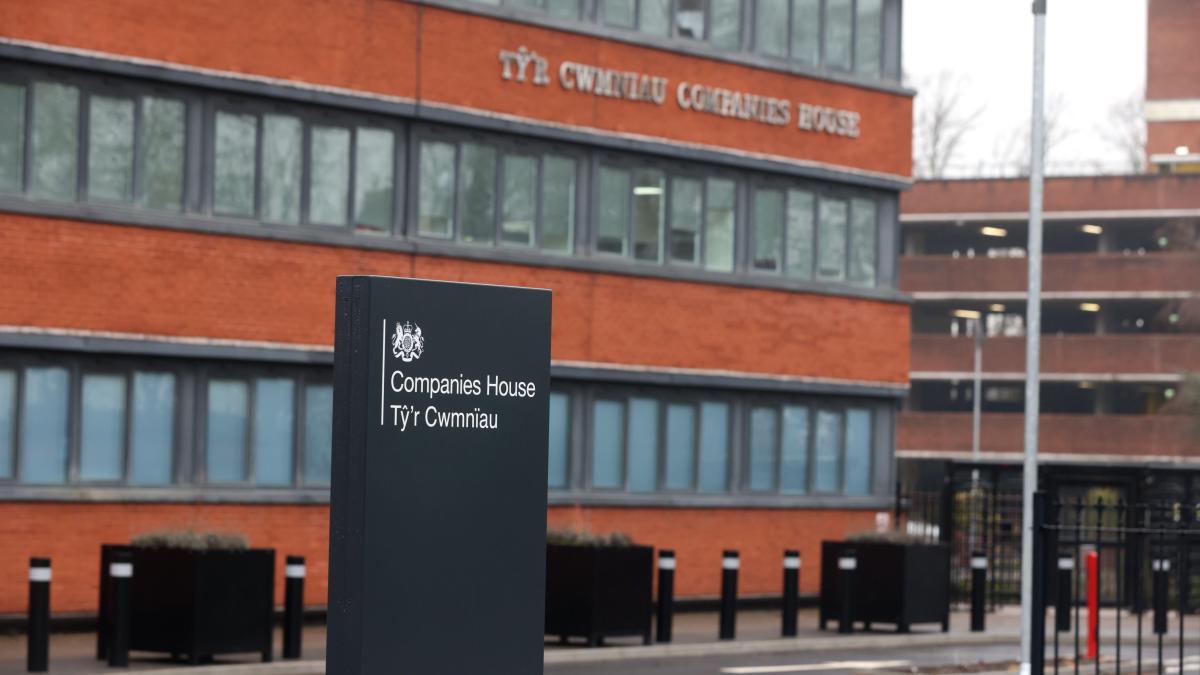
Company incorporations have dropped “dramatically” since new rules for millions of directors and controlling parties were introduced in November, but there are warnings that bogus directors and fake addresses are being used to subvert the regime.
Weekly company registrations have declined by about 30 per cent since the implementation of measures requiring new directors and beneficial owners of companies to verify their identity.
The legislation means acting as a director without being verified has become a criminal offence.
The rules, also being phased in for existing owners and directors over the next year, are intended to ensure that “people setting up, running and controlling companies are who they say they are”. It follows longstanding concerns that the register is being abused to facilitate financial crime and money laundering.
Weekly incorporations dropped from 18,199 in the week before the rules came in, to fewer than 13,000 for each of the five weeks in the run-up to Christmas.
Graham Barrow, an expert in corporate filings and financial fraud, said there had been a “pretty dramatic drop” but also a rise in tactics intended to allow business owners to avoid scrutiny.
“So far, it seems like the legislation has been impactful,” Barrow said. “I expected a significant drop, and 30 per cent or so is certainly that. It’s long overdue. The level of company incorporations has included a lot of crap for far too long.”
Anthony Asindi, senior associate at Ashurst, a law firm, also said the drop suggested the rules “have had their intended, deterrent effect”.
Companies House has still not tackled the use of fake addresses
ALAMY
“Perhaps more importantly, the sharp decline indicates the potential scale of the issue related to sham companies and directors on the register.”
Barrow, whose podcast, The Dark Money Files, researches and catalogues abuses of the registry, said the changes had not “got rid of the problem, and there are signs the tactics of those who wish to abuse the registry are changing”.
For example, Barrow said there had been an increase in the use of “paid-for proxy directors” who were effectively selling their identities in an apparent attempt to mask the true operators of companies.
In 2024 an investigation by The Times revealed how directors were being paid to act as fronts of failing companies so their real owners could avoid being scrutinised for their debts. Three directors involved in the scheme have been banned from running companies.
• I’m the director of a firm I’ve never heard of, in a town I’ve never been to
Barrow said other issues included the fact that the legislation has not tackled the use of fake addresses. He recently highlighted a road in County Durham with 36 houses on it that is recorded on Companies House as having directors registered to apparently non-existent numbers going as high as 65,480. He said such addresses were usually used by proxy directors.
“I have had so many conversations at government level asking why they are not asking for address verification. Perhaps there is a cost element, but then there are many other areas of public life where we must verify our addresses. Simply checking whether the addresses provided even exist would be a step in the right direction.”
Registered agents, such as solicitors, accountants and company formation firms, are able to verify their clients’ identities on their behalf and Barrow said this was an area that needed attention, with some formation agents not having verified their own identities yet.
“We have companies with unverified directors verifying the identities of others. I suspect regulators will be taking action against some of the identity verifiers who don’t seem to be doing a thorough job.”
As of the end of September there were 5.5 million companies on the register. More than 500,000 of those were in the process of dissolution and liquidation.