
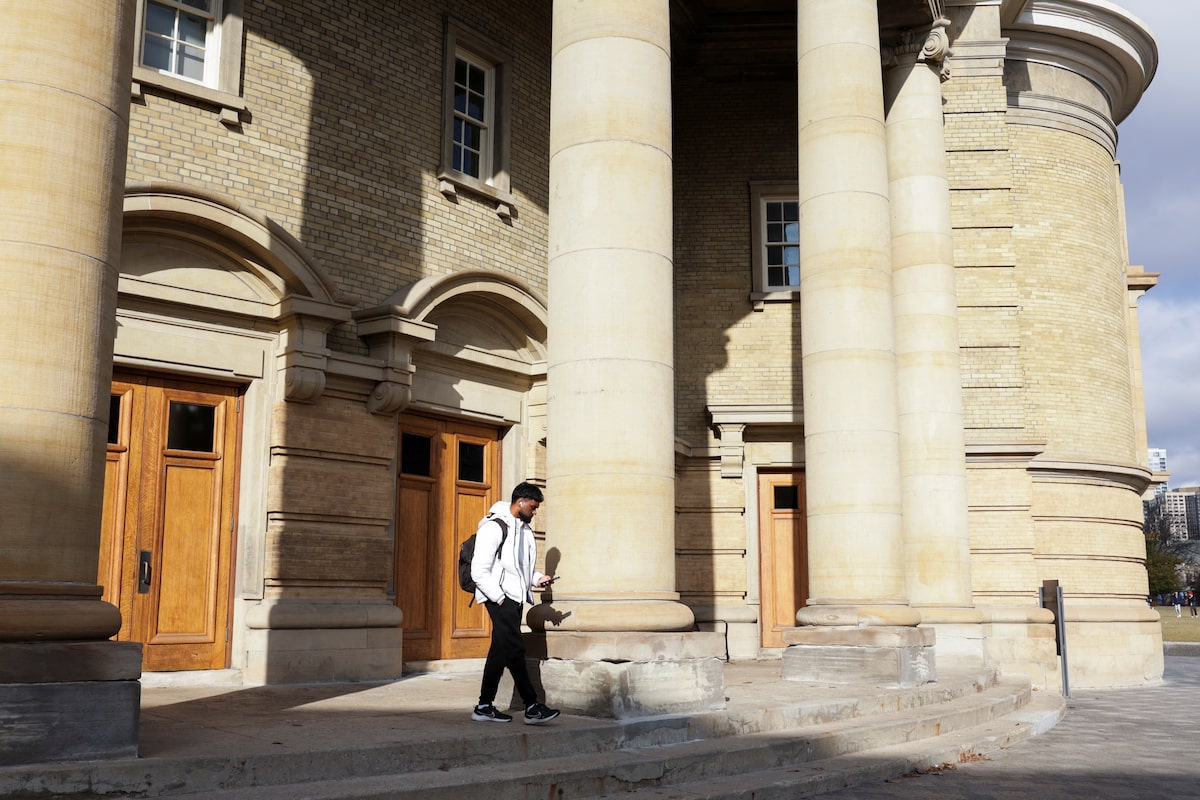
A student walks at the St. George campus of the University of Toronto, Nov. 20.Wa Lone/Reuters
Boxi Yang is a senior research associate for education and skills at the Conference Board of Canada.
Canada’s postsecondary sector is caught between two worlds. On the one hand, youth unemployment hovers near 14 per cent, the highest in more than a decade outside the pandemic. On the other, Canada is facing chronic labour shortages in health care, STEM and skilled trades. Add to this dichotomy the 2025 federal budget, which contains major new spending priorities but offers no coherent plan on how new labour-market needs will be met.
This disconnect raises a hard question: Does higher education still deliver value? The answer is yes, but only if the system evolves to connect learning with demand.
The fiscal result is clear: Postsecondary education is a good public investment. Graduates earn more, pay more in taxes and generally more than repay the public cost of their education. Government return on investment estimates show that programs in almost every field of study yield a positive fiscal return.
Immigration cuts leave an Ontario college, and its city, feeling the strain
The biggest payoffs come from STEM, trades and health programs. For every public dollar spent training a trades student, governments recoup roughly nine dollars in future tax revenue. A computer-science degree returns about six to one. Higher education, far from being a budget drain, is one of the few programs that genuinely pays for itself.
The puzzle is why, despite such strong yields, employers still face gaps in the very fields that create the most value. The reason lies in a supply-and-demand mismatch. The areas where graduates yield the biggest tax and productivity gains account for nearly half of all entry-level job vacancies in 2024. Yet only one-third of recent graduates were trained in these fields.
The gap is costly: Unfilled roles in these high-value sectors are estimated to have cost the economy an estimated $2.6-billion in 2024 alone. The system produces too many degrees in lower-demand disciplines and too few in fields where growth and public returns are highest.
Why can’t institutions keep up? Because our funding structure rewards volume, not alignment. Universities and colleges have expanded low-cost, lecture-based programs such as business and social sciences, which are cheap to run and easy to scale, even though their fiscal returns are modest.
By contrast, high-demand fields like nursing, engineering and applied technologies are far more costly to deliver. They require labs, specialized equipment, clinical placements and smaller class sizes. Domestic tuition covers only a slice of these costs, so institutions lean on international enrolment and provincial transfers to balance their budget. When Ottawa tightened rules on international students, that revenue stream was dramatically curtailed.
Ottawa aims to attract top research talent, including Canadians working abroad
Compounding the problem is fiscal asymmetry: Provinces shoulder almost all the cost of postsecondary operations, while the federal government collects most of the tax windfall from graduates’ higher earnings. There are no incentives for co-ordination, and so the mismatch persists.
Amid the imbalance, colleges and polytechnics have quietly excelled. Their shorter, hands-on programs feed directly into high-demand technical and trades roles. They deliver strong graduate outcomes and an even lower unemployment rate than that of university grads in the entry-level job market.
Yet they operate on thinner support. In 2022–23, colleges received about $7.8-billion in operating transfers, less than half the $16.1-billion directed to universities. Even after adjusting for enrolment and program length, colleges still received nearly 20 per cent less provincial funding per student. It’s as if we’ve asked the people who build the house to do it with fewer bricks.
As automation and AI redefine work, the need for applied talent is only growing. Colleges and polytechnics can scale that work force, but not on a shoestring.
Federal Budget 2025: Postsecondary schools cheer funds for talent, bemoan foreign student caps
Canada doesn’t need more degrees; it needs the right ones. This is the moment to rethink how we fund and measure success in higher education. Program expansion should follow evidence, not inertia. Up-to-date labour-market data can identify where new seats are needed most.
Funding, too, should also reward outcomes, not just enrolment. A share of transfers could be tied to graduate employment, earnings or participation in co-ops or apprenticeships. Institutions that deliver measurable results should be able to reinvest in what works.
Colleges and polytechnics, in particular, need stable funding that reflects the real cost of applied training. Without it, Canada will keep undersupplying the very talent that powers growth.
Higher education still pays, economically, fiscally, and socially. But the system’s incentives are misaligned. We are funding seats, not skills. If governments continue to treat education as an expense rather than a long-term investment, Canada risks eroding one of its most reliable engines of prosperity.