
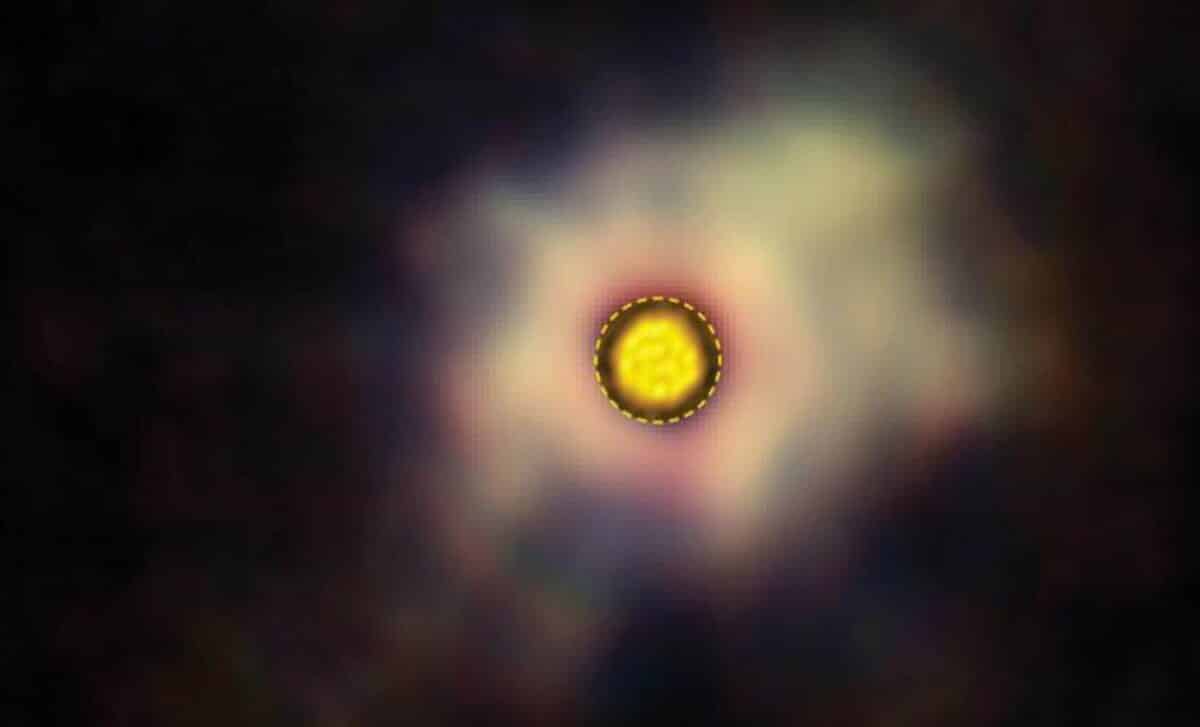
Aging stars have long been thought to blow life’s elements into space by using stardust as a vehicle, pushed outward by their own light. But recent observations of a nearby red giant suggest that this isn’t the case, dust alone doesn’t generate enough force to drive the stellar winds that spread the seeds of future planets.
That conclusion comes from a detailed study of R Doradus, a star just 180 light-years away, where astronomers were able to observe the very beginning of its mass loss process. Their findings disrupt decades of assumptions about how stars enrich the galaxy with elements like carbon, nitrogen, and oxygen, essential for forming new stars, planets, and potentially life.
Internal Star Activity May Be The Real Driver
Researchers used the SPHERE instrument at the Very Large Telescope in Chile to observe polarized light reflecting off dust around R Doradus. This allowed them to see faint structures in the star’s atmosphere, right where the wind is supposed to begin. According to the study, published in Astronomy & Astrophysics, the team detected silicates and alumina, common forms of dust in oxygen-rich environments.
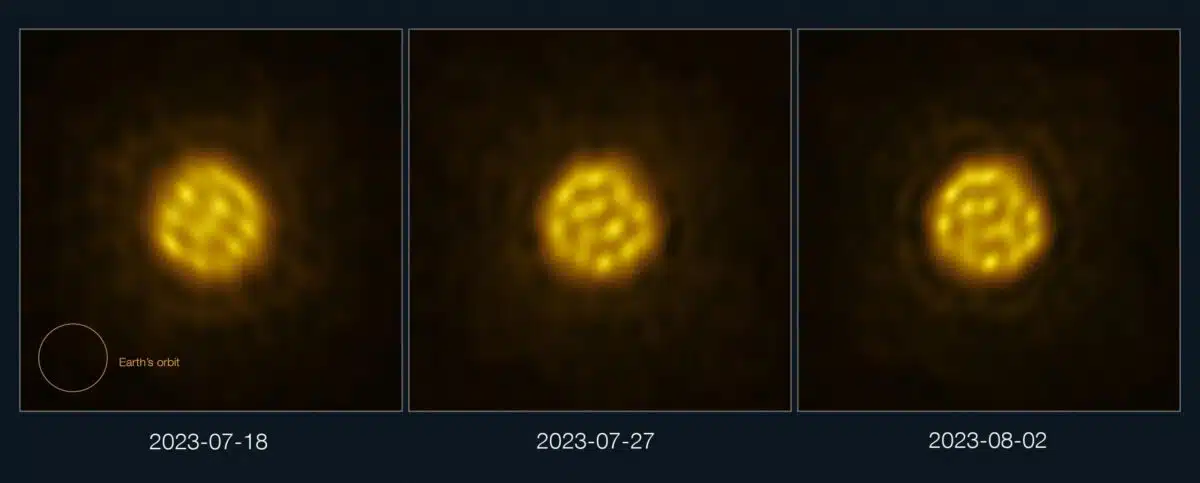 The star R Doradus was imaged using ALMA, the Atacama Large Millimetersubmillimeter Array, which is co-managed by ESO. Credit: ALMA (ESO/NAOJ/NRAO)/W. Vlemmings & al
To test whether these particles could actually push gas outward, the scientists ran simulations using radiative transfer models. These mathematical tools track how light moves through and interacts with matter. The results showed that the dust grains were too small: they didn’t catch enough starlight to generate meaningful force. As lead researcher Theo Khouri stated:
“We thought we had a good idea of how the process worked. It turns out we were wrong. For us as scientists, that’s the most exciting result.” Even assuming that every available atom of silicon or aluminum condensed into solid grains, gravity still dominated.
Larger Dust Grains Break Apart Before They Can Help
These findings also looked at the potential role of iron-rich dust, which absorbs more light and could, in theory, deliver a stronger push. But this idea collapsed under the heat. Because iron grains absorb more radiation, they heat up quickly, reaching temperatures high enough to sublimate, meaning they vaporize before they can contribute to wind acceleration.
This trade-off eliminated larger iron grains as serious contenders in the region close to the star. As reported by the research, even in the best-case scenario, iron-bearing dust doesn’t last long enough to help gas escape the star’s gravity. That rules out both small and large grains as primary drivers.
Internal Star Activity May Be The Real Driver
Once dust was ruled out, astronomers started looking for what else could be pushing gas off R Doradus. The clue seems to be in the star’s pulses and internal churning. This red giant regularly brightens and dims, expanding and shrinking in cycles of about 175 and 332 days. These steady pulses create shock waves strong enough to kick gas outward.
At the same time, convection, basically hot plasma rising and cooler plasma sinking, can lift gas into higher, cooler parts of the atmosphere. That’s where new dust can form, and maybe lend a hand. But the key point is this: dust isn’t leading the charge.
“Even though the simplest explanation doesn’t work, there are exciting alternatives to explore,” explained Wouter Vlemmings, professor at Chalmers and co-author of the study. “Giant convective bubbles, stellar pulsations, or dramatic episodes of dust formation could all help explain how these winds are launched.”
As noted EurekAlert!, to really understand how these winds begin, future observations will need to track stars like R Doradus through different phases of their pulsation cycles to see when and how winds actually take shape.