
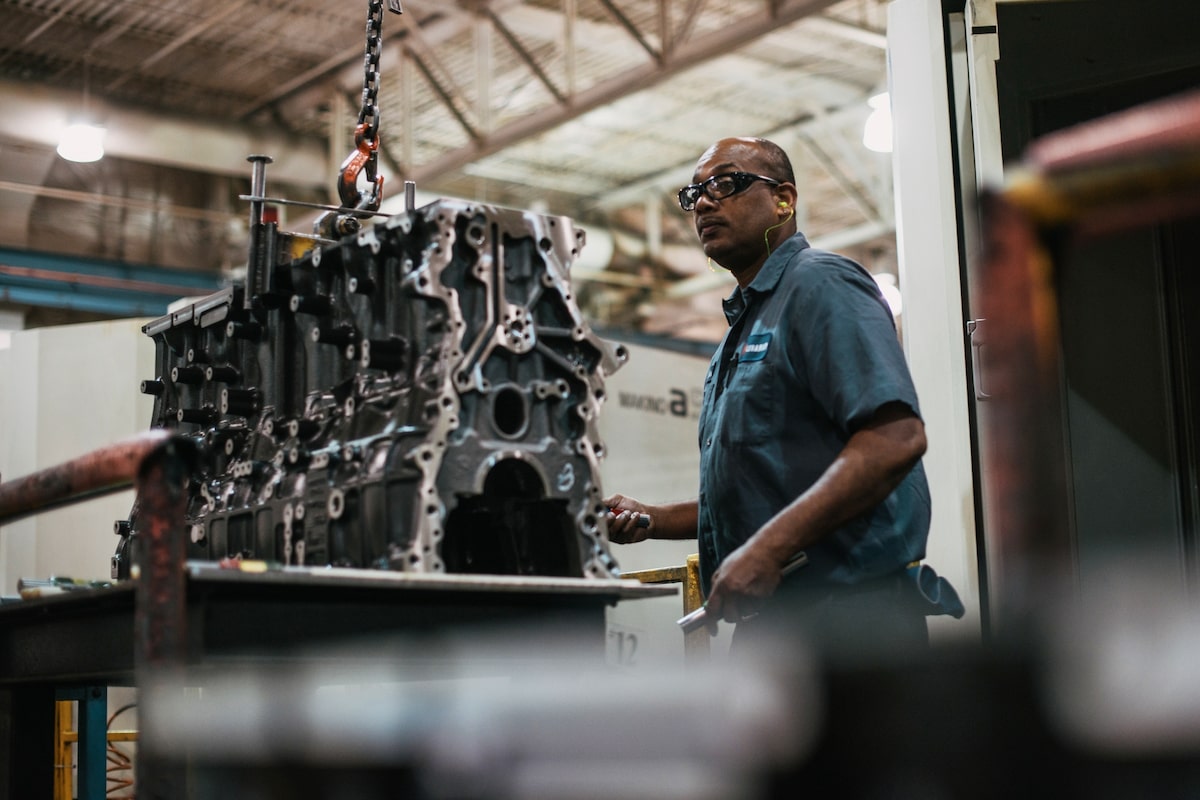
A worker operates a gun drill on an assembly line for engine blocks for Volvo trucks at the Linamar factory in Arden, North Carolina, in May, 2017. In October, 2025, the auto parts maker spent $300-million to acquire a Michigan-based aluminum chassis manufacturer.Mike Belleme/The Globe and Mail
Canadian tourists are steering clear of U.S. vacations to protest President Donald Trump’s policies. In contrast, Canadian chief executives are streaming across the border to make acquisitions and ensure they stay onside with the protectionist White House team.
Heading into 2026, the outlook for cross-border mergers and acquisitions is heating up, despite (or because of) Canada’s chilly trade relationship with the United States.
In the coming year, business leaders in virtually every sector will continue to bulk up by acquiring U.S. companies. In everything from tech to food, the CEO playbook is to better compete for customers in the world’s largest economy by owning factories in the U.S.
The deal-making doesn’t stop at the border. In the mining, energy and beleaguered lumber sectors, there are expectations of continued domestic M&A to build larger, lower-cost producers that send resources to both the U.S. and Asian markets.
And CEOs will follow Prime Minister Mark Carney’s charm offensive in Europe and Asia and use acquisitions in overseas markets as a hedge against further deterioration in the U.S. trade relationship.
Union Pacific, Norfolk Southern merger opposed by rail workers’ union
M&A activity will be fuelled by attractive interest rates at banks and private credit funds that are willing to lend, along with institutional investors willing to finance deals by buying stock.
All these factors mean the stage is set for cross-border takeover activity to continue at a record pace.
Through the first nine months of 2025, deals between Canada and its southern neighbour became the main driver of rising M&A activity “despite political noise,” investment bank Crosbie & Co. said in a recent report.
In the most recent quarter, ending Sept. 20, Crosbie’s data showed the total value of takeovers hit the highest levels seen in a decade, with $145-billion of deals announced. Deals between Canadian and U.S. companies accounted for 65 per cent of cross-border volume and 58 per cent of the total value of transactions.
“Since late 2024, some M&A was clearly put on hold as counterparties tried to better understand and wait-out some of the changes,” said Colin Walker, managing director at Crosbie, in the report.
“But increasingly, companies and their principals are deciding that the uncertainty will continue to be with us for a while, so they better get on with their strategies,” he continued.
Linamar expands U.S. manufacturing footprint with $300-million purchase of Aludyne assets
The “get on with it” message resonated at companies such as Linamar Corp. LNR-T, based Guelph, Ont.
In October, the auto parts maker spent $300-million to acquire a Michigan-based aluminum chassis manufacturer. In a press release, CEO Jim Jarrell said the acquisition “reinforces supply chain stability for our OEM customers,” which are car manufacturers with U.S. plants.
“Supply chain stability” is a polite way of saying the company is Trump-proofing its operations by owning U.S. factories that sit inside Fortress America and don’t pay tariffs when they sell parts to U.S. customers.
To ensure Linamar, founded in 1964, can weather any trade war, Mr. Jarrell also bulked up European operations in October by purchasing a German iron castings factory for €45-million ($72.5-million).
Heading into 2026, institutional investors have signalled they will commit capital to backing domestic champions with U.S. ambitions.
Bankers expect to see more deals next year that look like the December takeover staged by food producer Premium Brands Holdings Corp. PBH-T, a serial acquirer. The Vancouver-based company made one of its largest deals to date by paying US$662.5-million for Stampede Culinary Partners Inc.
George Paleologou, CEO of Premium Brands, made it clear the company’s strategy is to be a U.S. market leader in prepared meats. Stampede, based in the Chicago suburbs, bills itself as North America’s premier sous vide meat producer.
The key to the takeover was Premier Brands’s successful US$322-million stock sale in public markets and an additional US$170-million of equity sold to two fund managers, the Alberta Investment Management Corp. (AIMCo) and Jarislowsky Fraser Global Investment Management (owned by the Bank of Nova Scotia BNS-T).
The following week, engineering firm WSP Global Inc. announced a US$3.3-billion takeover of U.S. rival TRC Companies, funded in part by a $118-million stock sale to the Caisse de dépôt et placement du Québec.
When fund managers such as AIMCo, Jarislowsky and the Caisse are willing to step up, domestic CEOs can dream big on takeovers.
Domestic CEOs are also bulking up in their home market. Building a dominant platform in the oil sands drove last year’s bidding war over MEG Energy Corp., ultimately won by Cenovus Energy Inc. CVE-T It’s also the reason Athabasca Oil Corp. ATH-T, the smallest remaining oil sands producer, and a slew of natural gas producers enter 2026 as targets.
In telecom, look for inbound investments from foreign funds. Telus Corp. T-T is likely to sell a minority stake in its Telus Health division – valued at up to $10-billion – to a global investor such as Baring Private Equity Asia, which previously backed the Vancouver-based company’s subsidiary Telus International (Cda) Inc.
Rogers Communications Inc. RCI-B-T is expected to welcome a private equity investor as a minority partner in its sports platform, valued at $20-billion, once the telecom company buys the remaining 25-per-cent stake in Maple Leaf Sports & Entertainment owned by Larry Tanenbaum. Potential suitors include New York-based fund manager Arctos Partners, which already owns stakes in 20 major pro sports teams, among them the Pittsburgh Penguins, Golden State Warriors and L.A. Dodgers.
In 2026, the challenge of doing business in the United States can only grow, as Canadian diplomats begin renegotiating agreements with their largest trading partner. As the two sides prepare to face off, CEOs will be making southbound takeovers to ensure they keep access to U.S. markets.