
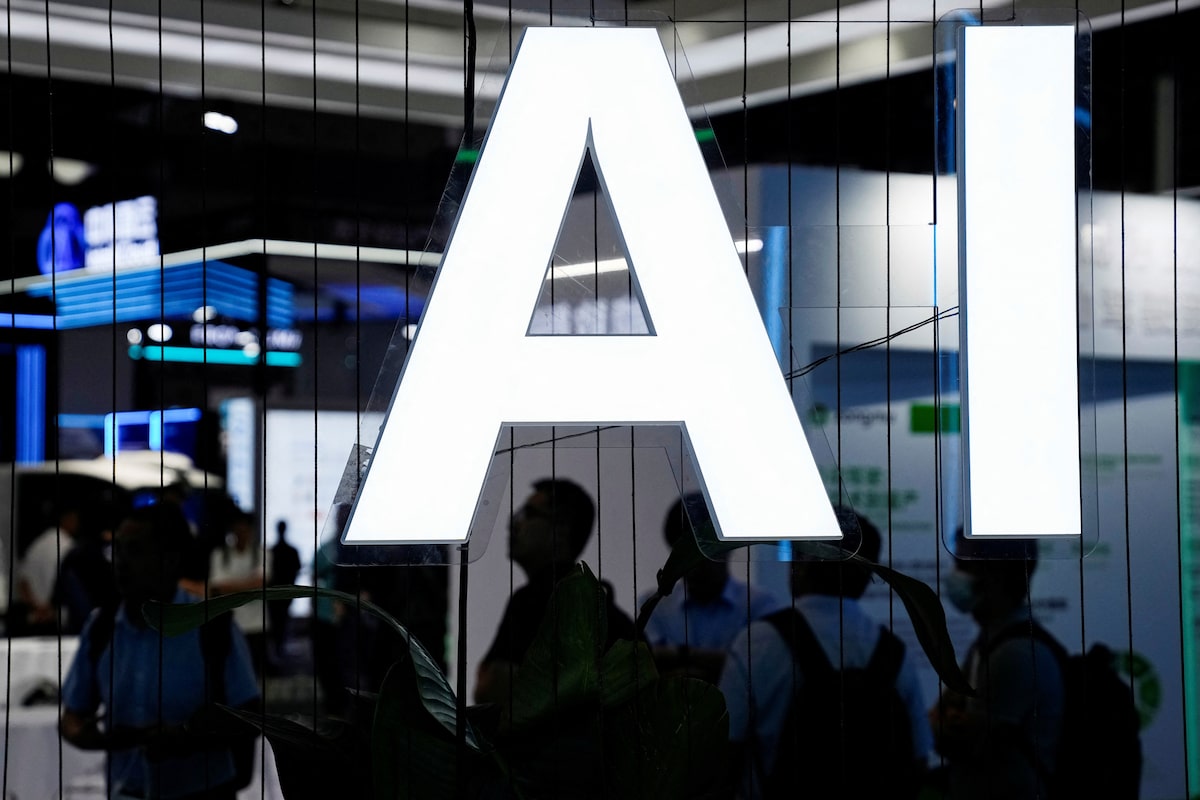
Participants at the World Artificial Intelligence Conference in Shanghai, July 2023. Chinese firms have accelerated their production of cheaper and more agile AI chips in the last few years.ALY SONG/Reuters
Bessma Momani is professor in the Faculty of Arts at the University of Waterloo and a senior fellow at the Centre for International Governance Innovation.
For several months, if not years, China and the United States have been in fierce competition in the high-stakes race for artificial intelligence dominance. From the continued tit-for-tat export restrictions on high-performance chips and the critical minerals used to make them, to limits to access to mineral processing, AI has clearly become another front in their intense geopolitical rivalry.
A few years ago, the United States appeared to be comfortably in the lead. Globally, the United States had the best computing power with the most sophisticated chips, further complemented by pioneering infrastructure with the highest number of data centres, which are used to store and compute enormous volumes of data. The U.S. could also flex its expansive geopolitical muscles by pressing allies like Taiwan to restrict exports of the world’s best high-performance chips needed to power advanced AI, and by pushing both Japan and the Netherlands to restrict the export of the lithographic instruments needed to fabricate these indispensable chips. It all went toward developing innovative closed-weight, frontier large language models like ChatGPT.
Ironically, however, these American manoeuvres left China to leverage its behemoth state powers, supplying its tech giants with significant energy and other subsidies to catch up. Chinese firms have accelerated their production of cheaper and more agile chips and, most remarkably, with far less direct financial investment. In late 2024, China also succeeded in releasing several sophisticated open-weight models such as Deepseek-R1. These models were transparent, downloadable and flexible, making them easier for companies to customize, experiment and innovate upon. Better yet, these AI models also required much less computing power, and thus much less energy, than America’s, which are dependent on resource-hungry data centres.
China reportedly set to limit access to Nvidia’s H200 chips after Trump green lights export
Despite China’s breakthroughs, the U.S. was charting a path toward AI dominance with more advanced AI patents and by American tech giants’ wide diffusion of AI. But Donald Trump may have impeded, if not reversed, one other key comparative AI advantage for the U.S.: Its ability to attract and retain the world’s best researchers.
AI has three principal inputs – diversity of data or information on the digital highway, faster and smaller chips made of critical minerals that provide the computing power to train and scale AI systems, and the development of AI talent – and America’s long-standing advantage was its welcoming environment for the world’s brightest. Seventy per cent of the U.S.’s 217 most-published, most-cited and most-impactful AI researchers were born or educated elsewhere. An estimated 66 per cent of Silicon Valley’s tech workers more broadly are born outside the United States, too, compared to the national average of 14 per cent. Moreover, the Massachusetts Institute of Technology – the world’s best university for data science and AI studies, according to the QS World Subject Rankings – reports that half the members of its faculty were born outside of the United States.
Analysis: At Pittsburgh summit, Trump turns AI evangelist in push for U.S. tech and energy dominance
The United States has married this international brain gain with the best-equipped labs in its universities and industry, significant government and private-sector research funding, and both Silicon Valley’s “move fast and break things” ethos and the American academy’s freedom to expand the frontiers of knowledge. This has been the recipe for America’s stellar AI innovation and commercialization.
Donald Trump speaks during the Pennsylvania Energy and Innovation Summit in July, 2025. Cuts to federal research funds and changes to acquiring an H-1B visa to attract global talent has hurt America’s stellar AI innovation and commercialization.Nathan Howard/Reuters
However, Mr. Trump’s thirst for domestic ideological control over American universities and his claims that this would clamp down on so-called “identity politics” are shifting the playing field. New federal diktats on permissible teaching subjects, as well as deep cuts to federal research funds by nearly US$7-billion in 2025, are all undermining the U.S.’s academic centres of excellence.
The Trump administration also recently announced restrictive and costly changes to acquiring an H-1B visa, which is commonly used to bring in highly skilled migrants with specialized technology abilities. Unsurprisingly, most of the visas issued were sponsored by Silicon Valley companies or by universities hoping to attract tenure-track professors to become international stars.
The White House’s crackdown on the academy and its punitive, civil-rights-eroding immigration policies – which disproportionately impact ethnic minorities and immigrants living in the United States, regardless of their status – will rapidly curtail America’s AI dominance. For many, the United States is no longer a “shining city upon a hill.”
Opinion: Trump’s H-1B visa price hike is good for Canada
Today, America finds itself at an inflection point where technological developments are being undermined by politics. In that context, Canada’s 2025 federal budget pledge to spend US$1.7-billion to try to attract 1,000 “world-class researchers” over 13 years was smart and strategic policy-making. And as this high-stakes race begins to narrow, let this be a reminder to all that human intelligence is still by far the most vital component to artificial intelligence’s trajectory.