

Earlier this month, I read Evelyn C. White’s article “‘Live until you die’: Reflections on hospice care and funeral services careers.” I read it a couple of times. There was a lot there to take in, and I was struck by how clearly the care and compassion of those she interviewed about death and dying came through.
I knew of Hospice Halifax through the long fundraising campaign that preceded its opening, and reading the occasional news story since then, but could not have told you much else about the place.
I’ve learned a lot more about Hospice Halifax over the last month, from family members and from my couple of visits.
What stands out the most is really the sense that the people running the place have thought of everything, for both residents and their loved ones. Resident stays are brief — about 21 days, White writes. But staff take the time to learn as much as they can about the people they are caring for, and what’s important to them.
Families and loved ones are also cared for.
The upstairs great room has breakfast items laid out every morning, and a fridge full of food, all offered for free or donations. There is a guest suite for those who want to stay overnight. A children’s room has toys and books, and a quiet counselling and rest space has comfortable seats and muted lighting.
Since it’s winter and the wind was howling, we did not enjoy the gardens, but I’m sure they are lovely in the summer. You get a view of the Northwest Arm from some of the rooms and from the great room, and there are items to occupy you if you’d like a little distraction: puzzles and games, and even a couple of shelves full of trashy novels.
A sense of quiet dignity and respect permeates everything.
Dignity and respect are pretty much the antithesis of what comes to mind when I think of what should be something completely unrelated to hospice care: private equity. And yet, in the United States, private equity firms have realized they can make huge profits off end-of-life care, by, well, offering less care and paying the people who offer that care less. I know the term private equity ghouls is overused, but this truly does seem ghoulish to me.
For-profit operators and private equity firms are drawn to hospices (I can’t bring myself to refer to it as the hospice “industry” or even “sector”) because of the particularities of U.S. health care. To wit: Medicare pays hospice operators a certain amount per patient per day. The bigger the gap between what you take in and what you spend, the more you profit.
In a recent study for the Law and Political Economy Project, Elle Rothermich, a senior research fellow at Yale’s Solomon Center for Health Law, looks at how for-profit and private equity firms have come to dominate the, OK, fine, hospice sector in the U.S.
Of some 6,000 Medicare-certified hospices in the country, about 4,400 are for-profit affairs. Rothermich writes:
Compared with nonprofit hospices, for-profit hospices offer fewer services, employ staff with less training, and are more likely to enroll patients with less intensive care needs. Some for-profit hospices use their business relationships with nursing homes and other care providers to recruit stable patients who may not even qualify for hospice. Meanwhile, high-need patients who do qualify for hospice may find themselves disenrolled.
Medicare caps the total amount it will pay out per person, so unscrupulous hospice operators can kick out patients who have maxed out their profitability potential.
Back in 2023, Cory Doctorow wrote about for-profit hospices and hospice scams (a subject he returned to again last month). From the 2023 essay:
There are so many hospice scams and most of them are so stupid that it takes a monumental failure of oversight not to catch and prevent them. Here’s a goodun: hospices bribe doctors to “admit” patients to a hospice without their knowledge. The hospice bills for the patient, but otherwise has no contact with them. This can go on for a long time, until the patient tries to visit the doctor and discovers that their Medicare has been canceled (you lose your Medicare once you go into hospice).
Doctorow refers to hospice chains hiring con artists to cajole people into signing up. Part of what prompted this Morning File essay was a letter I read the other day on the Ask a Manager blog. It was titled “I overheard my boyfriend pretending to be a doctor”:
He’s in marketing for hospice care and talks to a lot of families and patients to get them onto his company’s service. Yesterday I overheard a call with a family where he called himself a doctor. He’s not a doctor in any way, shape, or form. I asked him about it after the call and he said that the wife (the patient) hates the idea of hospice care and the son referred to him as a doctor on earlier discussions so she thought it was just the doctor recommending home care.
Am I wrong to have some serious ethical issues with that? I understand how hard end of life is, but pretending to be an MD seems a step too far. I told my boyfriend that I didn’t think that was appropriate, but he brushed it off.
Marketing for hospice care.
In the LPE report, Rothermich writes:
Hospice, perhaps more than other types of healthcare, lays bare the tension between medicine and the market. The value of a “good quality of life,” and what that entails, are highly personal determinations. Palliative care — of which hospice is a specialized form — is designed to assist seriously ill patients and their families as they make those determinations. Its animating principle, drawn from the work of Dame Cicely Saunders, is that a patient’s experience of pain has multiple dimensions — psychological, social, emotional, and spiritual as well as physical — all of which can and should be addressed holistically by a multidisciplinary care team. When hospice is commodified, this principle is flattened into a standardized list of discrete services that can each be given a monetary value: pain medication, durable medical equipment, skilled nursing visits, access to a chaplain. The aspects of hospice that cannot be standardized or given a monetary value are not legible to the market.
In other words, the parts of hospice care that are most important count the least for for-profit operators.
Earlier this year, in an article called “Private equity plunderers in our midst,” Joan Baxter wrote about the private equity playbook. The story includes a quote from the book These are the plunderers: how private equity runs – and wrecks – America:
Private equity is a catch-all phrase, but the financiers we are highlighting take over companies in transactions using high-cost borrowed money raised in the corporate bond markets from investors willing to take on greater risks. They are not entrepreneurs or traditional businesspeople, prospering while creating jobs and opportunities for others. Theirs is a distorted kind of capitalism, a setup in which they benefit while many others lose. They have perfected the art of “Asshole Capitalism,” a term of art devised by Aaron James, a philosophy professor at the University of California, Irvine. It is a system where “citizens feel entitled to unlimited enrichment even at social cost.”
At Hospice Halifax, the services are all free. All of them: music therapy, grief counselling, peer support groups, one-on-one therapy, meals, medical care. Their slogan is “We give you space to live before you die.”
It’s the antithesis of “We’ll squeeze as much profit out of you as we can before you die.”
(To send or post this item, copy the website address at the top of this page.)
NOTICED
1. Sanctuary Arts Centre
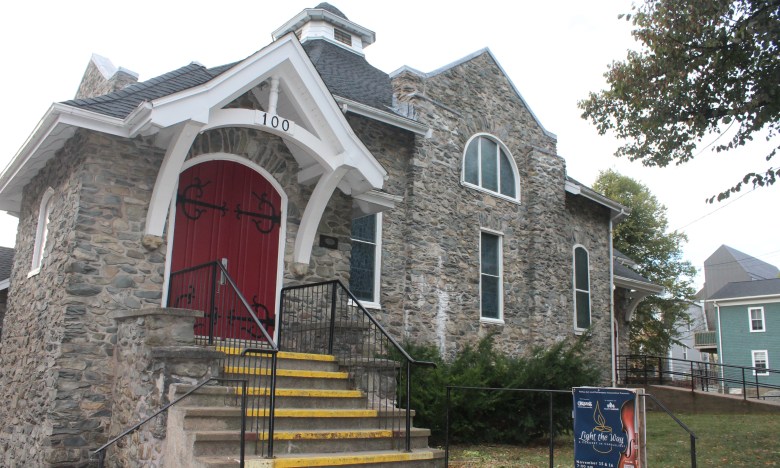 The Sanctuary Arts Centre in downtown Dartmouth on Oct. 14, 2025. Credit: Tim Bousquet
This item is written by Tim Bousquet.
Earlier this month, I reported on Sanctuary Arts Centre’s appeal of a Fire Marshal’s order related to the building housing the centre:
The Sanctuary Arts Centre in Dartmouth may have to cease operations because of the high cost of meeting fire code regulations.
At a hearing before the Nova Scotia Regulatory and Appeals Board, Ivano Andriani testified that meeting the orders of the fire marshal could cost on the order of $850,000. Andriani is the founder and president of the nonprofit Halifax Art and Performance Association, which operates Sanctuary. He said the organization was in no position to meet those costs, so if the orders were upheld, the association would fold.
At issue is Deputy Fire Marshal Lynelle Vetsch’s determination that the building should be classified “A1” instead of “A2” (explanations of each category explained in link), and therefore Sanctuary is required to install sprinklers throughout the building.
Andriani appealed the fire marshal’s order, and a two-day hearing was held before the board on Dec. 1 and 2. At the hearing, the board said it would issue a decision “before the holidays,” but as of this writing has not.
But on Wednesday, Christmas Eve, a new document, “User’s Guide – NBC 1995 Fire Protection, Occupant Safety and Accessibility (Part 3),” was entered into the case file. It’s not stated who entered the document into the record, but as the hearing has already been held, I’m presuming that the Regulatory and Appeals Board itself entered it to justify its coming decision.
“The Guide not only applies to new construction but includes commentaries that will assist in appropriate application of the Code when changes are planned for existing buildings,” explains its introduction. A section of the guide entitled “Commentary B – Application of Part 3 of the NBC 1995 to Existing Buildings,” includes a list of “Assumptions”:
Assumptions
A number of assumptions that were used to develop Commentary B should be considered in reviewing an existing building and assessing the need for changes. These include:
• Building occupants should not be assumed to be capable of fighting a fire through the use of portable extinguishers and standpipe systems. They are expected to rely on trained fire fighters to undertake these operations.
• Once the safety of all building occupants has been secured, then the life safety intent of the NBC 1995 has been met.
• Fire alarm and detection systems provide building occupants with an awareness that an emergency situation may exist and that an appropriate response by them may be necessary.
• If safe egress routes are established in a building, such that all occupants have sufficient time to evacuate in safety, then the intent of the NBC 1995 with respect to the safety of the occupants has been met.
• A fire can start in any space in a building.
• A fire can start in an area of the building adjacent to occupants.
• For a building two storeys high where the occupants are awake and fully ambulatory, the impact on life safety of structural fire protection is not significant, provided that other features — including the number of exits, the travel distance to exits, and similar means of egress facilities — are taken into consideration.
• For a building that is between three and six storeys high, and for a lower building used for residential or care or detention purposes, a minimum level of structural fire protection is required to ensure life safety.
• For a building more than six storeys high, a higher level of structural fire protection is needed to provide for the integrity of refuge areas and means of egress.
• The performance of an effectively maintained and operational automatic fire extinguishing system in an existing building will be as effective as the performance of an automatic fire extinguishing system in a new building and, therefore, the benefits that accrue in a new building from the installation of an automatic fire extinguishing system should apply equally in an existing building.
[emphasis added]
The two assumptions I’ve highlighted seem to apply to Sanctuary — it is a two-storey building with the required number of exits, and the exits have recently been upgraded by the fire inspector’s order.
I read this as an indication that the Regulatory and Appeals Board is about to rule in Sanctuary’s favour. That’s a guess on my part, but I’m eagerly awaiting the decision.
(Send this item: right click and copy this link)
2. Nova Scotia Power
 Nova Scotia Power customer app on Dec. 23, 2025. Credit: Yvette d’Entremont
Last week, Jennifer Henderson reported on information contained in a Dec. 23 report where Nova Scotia Power answered questions from the Nova Scotia Energy Board.
The questions were part of an inquiry into the ransomware attack that put at risk the personal information of 375,000 Nova Scotians and raised concerns that thousands of customers were overcharged.
In her Dec. 23 article, Henderson noted that the cyberattack on Nova Scotia Power “disrupted the communication between AMI smart meters attached to homes and businesses and the company’s automated billing system. The meters could still measure consumption, but that data was not being communicated.”
While many Nova Scotians have complained about power bills that they say wildly overestimate their consumption, Nova Scotia Power says it has not “intentionally” overbilled.
In an update, Henderson notes the utility has set up a dedicated page where customers can upload photos of their meters. She adds:
The company will also be holding in-person meetings in Middleton and Sydney next month to discuss disputed power bills with individuals who want personal attention rather than online or call centre contact.
(Send this item: right click and copy this link)
RECENTLY IN THE HALIFAX EXAMINER:
Letter by Andy Fillmore says owner of Dartmouth Cove lot will begin work Jan. 5
 Dartmouth Cove with King’s Wharf in the background on July 28, 2025.
Suzanne Rent reports on the latest in the Dartmouth Cove story:
An owner of one of the nine water lots in Dartmouth Cove said it will start work on its lot on Jan. 5, 2026. That’s according to a letter by Mayor Andy Fillmore to Municipal Affairs Minister John A. MacDonald.
According to a Facebook post from Coun. Sam Austin, that company is Atlantic Road Construction and Paving (ARCP), the company that’s been working to infill a water lot since May 2022, but has faced opposition from the community, councillors, and MP Darren Fisher…
Fillmore also wrote that Halifax regional council has directed the municipality to seek a judicial review of the amendments in order to protect HRM’s position if this “uncertainty around them is not resolved.”
Click or tap here to read “Letter by Andy Fillmore says owner of Dartmouth Cove lot will begin work Jan. 5.”
(Send this item: right click and copy this link)
IN OTHER NEWS
Sex and drugs and lobster rolls
 Stage set up at the Shore Club in Hubbards, on August 21, 2025. Credit: Philip Moscovitch
The first time I saw a “Sex, Drugs, & Lobster Rolls” T-shirt was in August, when Kathleen Edwards wore one on stage at the Shore Club in Hubbards, about an hour after the photo above was taken. I thought it was a cute and clever slogan, especially on a shirt worn by a musician.
Then, I heard a while later that the folks selling the T-shirts had to stop, because of a trademark dispute.
Aly Thomson at CBC has that story today. Is it a common phrase in the Maritimes that shouldn’t be trademarked? Or is it only well-known because of the work put in by the trademark holder, Nadyne Kasta, who started selling the shirts in P.E.I. in 2014, and applied for the trademark in 2021?
And is it a common phrase at all? I had not heard it before seeing it on Kathleen Edwards’ shirt.
(Send this item: right click and copy this link)
Government
No meetings
On campus
No events
In the harbour
Halifax
05:00: Atlantic Sea, ro-ro container, arrives at Fairview Cove from Liverpool, England
06:00: MSC Barbados, container ship, arrives at Pier 41 from Malaga, Spain
11:30: MSC Joy, container ship, arrives at Pier 42 from Montréal
11:45: MSC Barbados sails for sea
12:30: AlgoTitan, oil tanker, moves from Imperial Oil to Pier 9
15:00: Federal Tokoro, bulker, sails from Pier 28 for sea
15:30: Atlantic Sea sails for sea
22:00: MSC Matilde V, container ship, arrives at Pier 41 from Liverpool, England
23:00: MSC Joy sails for sea
Cape Breton
04:00: Green Planet, a ridiculously named oil tanker, arrives at EverWind from Houston
Footnotes
For some reason, I have decided to subject myself to listening to the entire Kid Rock oeuvre, a pursuit someone I know referred to as an “idiotic endeavour that has no meaningful value whatsoever.” To be clear, he said this approvingly.
I am now up to 2007’s Rock n Roll Jesus, which AllMusic referred to as “Big, bold and brainless…Plays like music for a theme restaurant.”