
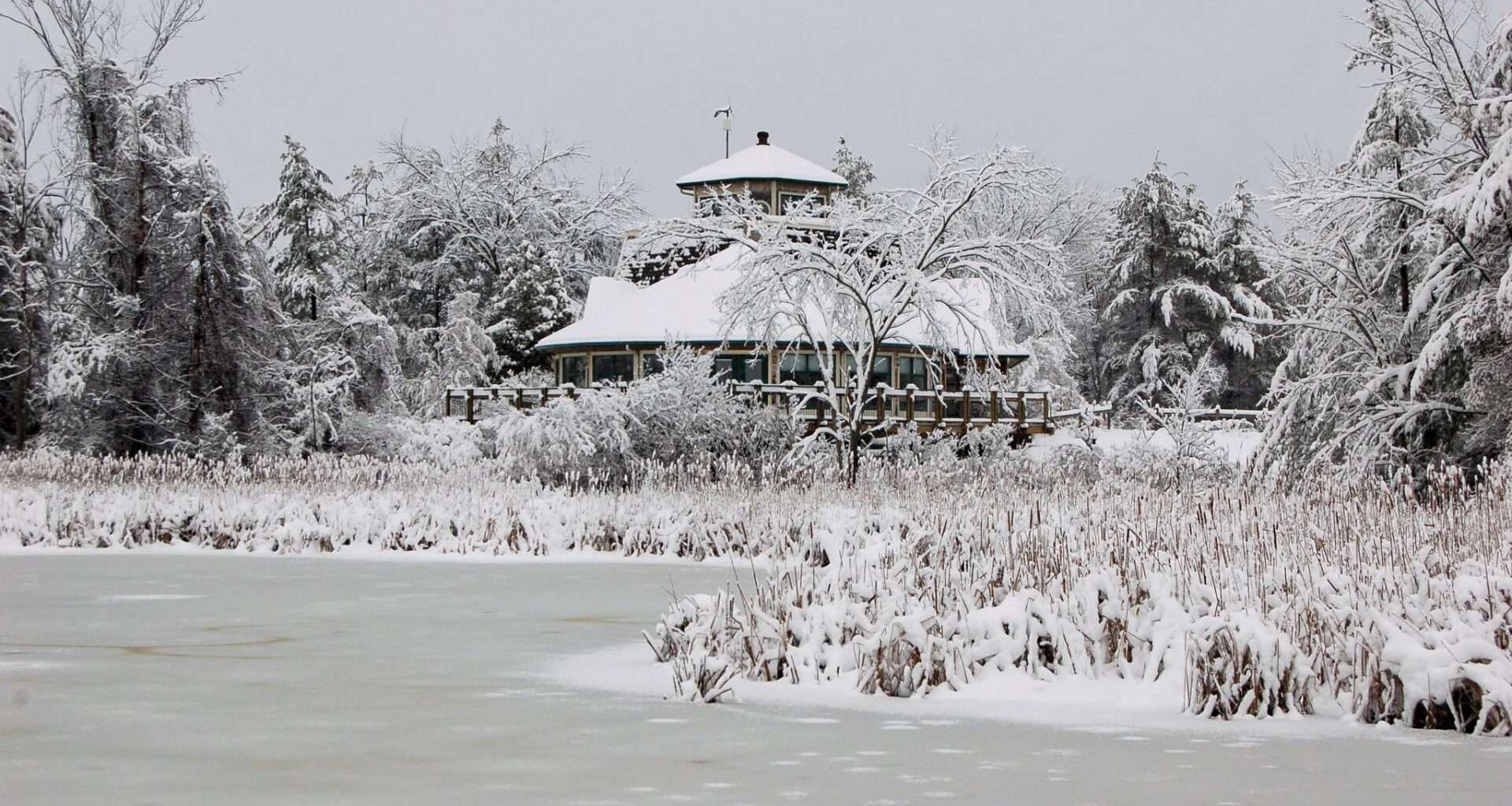
 The Outdoor Centre at the Little Cataraqui Creek Conservation Area, one of several conservation areas that protected and managed by Cataraqui Conservation, in a fresh layer of snow. Photo via CRCA website.
Kingston city councillors urged the Ontario government to stop a forced merger of conservation authorities and not to fix a system that they say isn’t broken.
“We are sounding the alarm that this is quite a change for us,” said Countryside District Councillor Gary Oosterhof, a leading voice on the trail of conservation preservation.
Oosterhof, a long-time Board member of the Cataraqui Region Conservation Authority (CRCA), put forward a municipal motion that opposes provincial plans to fold three-dozen conservation authorities into seven regional bodies.
CRCA, also known as Cataraqui Conservation Authority, would become part of the much larger St. Lawrence Regional Conservation Authority, comprised of 46 municipalities in eastern Ontario, to oversee watershed management, according to the province, which recently amended the Conservation Authorities Act to lay the groundwork for consolidation.
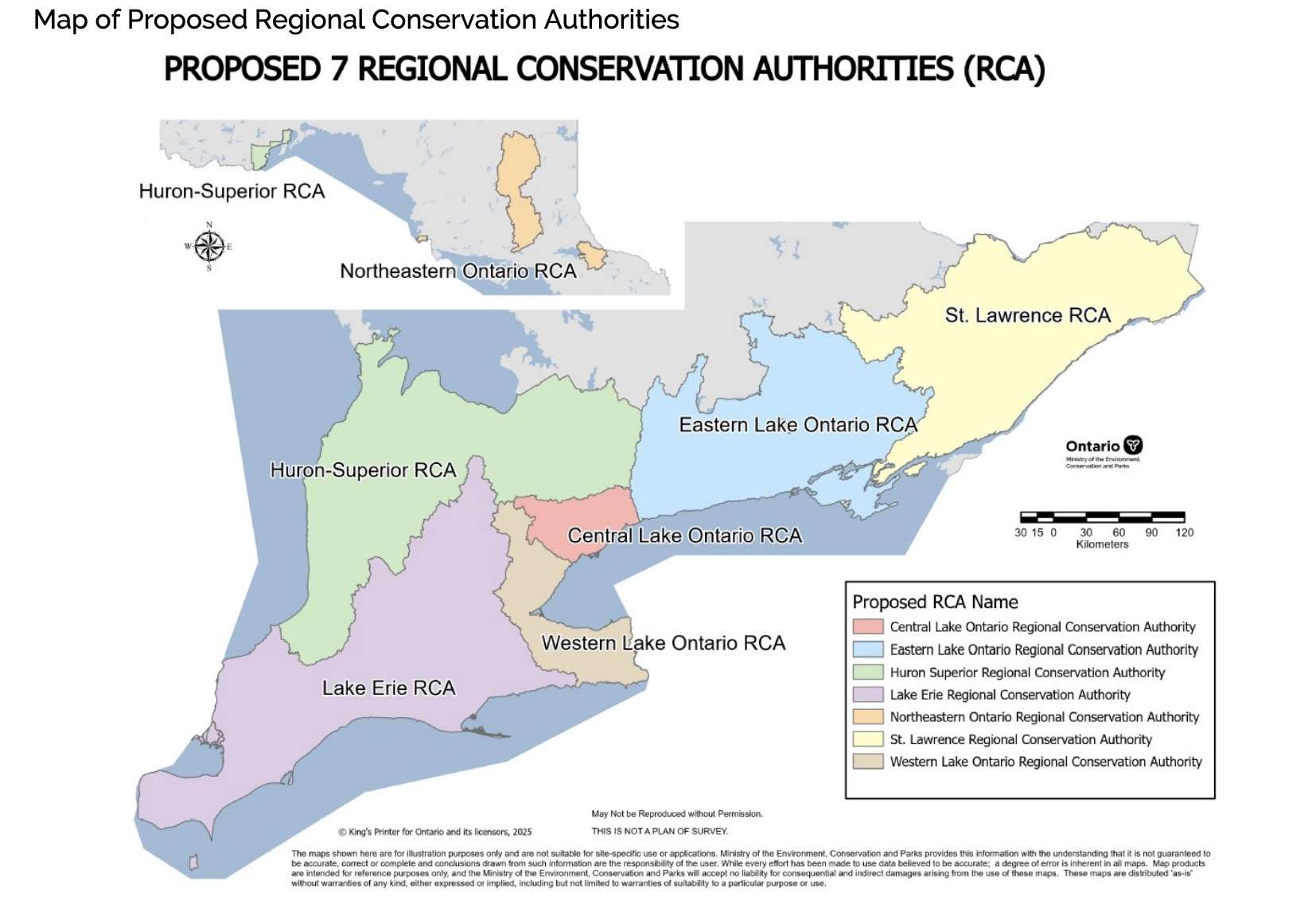 Proposed Regional Conservation Authority areas. Image via City of Kingston documents.
Conservation services like flood forecasting, land use planning, recreational trails, and local governance could be eroded or eliminated under a larger bureaucracy, Oosterhof warned.
Oosterhof said the CRCA is a good size with the 11 partner municipalities under its current jurisdiction, of which Kingston is the largest, and provides efficient services with a $6.8 million annual budget. The City contributes about $2 million a year.
“It doesn’t get done for a better price,” he said of the CRCA’s existing operations.
Other city councillors shared his concerns and frustrations.
“Who’s asking for this?” wondered Kingscourt-Rideau District Councillor Brandon Tozzo, who is also worried about reduced local control and input over conservation policies.
Councillors rallied to support Oosterhof’s pre-Christmas motion affirming “strong support for the continued independence of the Cataraqui Conservation Authority (CCA).”
“This is one of those instances where bigger isn’t better,” added Pittsburgh District Councillor Ryan Boehme in a political debate to oppose the planned conservation amalgamation during the Council meeting held Tuesday, Dec. 16, 2025.
City staff presented an information report at the same Council meeting that pointed out the province does not intend to change the mandated programs and services of conservation authorities, but staff cautioned the future structure of regional conservation bodies may “not be as nimble and responsive to local issues, development approvals, or conservation area management.”
The report also repeated provincial statements that regional consolidation would not result in layoffs of front-line staff, and existing conservation offices would remain as field offices.
But councillors aren’t convinced.
“I don’t see this working as well,” said Loyalist-Cataraqui District Councillor Paul Chaves.
Portsmouth District Councillor Don Amos (who serves as Council’s appointee on the CRCA Board along with Councillors Oosterhof, Lisa Osanic, and Wendy Stephen) suggested the conservation streamlining effort is “not going to bode well” when it comes to local accountability and fiscal responsibility.
“When you have a forced amalgamation and back office integration, sometimes it works… and most times it doesn’t end well for anybody except the taxpayer ends up paying more,” said Amos.
He likened the controversial plan to the recent provincial move to scrap speed cameras based on Toronto-focused complaints from Premier Doug Ford that it turned into a municipal “cash grab.”
“This feels like a Toronto, once again, issue that’s being doled out to the rest of the province.”
Amos said there is no way that service levels and community values will be preserved through a regional conservation authority of such magnitude.
The proposed St. Lawrence Regional Conservation Authority would encompass watersheds flowing into the St. Lawrence River, coordinating flood and water management across eastern Ontario, primarily based on the Upper St. Lawrence, Lower Ottawa River, and southern portion of the Central Ottawa River Secondary Watersheds.
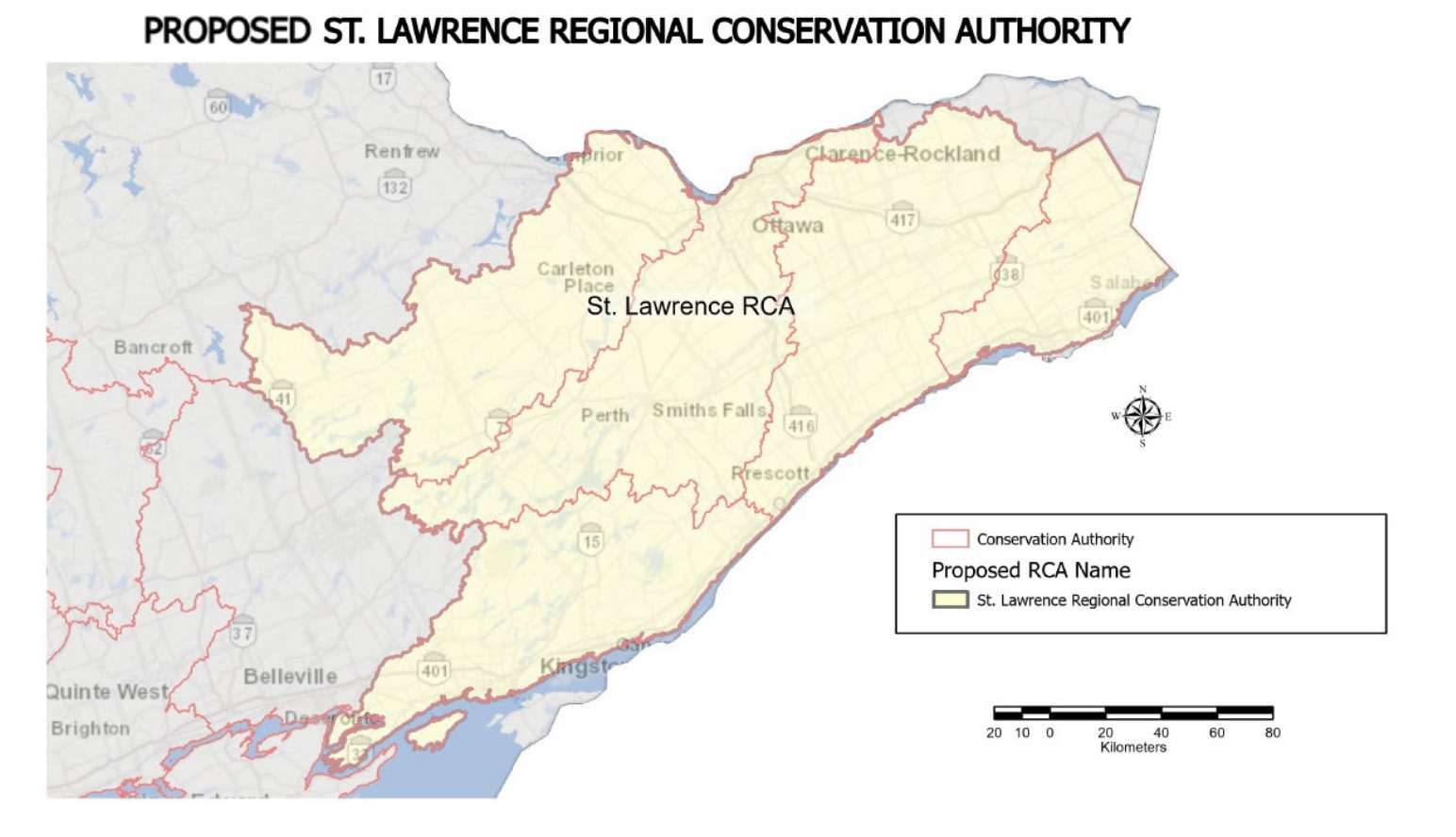 Proposed St. Lawrence Regional Conservation Authority area. Image via City of Kingston documents.
Municipalities merged into this regional body would span from Kingston to Cornwall and north to Ottawa and Carleton Place, covering 18,500 square kilometres — more than three times larger than Prince Edward Island — compared with the CRCA’s existing jurisdiction of 3,800 square kilometres.
It remains unclear how the St. Lawrence Regional Conservation Authority’s governance model would be structured with over 40 member municipalities. Each regional authority would fall under the power of the newly-created Ontario Provincial Conservation Agency.
Councillors scoffed at a staff report suggesting that if the current representation model is followed, then the regional authority in eastern Ontario could see a board with as many as 70 appointed members.
The province set aside six weeks to hear public feedback on the proposed new conservation boundaries and criteria for regional consolidation, but not on whether it should actually occur. The deadline to comment expired on Monday, Dec. 22, 2025, just days after Council’s motion called on the province to save the existing structure.
A furious Tozzo said the consolidation scheme amounts to the erosion of local powers of a system that’s already working just fine.
He added: “This [deserves] a lump of coal in Doug Ford’s stocking, if I could do it.”
The full agenda for the most recent meeting of Kingston City Council can be read on the City’s website (click ‘View All’ at the bottom of the list under the heading ‘Meeting Calendar’ to get to the City’s calendar to view agendas for meetings that have already occurred). Meetings can be viewed virtually (during or after the meeting) in the video feature within the relevant Council agenda.