
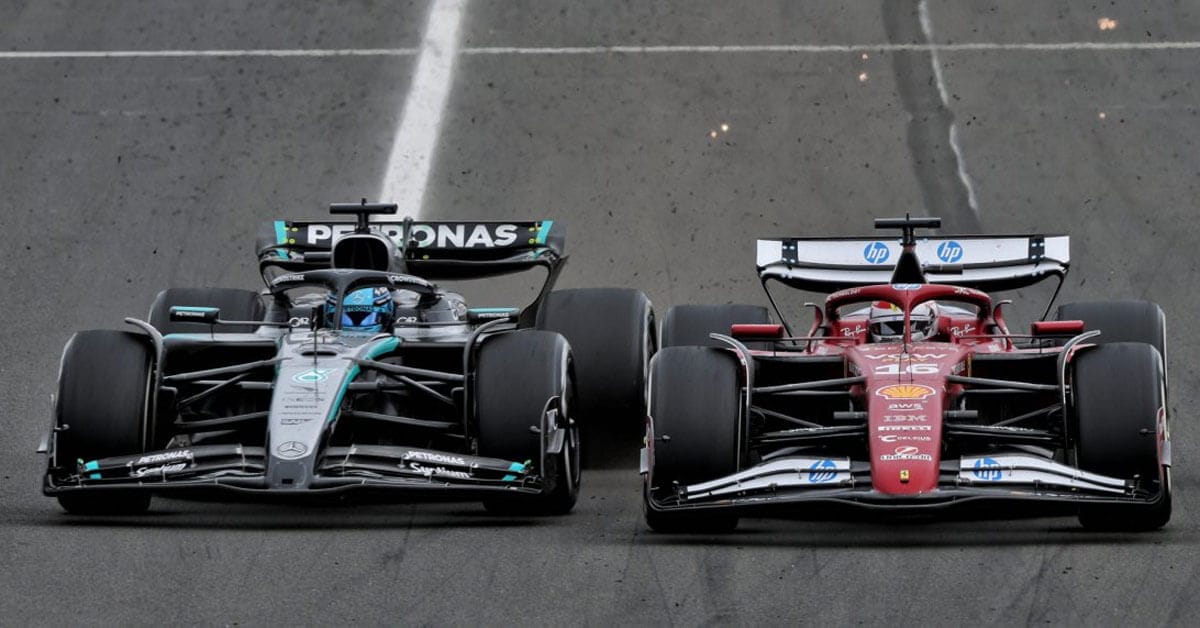
Ferrari is fully focused on the 2026 season, and for this reason, the Scuderia wants to take full advantage of the fact that the 678 chassis was designed and built entirely at its Maranello factory. The 2026 power unit has been developed to give aerodynamicists Diego Tondi and Frank Sanchez the opportunity to push concepts that reduce drag. It will use smaller radiant masses, with the electric battery designed to be compact and lightweight, allowing for more aerodynamically favorable shapes.
For Frédéric Vasseur and his technical team, the 2026 project is almost “vital.” They must demonstrate that the decision made in April—to sacrifice the 2025 season to focus entirely on 2026—was correct and that every available resource was wisely deployed.
After Abu Dhabi, a quiet period settled over Maranello, with the team working together without public statements or, as had happened the previous year, organizing fan events. However, Ferrari soon discovered that Mercedes and Red Bull had developed a system allowing their power units to increase the compression ratio from the 16:1 mandated by the regulations (measured at ambient temperature) up to 18:1 once the six-cylinder engine reaches operational temperature. This revelation infuriated Ferrari, prompting an immediate and strong response. Together with Honda and Audi, Ferrari requested clarification from the FIA, which ultimately deemed the Mercedes and Red Bull approach fully legal.
Both teams now appear to have a power advantage of approximately 13 horsepower over the competition. Considering that each horsepower is worth roughly 20 thousandths of a second in lap time, the engineers from Mercedes and Red Bull achieved their goal, forcing the other teams either to chase or to look ahead to 2027, when the FIA has mandated a return to fully compliant engines.
According to Motorsport Italia, a closely guarded secret is that Enrico Gualtieri decided to adopt a steel-alloy cylinder head instead of the aluminum version that had been developed in parallel, which would not have lasted for four power unit usages across a season.
“With the recent departure of Wolf Zimmermann and his deputy Lars Schmidt to Audi, it seemed that the steel-alloy head (with copper and ceramic elements) would have a short lifespan. However, Davide Mazzoni, head of the 2026 power unit project, had already instructed Guido Di Paola, Head of F1 Internal Combustion Engine Concept and Design, to revisit this extreme solution developed together with Austrian company AvL, in order to achieve the basic reliability that had concerned the Ferrari team,” explained sources.

Steel is heavier than aluminum but allows experimentation with combustion chamber pressures and temperatures never before reached. This should provide an advantage, especially since the 2026 power unit will need to weigh 30 kilograms more than this year’s units (150 kg vs. 120 kg). In this way, Ferrari could challenge Mercedes’ ingenious system, increasing engine power while still remaining within the technical regulations.
This technical arms race therefore highlights the massive stakes of the 2026 engine reset. Ferrari’s decision to pursue metallurgical innovation over thermal tricks suggests a “brute force” engineering approach intended to ensure that, when the new era begins, the Prancing Horse isn’t just a participant, but the benchmark. With the integration between the power unit and the chassis becoming tighter than ever, Maranello’s gamble on steel could be the deciding factor in whether they can finally topple the dominance of the Silver Arrows and Red Bull.
Dec 30, 2025Maria Lombardi
Let other Scuderia Fans know about us


