


Listen to this article
Estimated 5 minutes
The audio version of this article is generated by AI-based technology. Mispronunciations can occur. We are working with our partners to continually review and improve the results.
It is the type of storm that is supposed to happen once a century: two months of rain in a single night.
But Steinbach’s animal shelter, which moved into a new building more than two years ago, has yet to experience a September when it did not have to evacuate its animals due to flooding.
And at least 200 residents in the southeastern Manitoba city are still waiting to find out whether they can expect financial aid for the back-to-back floods from a provincial disaster relief fund.
“[The floods were] almost a year to the day, so it’s kind of unbelievable in that sense,” said Graham Pollock, vice-president of Steinbach and Area Animal Rescue.
In 2024, a storm dropped 156 millimetres of rain over Sept. 16-17.
WATCH | Storm leaves streets flowing like rivers and yards that are lakes: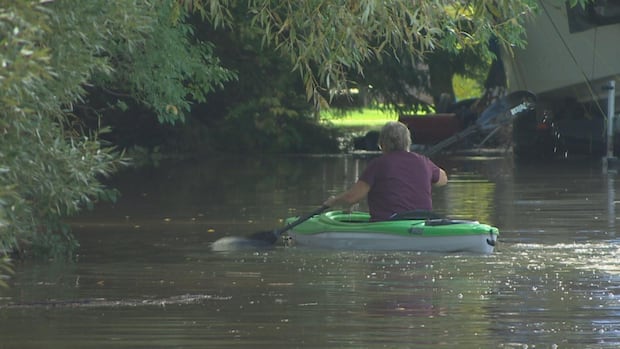
Steinbach recovering from consecutive years of flooding
September storms dropped once-a-century levels of rain on Steinbach for two years running. City residents are waiting for word from the province on disaster assistance, while the city’s animal shelter is also rebuilding.
This year, the rain fell even harder. Over Sept. 11-12, the city was deluged with 103 millimetres in just four hours, and 135 millimetres by the time it stopped, according to Environment and Climate Change Canada.
Steinbach and Area Animal Rescue volunteers had to find homes for 22 animals that needed a home for the month it took to clear the damage and restore power.
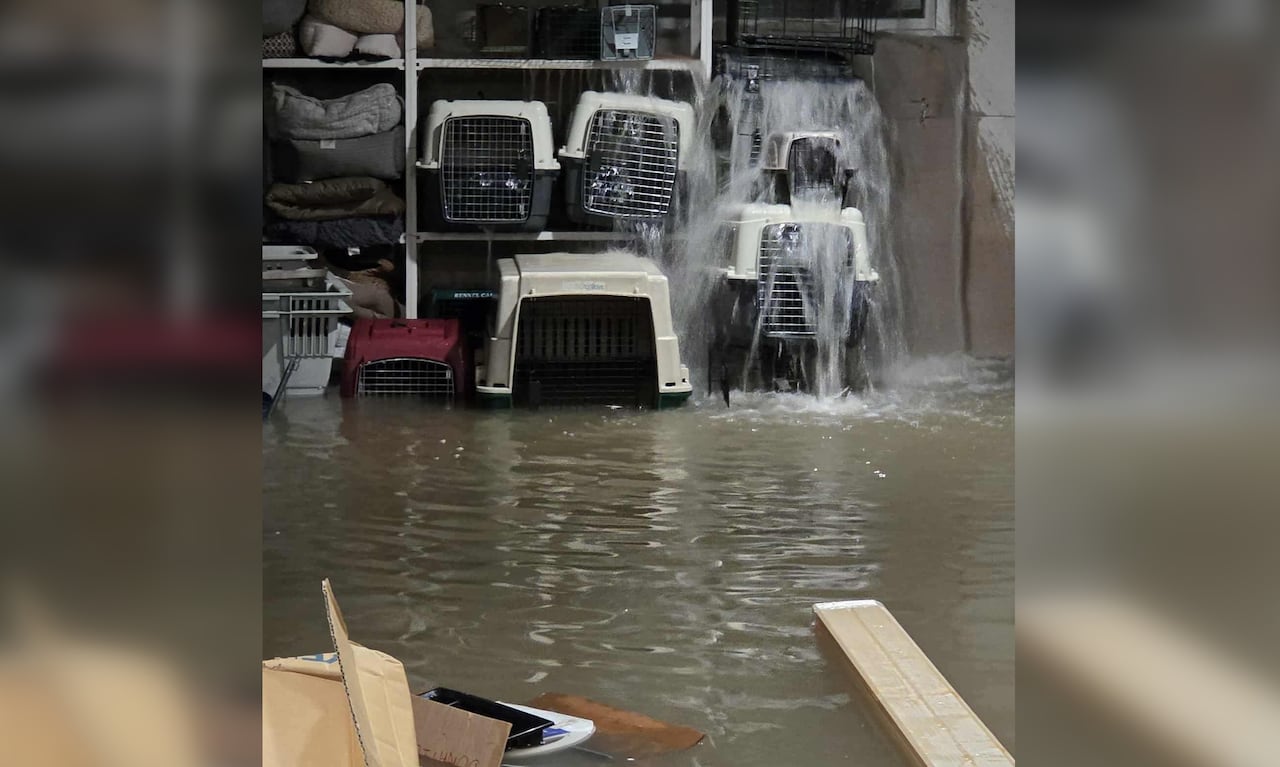 Water pours over animal crates in the basement of the Steinbach and Area Animal Rescue on Sept. 12, 2025. (Submitted by Graham Pollock)
The volunteer-run organization has now spent $50,000 on overland flooding deductibles in two years, and the repairs are still incomplete.
Pollock says when this year’s rain fell, he got a call at 2 a.m. that water was again pouring through windows and filling the basement.
Shelter president Michelle Neufeld happened to be checking on the cats late that night, Pollock recalled, only to see history repeating itself. There was no rainfall warning from Environment Canada for the unexpected deluge.
“She could see in the back, the water was starting to come out from the drain … and start to creep across the yard,” Pollock said.
A pool two metres deep formed in the shelter’s basement. All the food was under water and other supplies were bobbing near the ceiling.
200 waiting for assistance
Other Steinbach residents were also hit hard by the second year of flooding. The intensely focused line of the storm also dropped more than 100 millimetres of rain on La Broquerie, 10 kilometres east of Steinbach, and on Niverville, 20 kilometres northwest of the city.
Troy Warkentin, Steinbach’s city manager, says the province has yet to declare the flood a disaster and approve aid for about 200 people who applied for assistance with uninsured costs through the Manitoba Disaster Financial Assistance program.
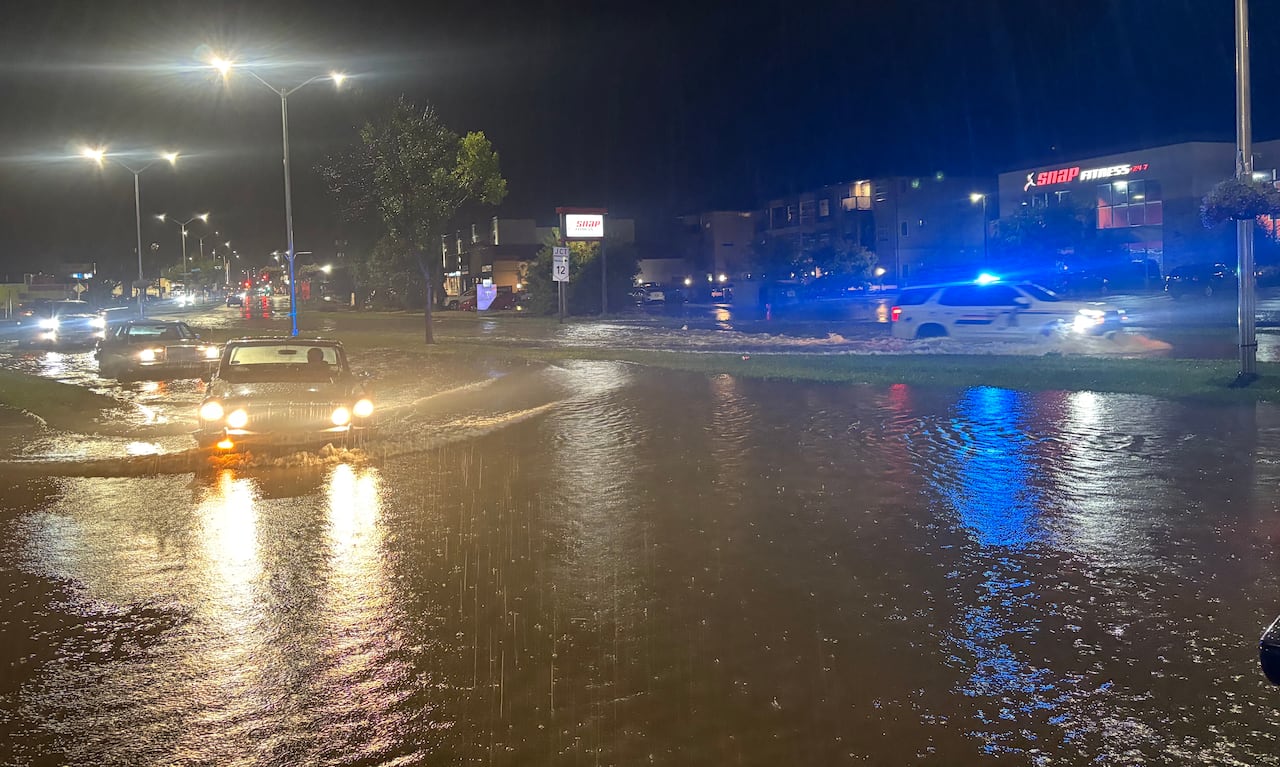 Cars and a police vehicle try to manoeuvre along Steinbach’s Main Street, just west of Brandt Street, after a heavy downpour the night of Sept. 11 that continued into the morning. (Christopher Gareau/CBC)
“To be hit with similar storms of that magnitude two years in a row, I don’t know what the odds are but it seems extremely, extremely rare for the city to have experienced that kind of event,” he said.
The only currently approved disaster assistance, announced on Oct. 1, is for this year’s wildfires.
Warkentin hopes to hear early in the new year on the status of Steinbach’s application.
City council heard from residents who came to meetings asking for action after the back-to-back September storms.
Overwhelmed infrastructure
Public works already had an approved plan to twin its force main (a pressurized sewer pipe that uses pumps to move wastewater uphill or across flat ground when gravity flow isn’t enough) that sends water to a lagoon in 2026. That should allow the stormwater pump to send water out of Steinbach twice as quickly during heavy downpours.
This fall, staff went into ditches and drains to improve grading and clear out vegetation, Warkentin said. That includes nearly two kilometres of the main drain that runs behind the animal shelter, collecting water flowing from the city and areas east and south of Steinbach.
Warkentin said the city is also looking at lift station expansion and drainage infrastructure in next year’s budget, as it plans for the city’s rapid population growth.
In the meantime, more residents are investing in sump pumps and backflow valves to keep homes dry.
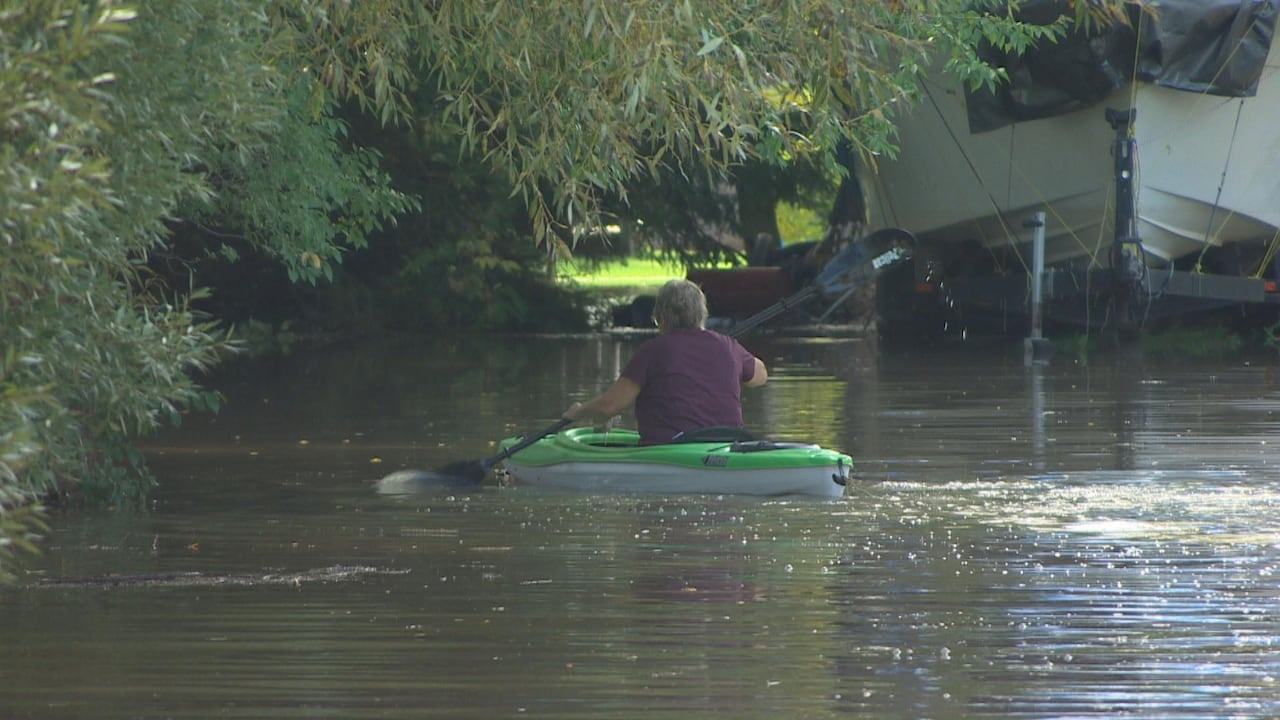 LaVerna Moreland paddles her kayak on a flooded street in Steinbach in the aftermath of a 2025 storm that left several southern Manitoba communities underwater. (Radio-Canada)
The animal shelter has also built up the ground around its basement windows.
However, infrastructure planning and improvements will not protect the entire city from downpours such as those seen the last two Septembers, Warkentin stresses.
“It’s coming down to the fact that the storm in 2024 and again in 2025, they were just so severe regarding their intensity as compared to what is typically the design standard in Steinbach and frankly, any other municipality that has stormwater systems,” he said.
“It just overwhelmed the systems that were in place.”