
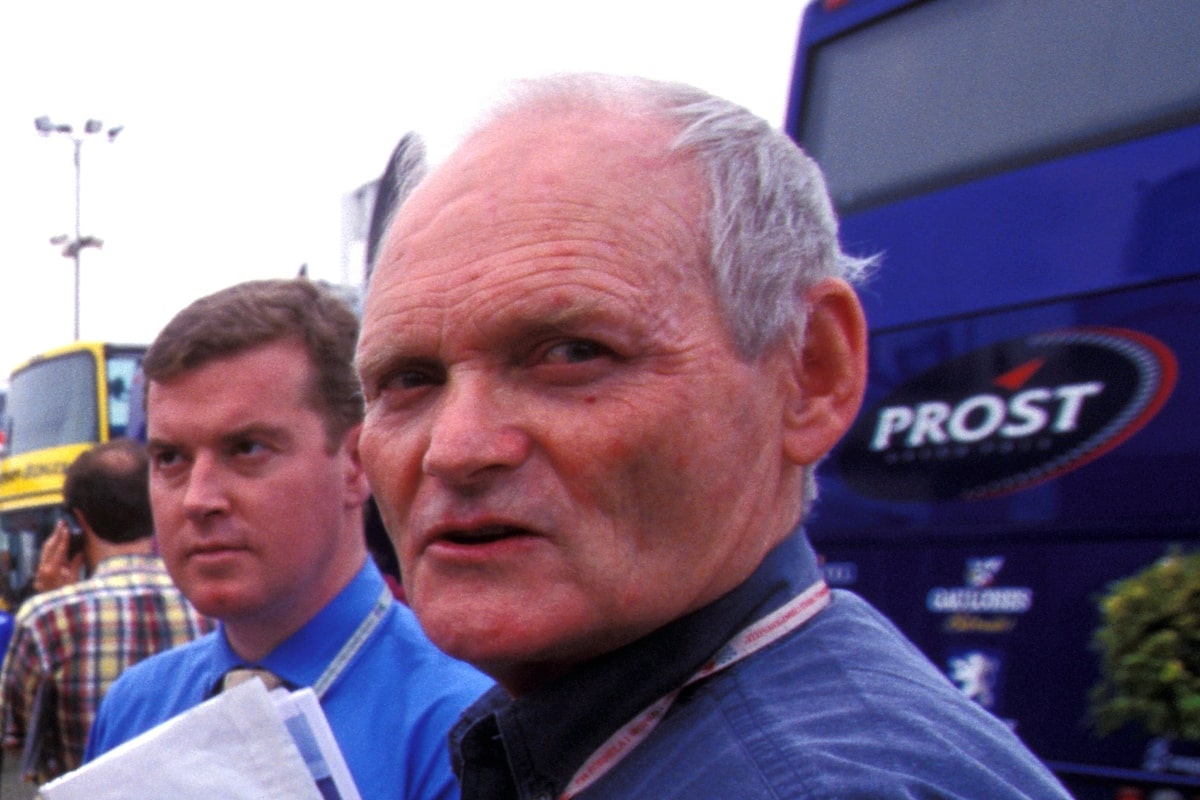
Journalist Gerald Donaldson at the Italian Grand Prix in Monza in September, 1998.Sutton Motorsports/Reuters
Gerald Donaldson was part of an exclusive journalistic group, the writers who cover Formula One, the top tier of world motor racing. Each year, they would write stories about the 24 Grand Prix races held on tracks ranging from the tight city streets of Monaco to the old Expo 67 grounds in Montreal, the one Canadian F1 race.
Mr. Donaldson, who died in Toronto on Dec. 14 at age 87, was the only regular Canadian F1 writer at the time in a field dominated by journalists from Britain and continental Europe, where the races are more popular. Along with chronicling the races, Mr. Donaldson profiled the racers, including Briton James Hunt and the Canadian racing superstar Gilles Villeneuve.
“The drivers were trying to improve their grid positions for tomorrow’s race,” Mr. Donaldson wrote in the prologue to his book on Mr. Villeneuve. “None was trying harder than the French Canadian in the red number 27 Ferrari. He came powering through the chicane on full throttle and disappeared over the hill toward Terlamenbocht, one of the most difficult curves on the Zolder circuit. It was to be his last lap.”
Mr. Donaldson was covering the race where Mr. Villeneuve died in a violent crash on May 8, 1982, at that track in Belgium and was one of the first people on the scene of the actual collision. Nothing could be done. Mr. Donaldson published the book on Mr. Villeneuve in 1989. Other racing books would follow, including one on Juan Fangio, the great Argentine champion of the 1950s known as El Maestro.
Mr. Donaldson first became hooked on racing at age 23 when he saw Stirling Moss, the British racing legend, win at Mosport, a track just outside Toronto, in June, 1961. But he had a lot of living to do before he took up writing about motor racing full time.
David Gerald Craig Donaldson was born on July 18, 1938, in Almonte, Ont., an old mill town about 50 kilometres from Ottawa. The town’s unusual name came in a burst of anti-American fervour in the 1850s, when the locals renamed what was then Waterford after Juan Almonte, the Mexican minister of war who was also ambassador to the United States. (Not long after that name change, James Naismith, the inventor of the game of basketball, was born in Almonte.)
Gerald’s father was David Donaldson, the plant superintendent at the Sealtest Dairy in Almonte; his mother, the former Mary Purdon, was a homemaker. Gerald went to Almonte High School. A rebellious boy, he quit before graduating and hitchhiked out west. He did a series of manual jobs, including tree planter and farmhand.
He returned to Toronto and registered at the Ontario College of Art (now OCAD University) as a mature student. He then worked in advertising as a writer, even starting two small ad agencies of his own. He lived in Yorkville before it was cool and hung around artsy places, drinking with people like the painter Harold Town in the Pilot Tavern.
He tried writing novels, spending long stretches in Mexico and in the south of France, renting Edith Piaf’s old house in Antibes. A famous Toronto publisher told him to try non-fiction, and he did. His first book was a ghostwriting job, a biography of the Canadian skiing star Steve Podborski in 1987. Mr. Donaldson would go on to write 20 books, including four biographies of Formula One racing stars.
Mr. Donaldson started covering Formula One in 1977. He decided to make it his primary job, covering as many of the races as he could. Almost all of the Formula One races are held outside North America. To cover them, he and his wife, Diane Fine, spent months every year in a rented a house in the Cotswolds in England.
Following the Formula One circuit costs money. Ms. Fine estimates it cost at least $70,000 a year.
“He had to fund all his travel, airfare and hotels. That took real devotion and he went to every race for decades,” said Brad Spurgeon, who covered Formula One for the International Herald Tribune and the New York Times. “He had to finance himself through newspaper and magazine articles and his books, which are read and well respected in the Formula One community.”
Mr. Donaldson also did podcasts, a blog called F1 Speedwriter, and racing commentary on TSN and the CBC.
Admission into that group of specialist writers means getting a pass from the Fédération Internationale de l’Automobile (FIA), which runs Formula One.
“That pass allows access to the paddock, which is restricted to journalists and of course the racing teams. Jackie Stewart [a British racing star] called it the Inner Sanctum. It gives people like Gerald the exclusive access needed to cover the sport,” said Mr. Spurgeon, who wrote the book Formula 1: The Impossible Collection.
Gerald Donaldson with driver David Coulthard at the Hungarian Grand Prix in Budapest in August, 1998.Sutton Motorsports/Reuters
Mr. Donaldson also covered other races. In 1986 he wrote about the Dakar rally, which at the time ran from Paris to Dakar in Senegal, across the Sahara Desert. It was dangerous for the drivers, and for the journalists. The cars crossed the Mediterranean by ferry, Mr. Donaldson and his colleagues crossed by plane to Algiers.
“We flew in a decrepit twin-engined Fokker. Told of anti-journalist sentiments of Algerian authorities; consider faking profession on entry form at airport. Belgian colleague tells Midnight Express horror story of a journalist who spent six days in Algerian jail when found using typewriter after registering as mechanic,” Mr. Donaldson wrote.
In a story for the Globe in 1985, Mr. Donaldson focused on the danger of the high-speed world of Formula One.
“When Austrian driver Jochen Rindt was killed at the Italian Grand Prix 15 years ago, one of his peers, Jacky Ickx, wrote a eulogy that is often quoted when motor racing claims another victim: ‘There can be little doubt he remained happy until the very moment of his accident, for we drivers are always happy behind the wheel. The two seconds of the final drama cannot have changed things, for there is something passionate about fighting a car that has gone mad. … There isn’t a single one of us who hasn’t left his hotel room in the morning well aware that he may not return, but this does not prevent us from achieving complete happiness. … The knowledge that everything could finish before the end of the day enables us to enjoy the wonders of life and all that surrounds it all the more.’”
Back home in Canada, Mr. Donaldson enjoyed a quiet life away from the noise and glamour of Formula One. He and his brother Gordon Donaldson built a small cabin in the woods.
“There was no road, no electricity. He loved the solitude and nature, watching the bears, deer and birds,” Gordon said.
“I went to races with him in Europe, in Monaco and Le Mans. His favourite track was Spa in Belgium, right in the Ardennes Forest. It’s fast, it’s dangerous and it’s thrilling,” he said. “I had no idea how famous he was, not in Canada, but in Europe.”
Gerald Donaldson was athletic. He played hockey late in life, ran marathons and worked out. He met Ms. Fine at a gym in Toronto. He was also well read, beyond his specialized world of motor racing.
“I remember being at a hotel in Germany with him before a race in 2000. And there was Gerald reading The Consolations of Philosophy by the British intellectual Alain de Botton,” Mr. Spurgeon recalled. “Gerald was self-effacing but a highly talented writer who everyone in the racing world respected.”
Mr. Donaldson was married twice. His first wife, Elizabeth Stuart, was the girl next door and the daughter of his mother’s best friend. She died of cancer. He leaves his brother, Gordon; his wife, Ms. Fine; and his stepchildren, Jeremy, David and Noah Fine, to whom he was close.
You can find more obituaries from The Globe and Mail here.
To submit a memory about someone we have recently profiled on the Obituaries page, e-mail us at obit@globeandmail.com.