
In gambling casinos, the house edge, depending on the game, is typically 1 to 5 per cent. With that in mind, I will be happy if half of my predictions for 2026 prove accurate, or even largely accurate. Here goes, and happy new year from snow-free Rome.
Plane logic Open this photo in gallery:
A Saab JAS39 Gripen from the Hungarian Air Force performs during the Airpower 19 air show in Zeltweg, Styria, Austria, in September, 2019.Ronald Zak/The Associated Press
Canada will do a deal to build the Swedish Saab Gripen E-series fighter jet and the Saab GlobalEye surveillance plane on Canadian soil, presumably at a Bombardier BBD-B-T factory in Ontario or Quebec. The Canadian military has not warmed to the Gripen, largely because it fears the expense of running a dual-fighter fleet. It wants Canada to stick with the U.S.-made F-35 stealth fighter jets, of which 16 are on their way, with options for another 72.
The generals are betting that Prime Minister Mark Carney doesn’t have the courage to anger U.S. President Donald Trump by adding the Gripen at the expense of some or many F-35 orders. But Saab has said that building the Gripen and GlobalEye in Canada would create 10,000 jobs, or possibly more if the Canadian factories pump them out for Ukraine and other export customers.
The chance to develop the largest military aerospace R&D talent pool and supply chain since the death of the Canadian-developed Avro Arrow interceptor in 1959 will be too hard to pass up. Yes, Mr. Trump will get angry and possibly retaliate, but so what? Anger and retaliation are his default positions.
Less free tradeOpen this photo in gallery:
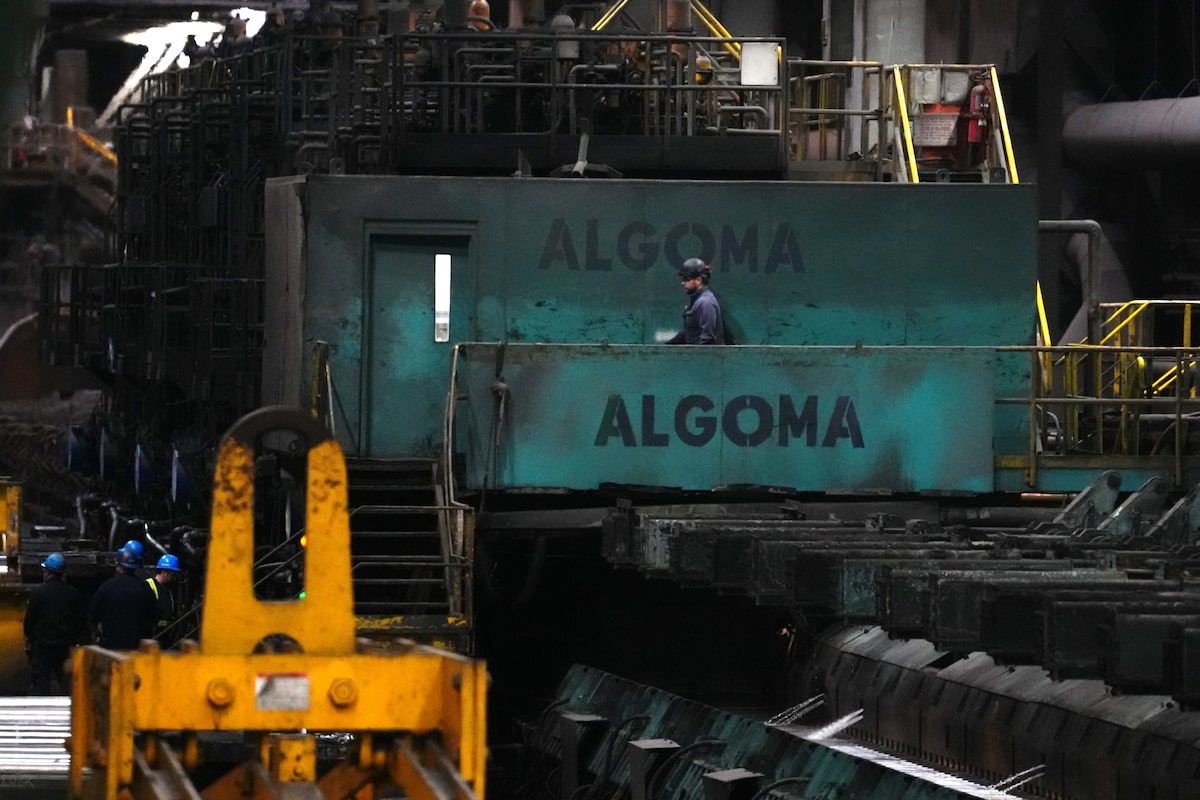
A worker at Algoma Steel in Sault Ste. Marie, Ont., in April, 2025.Sean Kilpatrick/The Canadian Press
The Trump-directed trade wars won’t flare up again in 2026, since tariffs are not a universal win for the U.S. They trigger retaliation from other countries and put upward pressure on consumer prices; the U.S. President wants inflation to fall in the run-up to the midterm elections in November. But a tariff lull does not mean the trade storm is over, at least in North America.
The U.S.-Mexico-Canada agreement is up for review in 2026. Mr. Trump and his MAGA-backers will demand a U.S.-centric replacement. No surprise there; the 25-per-cent tariffs on Canadian autos, steel and aluminum that hit in 2025 were a forewarning that Canada is doomed on the trade front. The USMCA won’t go without a fight, but it will go.
Merger mania reduxOpen this photo in gallery:
The Teck Resources logo on a podium at the company’s special meeting of shareholders in Vancouver.DARRYL DYCK/The Canadian Press
Mergers and acquisitions are coming off a banner year. Harvard’s 2025 M&A review said that compared to last year, deal volume is expected to rise by almost half in the U.S. alone to US$2.3-trillion, equivalent to Canada’s gross domestic product. Global volumes should rise by about a quarter. There is every reason to believe the frenzied pace will continue in 2026.
Interest rates in the U.S. and elsewhere are coming down, making financing costs cheaper. The U.S.’s anti-consolidation stance is vanishing (which is not to say antitrust reviews are history). Europe is practically begging for global champions in defence, banking, pharmaceuticals, energy and other industries, meaning regulatory reviews will be given the light touch there, too.
My guess is that mining and banking are the sectors to watch. The lunge for critical metals, especially copper, means that megadeals will remain on the agenda. A blockbuster merger between Glencore GLNCY of Switzerland and Britain’s Rio Tinto RIO-N is not out of the question, nor is the takeover of Anglo American NGLOY, considering its purchase of copper-heavy, Vancouver-based Teck Resources TECK-B-T has received shareholder approval.
On the resources front, my other guess is that once-mighty BP BP-N, the former British Petroleum, is not long for this world as an independent player. The company has had too many value destroying reversals (black-to-green and vice versa) to play in the big leagues – its market value is less than one-fifth of Exxon’s XOM-N.
In the financial world, watch out for the Canadian banks. They are huge, even by global standards. Royal Bank of Canada RY-T is worth US$240-billion, closing in on Wells Fargo’s WFC-N value. It’s only a matter of time before RBC and its Canadian rivals pounce on big targets in the U.S.
AI’s social backlashOpen this photo in gallery:
The OpenAI logo on a mobile phone in front of a computer screen with output from ChatGPT.Michael Dwyer/The Associated Press
The joy of the artificial intelligence industry’s stunning growth and investment returns will be replaced in 2026 by fear and loathing over job losses. Nothing puts a smile of the faces of CEOs and company shareholders more than sinking labour costs, and AI is putting the curve in the right direction for them.
The Financial Times reported this week that Morgan Stanley forecasts the European banks alone will eliminate 200,000 banking jobs, equivalent to 10 per cent of their payrolls, by 2030, as AI takes over. The job cuts are expected to come within the central services divisions, such as back-office roles. Repeat in other industries.
I predict that AI-related job cuts will see strikes in 2026, as employees demand contracts insulated from the technology. Automation has sparked labour agitation in the past, including the Luddite rebellions in the early 19th century and, in 2023, the Hollywood strikes, where writers and actors demanded work clauses that curtail AI use.
Tesla’s battery will drainOpen this photo in gallery:
Tesla CEO Elon Musk boards Air Force One from Morristown Municipal Airport in Morristown, New Jersey, in March, 2025.Nathan Howard/Reuters
Elon Musk’s Tesla had a pretty good year. The shares were up 9 per cent, giving the electric vehicle giant a market value of US$1.5-trillion. A repeat performance in 2026 is highly unlikely. Mr. Trump has no love for EVs, even if his bromance with Mr. Musk seems to have been restored. The U.S. federal tax credits for EVs are on their way out, and rules to reduce or eliminate vehicle emissions are being scrapped.
In the European Union, gas and diesel cars were given a new lease on life just a few weeks ago with the dilution of the 2035 zero-emissions requirement. Meanwhile, Chinese EVs are coming on strong pretty much everywhere except Canada and the U.S., where 100-per-cent tariffs banish them from showrooms. They have moved up the quality chain fast and are cheaper than Teslas.
Musk’s nightmare scenario – a Chinese ban on Tesla sales on national security grounds, because the cars are equipped with all sorts of cameras and sensors – has gone from the unimaginable to the possible.