
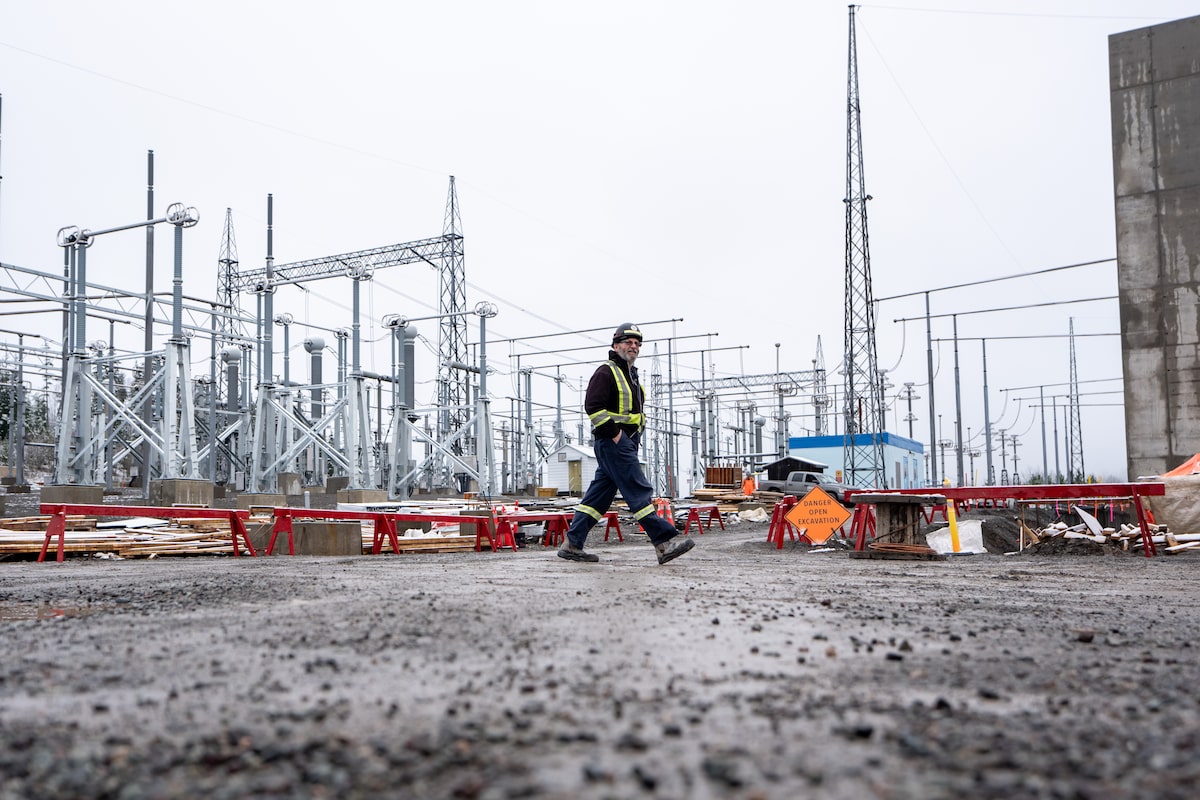
A worker walks in the BC Hydro Skeena Substation, under construction in Terrace, B.C., in November.ETHAN CAIRNS/The Canadian Press
All levels of government in Canada have made getting things built a key resolution for 2026.
But as it is, buildings in government-related sectors are already the only area where new construction investment has been expanding.
Total new, non-residential construction investment in the three categories of education, welfare and medical – all heavily dependent on government spending – grew by close to 150 per cent from the start of 2020 to October, 2025, according to an analysis of data recently released by Statistics Canada.
Over the same period, new private-sector oriented building construction in the three categories of warehouses, factories and office buildings largely flatlined, growing by just 12 per cent.
While not a perfect divide between public and private investment – a medical building may be privately owned, while governments regularly put money toward new factories – the converging trend between the two broad segments echoes the persistent problem Canada faces when it comes to weak business investment.
The three commercial and industrial segments have faced both headwinds and tailwinds since 2020. The office construction sector suffered a massive blow from the pandemic as the work-from-home phenomenon sent office vacancy rates soaring. On the flip side, warehouse construction ramped up as internet-based retail gained steam, but has since fallen.
Factory construction also saw a bump as the federal and some provincial governments pumped money into electric battery projects, but during the U.S. trade war, investment in new factories has plunged below where it was at the start of 2020.
Meanwhile, construction investment in the three sectors that fall within Statscan’s government and institutional category, which covers public and semi-public services, are all up significantly.
For instance, colleges and universities embarked on expansions to accommodate the influx of foreign students, though that may be put to the test as tighter immigration rules lead to collapsing enrolment levels, while several provinces have embarked on major school construction projects.
And as Canada’s population ages, provinces have had to ramp up health care spending with new hospitals and clinics, a trend reflected in national employment numbers. Roughly one-third of all jobs created between October, 2019, and October, 2025, were in health care and social assistance.
Decoder is a weekly feature that unpacks an important economic chart.