
 An Garda Síochána launched 14 investigations into the death of cyclists in 2025 when deaths surged after many years that had delivered progress on road safety
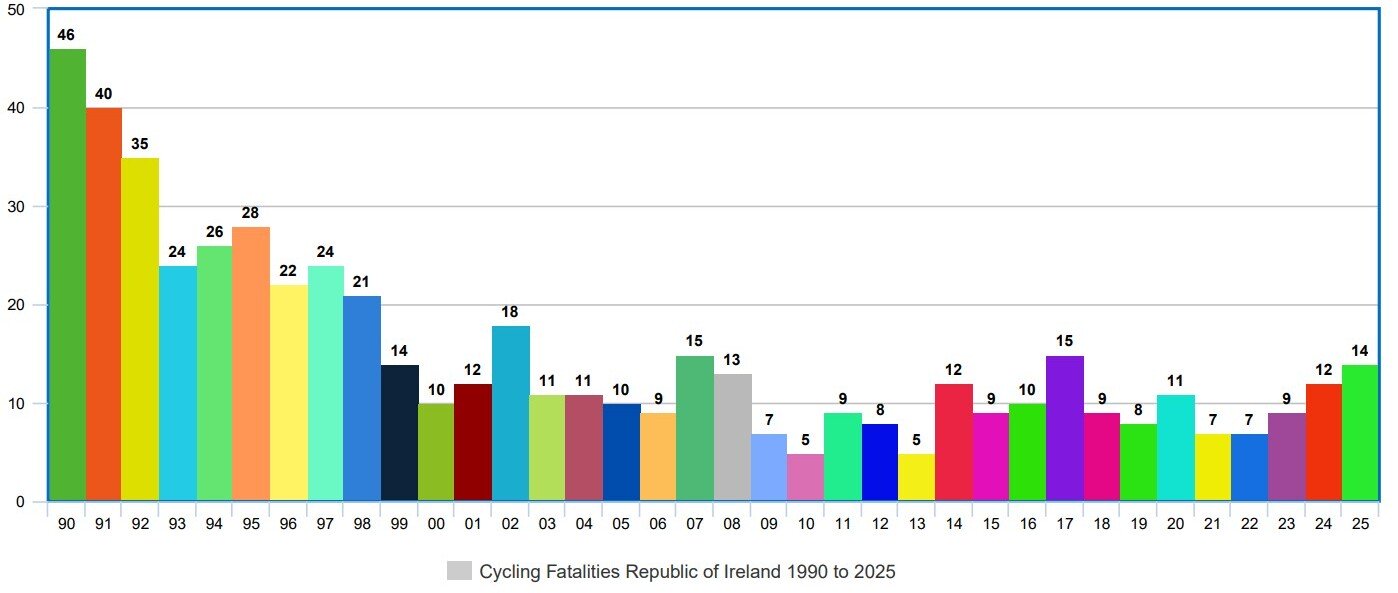
Cycling deaths reached one of their highest levels for the last 25 years in the Republic in 2025, having doubled in just five years. While significant progress had been made in reducing road fatalities for a number of years, and cyclist deaths were at record lows for a time, that era now appears to be over.
A total of 14 cyclists were killed on the roads in 2025, up from 12 in the previous year and seven in both 2021 and 2022. Though far more cyclists were killed in the 1990s – with 46 fatalities in 1990, for example – the sheer number of fatalities in 2025 was large in the context of the past 25 years.
During that period, in only three years were more cyclists killed than during the past year. There were 15 cycling fatalities in both 2017 and 2007 and 18 in 2002.
During the period since the late 1990s, when the number of people being killed on Irish roads began to decline, cycling deaths had fallen from close to 50 per year to a record low of five fatalities in 2010.
The worrying increase in cycling deaths over the past two years – almost always in crashes involving drivers – comes a time when the Republic’s general road safety record has deteriorated.
According to Garda records, by the morning of December 29th, some 189 people had died on Irish roads in 2025. Since then, another man was killed just outside Kildare Town, on the evening of December 30th, when he was struck by a driver in a car while walking.
That brought the number of road deaths in the Republic in 2025 to a provisional 190, the highest number in over a decade.
However, despite news of recent crashes being covered extensively in the media, the Garda’s Christmas-New Year roads enforcement operation has detected thousands of breaches of the law.
Some 600 arrests were made for intoxicated driving – including alcohol or drugs, or a combination of both – over the past four weeks. Of these, just over 40 per cent are suspected of being intoxicated while driving after using cannabis or cocaine.
“These are people making a conscious decision to take illegal drugs and to sit behind the wheel of a car that weighs approximately one tonne,” Supt Liam Geraghty said of the drivers that had recently come to the Garda’s attention.
“Six hundred people took alcohol or took drugs and still got behind the wheel of a car, putting themselves, and possibly their passengers and all other road users, at risk. In the same period over 4,600 drivers were detected driving in excess of the speed limit last week.”
Notable top speeds detected at speed checks in the past week included:
118km/hr in a 50km/hr zone on the North Circular Road, Dublin 7
140km/hr in a 60km/hr zone on the N15 in Mullandrait, Stranorlar, Co Donegal
167km/hr in an 80km/hr zone on the R430 road in Drumagh, Crettyard, Co Laois
207km/hr in a 100km/hr zone on the N18 in Ballinacurra Weston, Co Limerick
164km/hr in a 120km/hr zone on the M9 in Yellowbogcommon, Kilcullen, Co Kildare
Over 435 vehicles were seized by gardaí for a range of offences under the Road Traffic Act, 1961. In addition, approximately 150 Fixed Charge Notices were issued for the offence of using a mobile phone while driving and approximately 45 Fixed Charge Notices were issued for seat belt offences.