

With the 2026 season approaching, there is arguably more pressure on Ferrari than any other top team. Ferrari is the only established front-runner to have gone without a world title in the 2010s and early 2020s.
Even in normal circumstances, Ferrari’s Championship drought would be unacceptable. In the context of Charles Leclerc and Lewis Hamilton’s futures, however, 2026 becomes even more critical.
Perhaps because of this, the technical team led by Enrico Gualtieri have been aggressive in power unit development.
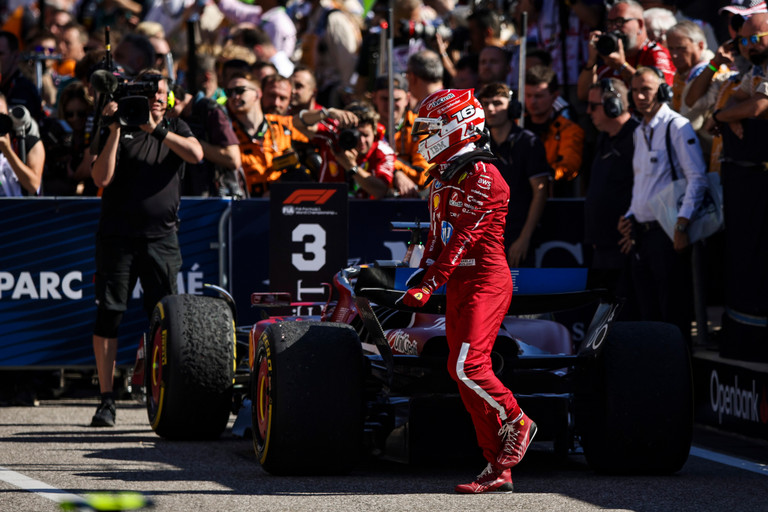 Charles Leclerc, Scuderia Ferrari, Ferrari Media Gallery.
Ferrari know the importance of 2026
Due to the secrecy of 2026 development, very little is known about the aerodynamic designs of this year’s cars. The likes of Adrian Newey and James Allison will work to keep their most innovative ideas secret for as long as possible.
What has been more widely reported, however, is engine development. Throughout the winter break, there has been no shortage of coverage on this area.
Mercedes are often at centre stage, having been declared favourites to produce the best 2026 engines many months ago.
Most recently, the Silver Arrows’ compression ratio trick (also under development at Red Bull) is generating headlines.
Whilst estimates vary, the consensus is that Mercedes could gain a few tenths per lap from using thermal expansion to increase their compression ratio when out on track.
Amidst this controversial development, talk has quietened down about Ferrari’s power unit.
In the later months of 2025, it was reported that Ferrari were encountering a few obstacles with their power unit. This was attributed to their high-risk approach, with the Maranello squad pursuing a radical and unique design.
New information confirms the aggressive nature of the Italian team’s power unit development.
As revealed by it.motorsport, Ferrari’s new engine cylinders will be made of steel alloy – as opposed to aluminium, which is the widely used standard.
This steel solution has been analysed for some time, and was initially seen as carrying significant risks.
However, Ferrari’s Davide Mazzoni tasked his technical personnel with comprehensively assessing this more extreme option. Ferrari are putting their faith into the idea that steel can withstand higher temperatures and pressures in the combustion chamber.
Not only is this useful for testing and development, but it also – in theory – should help the Scuderia’s reliability.
The main drawback to this solution is that steel alloy is heavier than aluminium. Carrying more weight, of course, loses lap-time.
Generally speaking, weight will be a big theme at the beginning of 2026 – some teams will be several kilograms heavier than others to start the year.
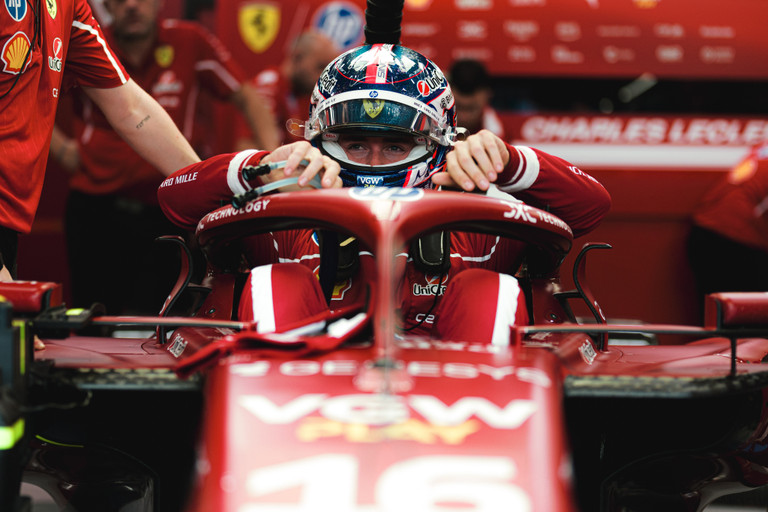 Charles Leclerc, Scuderia Ferrari, Ferrari Media Gallery.
No risk, no reward
It should be noted that at the start of the 2022 regulations, many teams were several kilograms overweight.
Only Sauber were at the minimum weight, which gave them an initial advantage- though other teams introduced upgrades to make their cars lighter and eliminate this advantage.
With this in mind, Ferrari believe their distinct power unit material has merit. Their objective will be to ensure this year’s engine has solid enough reliability to allow for brave upgrades in pursuit of horsepower, electrical efficiency and overall performance.
For some time, reliability has been one of the areas of concern regarding the Scuderia’s 2026 power unit. In this sense, pre-season testing will be a crucial test for Fred Vasseur’s team.
Ultimately, Ferrari cannot afford to play it safe. There are simply too many teams with the resources and knowledge economy capable of producing truly innovative concepts for 2026.
As a manufacturer, team, the Maranello squad have the challenge of getting it right on both the engine and aerodynamic front. Of course, this is also a blessing – which puts the team’s destiny firmly in their own hands.
When the FIA deemed Mercedes and Red Bull’s compression ratio trick legal, there were worries about the potential for other manufacturers to be left behind.
Not only were this fears overblown (based on estimates about the lap-time this solution unlocks) but it failed to take into account one fundamental reality. Every team, particularly the manufacturers, will have tricks up their sleeves in 2026.
Although Ferrari are sure to have many unique interpretations of these regulations, the use of a steel alloy is already a significant one.
Over time, the teams most comfortable with pushing the limits and bringing new ideas will separate themselves from the rest.
READ MORE: F1 – Red Bull could exceed expectations with 2026 engine
Main photo: Ferrari Media Gallery