
There is a growing excitement around the “blue economy,” a concept that promises a future of sustainable prosperity drawn from our oceans. However, a recent ministerial tour of St. Vincent and the Grenadines’ Leeward coastal fishery centers reveals a critical policy paradox: the nation’s “blue economy” future is shackled to the systemic neglect of its past.
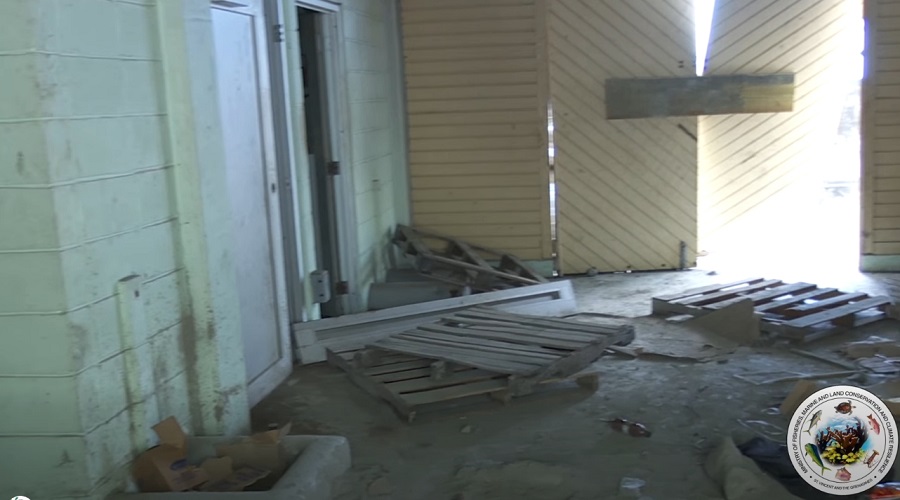
During a visit to the fishery center in Chateaubelair, the stark reality of past policy failures was unavoidable. The minister’s reaction was one of profound disappointment, describing the feeling as being both “appalled” and “ashamed.”
The facility, constructed in the late 1990s and officially opened around 2001, has stood for over two decades with “no form of maintenance, no form of use,” a silent monument to a vision abandoned almost as soon as it was inaugurated. This 25-year stasis is a physical manifestation of a broken feedback loop between central government planning and on-the-ground community needs.
“It is sad to see that we are at a state where now we have to redo, rethink, restore”, Huggins said.
If Chateaubelair is a monument to top-down failure, the functional fishery center in Barrouallie provides a blueprint for bottom-up success.
While the situation in Chateaubelair was described as “pretty dire,” in Barrouallie, the situation was markedly better, described as “not as bad” and a source of “great hope.” This is clearly shows that community involvement and local ownership are essential for the long-term sustainability of public infrastructure.
The tour’s next stop at Lowman’s Bay where officials met with fishers originally from the bottom town area, demonstrated that neglected facilities and neglected communities are two sides of the same coin. Fishers voiced a familiar story of displacement and broken promises, explaining they felt “pushed over here” by a “previous administration” whose commitments they stated, were never fulfilled.
The visit immediately uncovered long-festering issues, most notably marine pollution from construction debris—a problem invisible to policymakers but a daily reality for the fishers.
Huggins noted that the tour allowed the current leadership to identify issues that “were not highlighted before, were not addressed before,” underscoring a fundamental principle of effective governance.
“Real solutions can only be developed after leaders engage in direct, on-the-ground stakeholder consultation”.
Huggins said a plan is now in place to fully restore all fishery centers between 2026 and 2030, outfitting them with modern, energy-efficient technology like solar power.
However, the litmus test for this new NDP government is whether they can break a generational cycle of ambitious planning followed by fiscal and administrative abandonment.