
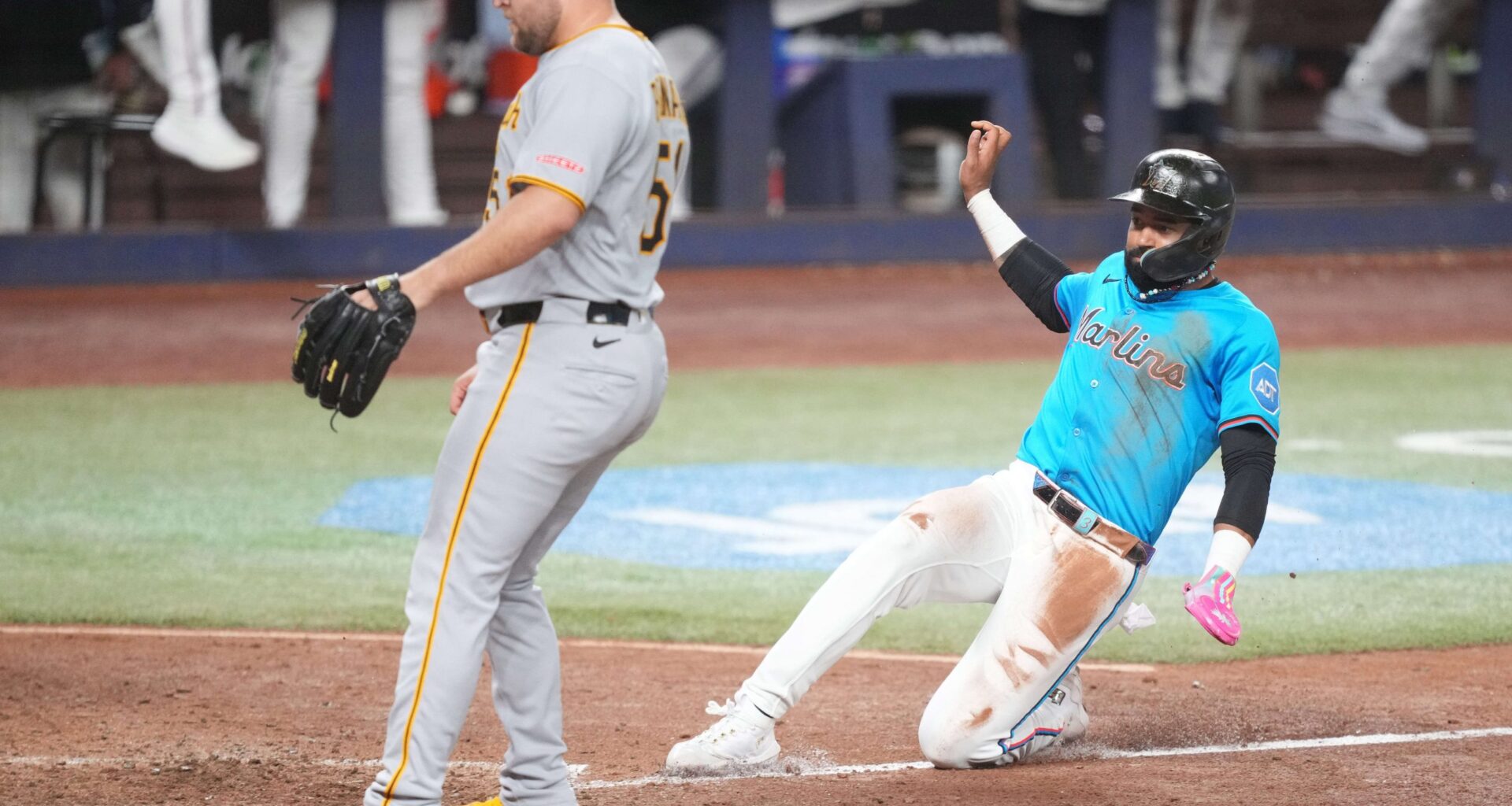
Image credit: © Jim Rassol-Imagn Images
Last summer, I was so taken with the manner and frequency with which David Bednar and Camilo Doval were giving up runs as closers that I wrote about its historical rarity, as their combination of saves (20+) and ERA (20% below average) had only happened 17 times prior, all the way back through 1871. The day that piece was published, Doval was demoted to Triple-A and removed from the closer role. During the writing of this piece, Bednar was, too. And still, this so-called Golden Age of Bad Closers would get more golden, as Craig Kimbrel’s September implosions for the Orioles sent his ERA high enough to make the list, alongside his 23 saves. That made 2024 the first year ever where three players made the lots-of-saves, lots-of-runs-allowed list.
We are at the perfect historical moment for bad closing. Teams recognize many things at once. The ninth inning outs are not necessarily the most important ones, but they do bring extra nerves such that you would not want to put just anyone there. They also recognize that, as with the batting order, players are more comfortable with roles, and that’s more valuable than seeking some marginal gain. When creative closer roles were more common a few years ago, they would sometimes lead to adversarial relationships with players, such as when a lack of saves cost Josh Hader money in arbitration.
This being the case, most teams still have a designated closer, with the exceptions generally being bullpens so bad that they can only hope someone steps forward to claim the role or great bullpens where teams don’t feel they have one definite best reliever. Even when the Tigers abandoned the starting pitcher last summer, Jason Foley was still the closer, and they’ve only pivoted away from that in the chaotic postseason environment and then this spring when they were worried enough to demote him to Triple-A.
Teams also have such awareness of non-ERA pitching metrics and such strong statistical understandings that they do not overreact to small samples. Five runs allowed in three straight blown saves may look bad, but the pitch shapes and velocity are holding, and the BABIP was at .582—it’s a small sample; trust that things will get better. David Bednar is therefore both anointed the closer and provided job security if he struggles after an initial run of success. Coming off a dreadful season, he allows more than a run per inning in the spring. Don’t worry; Spring stats don’t matter. He is still the closer.
Still, teams do not accept such run-allowance for long, eventually privileging their eyes over the FIPs and strand rates and spin rates. This is what characterizes the closer leash. You can blow one save, or even two, or even three, but it is one of the simplest changes a team can make, Every year teams that were projected to be around .500 sit around .500 but still unseat their closer, blaming late-inning losses for their fading postseason chances instead of poor roster construction. It is so much easier to oust a closer than a manager, and so much easier to oust a closer than to trade for Shohei Ohtani. As such, there is a very small set of closers to have reached this combination of saves and struggles, even in our Golden Era. The closer leash then, even as it may be lengthening on the aggregate, remains short.
At the end of the 2024 season, it seemed possible that all three had fallen, as all bad closers eventually do. Not only had Doval and Kimbrel been kicked out, but Bednar had been replaced with Aroldis Chapman in September. Then something very strange happened. At the start of Spring Training, before any games were even played, the Pirates announced that Bednar would be the closer again. He had, somehow, reclaimed the role in the dead of winter. One member of 2024’s iconic trio had been resurrected, and any Pirates fan will tell you that his entry to 2025 was as rotten as any part of 2024 ever was, so much so that he only lasted four days into the regular season before being sent to Triple-A.
My theory, which I will attempt to prove here, is that David Bednar had the longest leash in the history of closers. To do this, I will be going through all 20 entrants to the lots-of-saves, lots-of-runs-allowed list and looking for explanations as to why they held the job for so long and whether they were able to get it back with the same team. Due to closers only emerging historically within the last 40 to 50 years, the first player to ever have at least 20 saves and an ERA+ no higher than 80 was only in 1997, but the other nineteen names will be saved for Part II—first we must set the stage with our central figure.
David Bednar, 2024, Pirates: 23 saves, 5.77 ERA, 73 ERA+
I will give Bednar credit for what he has done well. He broke out in the 2021 season, putting up a 2.23 ERA and 2.69 FIP in 60 2/3 innings, benefiting from increased velocity and greater opportunity in the Pirates organization, sent there as part of the return for Joe Musgrove. Models like StuffPro always thought this breakout would be arriving, with his fastball and splitter already rating well even when he was scuffling in small samples for San Diego. In 2022, he backed up that success and took the closer’s role, leading to an NL-best 39 saves in 2023. His numbers were very consistent, registering a 78, 81, and 83 DRA- across those seasons, respectively.
There was a small strikeout dip in 2023, but that simply knocked him from an excellent 32.9% to a strong 28.9%, and his ground ball and pop up rates improved, so it didn’t dent his peripheral metrics at all. As before, his ERA and FIP remained comfortably below 3.00.
It’s really quite tough to pinpoint what went wrong in 2024—no doubt that is part of why his grip on the closer’s role has been so strong. His spring was delayed by right lat tightness, but Bednar was throwing harder, with pitch shapes that looked very similar, including a career-best -2.2 StuffPro on his splitter. It simply did not matter. His walk rate spiked from 7.6% to 10.7%; he was in the zone just as much, but his curveball wasn’t picking up as many chases, and batters weren’t whiffing at it or his fastball in the zone. His strikeout rate fell to 22.1%. He lost those added ground balls, and batters figured out how to pull the ball more against him. His locations were off, at least a bit more, even if it wasn’t much different, and he allowed nine home runs in under 60 innings.
That totals a 5.77 ERA, roughly 27% worse than league-average. Part of it was certainly bad luck, particularly his mere 62.2% strand rate, but even metrics which account for that were only moderately more friendly—a 109 DRA-, 4.80 FIP, 4.87 xFIP, and a 4.37 xERA. But still, he was the closer, and he managed to rack up eight losses, plus another three blown saves where he was not charged for the loss, for yet another inadequate Pirates team.
Like most bad closers, he didn’t make it through the season, losing his job in September to Aroldis Chapman. But the Pirates announced right at the start of Spring Training that he would be the closer again. In covering their explanations, beat writer Alex Strumpf summed up the reasoning in one line: “The confidence is back.”
I’m not sure how many spring bullpen sessions it takes to measure confidence, and in defiance of that evaluation, Bednar would allow nine earned runs in eight Spring Training innings. Don’t you know Spring results don’t mean anything? Of course he’s still the closer. The Pirates fit right into the sweet spot of most MLB teams nowadays—just respectful enough of the player need for roles that they will have a closer, but not silly enough to buy into Spring stats or a few bad games in a row, so long as the stuff still looks good on paper.
Bednar has pitched in three games in the regular season, all exclusively in the ninth inning. First, entering in a tie game, he gave up two hits and a walk without recording an out to give the Marlins an Opening Day walk-off. Second, with a three-run lead, he allowed a walk and a home run to the first two batters to create a nervy one-run save. Third, again pitching in a tie game, he allowed an infield single to the first batter he faced, followed by a stolen base on which the catcher threw the ball into center field, sending the runner to third; a few pitches later, Bednar gave up a walk-off wild pitch.
There is some bad luck here. The “wild pitch” had a block probability of 93%, per Statcast. The Opening Day triple had a 20% catch probability—not easy but possible, and the walk after it was intentional. But cries of bad luck have not saved many closers before Bednar, and they could not save him now. Still, that the Pirates would give him back the closer role for no apparent reason suggests that the length of his leash as closer could be the longest in MLB history, and it beckons tomorrow’s look into our other 19 qualifying bad closing seasons.
Thank you for reading
This is a free article. If you enjoyed it, consider subscribing to Baseball Prospectus. Subscriptions support ongoing public baseball research and analysis in an increasingly proprietary environment.