
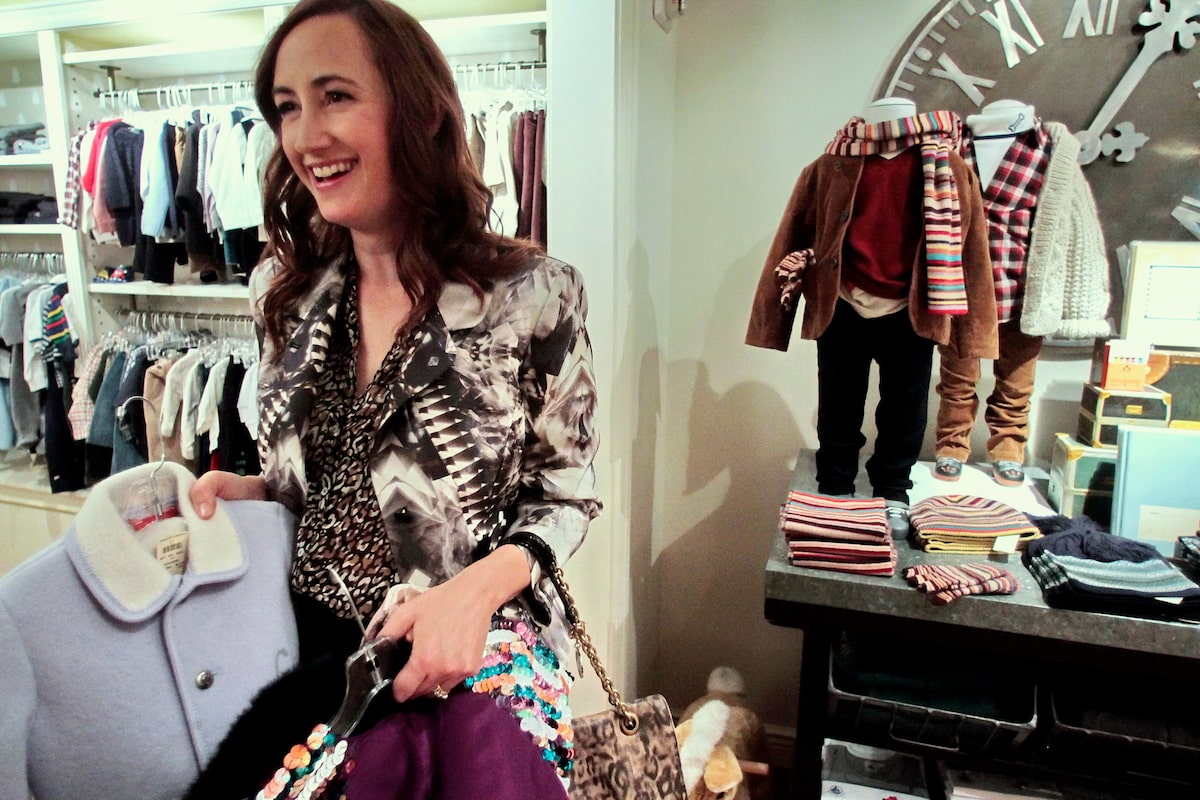
Sophie Kinsella shops at Bergdorf Goodman in New York, Sept. 21, 2010. The bestselling author died in December, 2025 at the age of 55.Bebeto Matthews/The Associated Press
Sophie Kinsella couldn’t help but find the joke in everything. Even when she was about to undergo brain surgery for glioblastoma, the aggressive form of cancer that she was diagnosed with at the end of 2022, the author found something to make her laugh
“I pretended that I was at the spa, and I actually said to the surgeon, ‘Oh, this is a fancy spa you’ve got here,’ and he laughed,” Kinsella said. “That’s who I am. I find the funny side of life.”
Kinsella, the author of the popular Shopaholic series, passed away on Dec. 10 at the age of 55 after selling more than 45 million copies of her books. Her first novel was released when she was 26 under her real name, Madeleine Wickham.
Last year, Kinsella published a fictionalized account of her experience with brain cancer. What Does It Feel Like? is a slim but extraordinary volume: tender, heartbreaking and – most miraculously – genuinely funny.
The writer credited her success to a single foundational principle. “You have to write an honest story, and then people might relate to it. That’s how things become a bestseller,” she said. “I write from the heart. I don’t think to myself, oh, I’ll write a bestseller. I think to myself, I want to tell a good story.”
And what makes a good story? “The best stories come from truth. The best comedy comes from pain.”
For many of her characters, that pain was the small twinge that comes with making a fool of oneself. In her real life, it was the gut-punch irony of, as she has her heroine say on her behalf in What Does It Feel Like?, the “queen of happy endings” not being able to write one for herself.
In September of last year, Kinsella spoke to The Globe from her home in England.
For people who haven’t read your books, and who might dismiss them as – and I hate this term – chick lit, this idea that these are books built on truth might surprise.
It’s interesting isn’t it? If you look at the subjects that I’ve taken on, like debt, it’s a problem that people have – countries have. It’s not frothy. Being a workaholic is a real issue, like my book The Burnout. Poor Sasha is inundated with e-mails, she’s trying to keep herself above water. A lot of people have reached out to me and said, “This is me. I understand that. That’s my office life.”
Well, there you are – that’s a place of pain. From that, you can find comedy, and I do, because that’s how I write. But I start from reality, with problems, and then my heroine will solve her problems because I like a happy ending.
There’s an effortlessness to your writing. “Breeziness” is the word that comes to mind. Is that actually the experience of writing for you?
What I work at is the timing of the scene, because for me, the timing has to be just right to get that funny moment, that laugh. I play around with the scene a lot. I look at it, and it isn’t right. I look at it again, and it’s still not right. I edit, and edit, and edit until I feel that it works.
You had success pretty early on in your life. How do you feel about those early books?
You never stop being fond of what you’ve produced. Probably if I wrote them today I would do things differently, but I see them very much of their time, and they belong to that time. It’s nice to revisit, and I feel lucky that these books were my entry into a career.
Kinsella attends the photocall of the movie Can You Keep A Secret? in Rome, during the Alice nella Città Festival on Oct. 19, 2019Stefania D’Alessandro/Getty Images
If we play a game of alternative lives – let’s say you didn’t write in your 20s – and then you started writing at 35, do you think you would have been a different kind of author?
I might have chosen different subject matter. I’ve always written out of my age group. The first book I ever wrote when I was 24, it wasn’t a book about a 24-year-old. It was about older people with children and midlife problems. I didn’t want to write an autobiographical book when I was starting out. I wanted to write fiction. I wanted to prove that I wasn’t just writing my life.
Funnily enough, I always did things in reverse, because the traditional path is your first book is your autobiographical book, and I did it the other way round. I saved up writing my autobiographical book until I was 30, and then I wrote the book about being a 25-year-old financial journalist.
When you write an iconic book like Shopaholic, what is that like for the rest of your career? What is the shadow – or the glow, if you want to put it another way – of that?
I like glow, because it’s been nothing but joy. I know there are some people who all they are interested in is Shopaholic, and I appreciate that. Equally, there are people who don’t get on with Shopaholic at all, and they prefer my stand-alone books. I’m lucky enough that I’ve got both in my life.
The particular joy of Shopaholic is that I had no idea when I was writing it that so many people would relate to it. I thought I was writing a little book about a girl in London with an overdraft, and I thought maybe a few other girls in London with overdrafts would relate. That’s when I realized that I could write a book that would relate to other people, and I’ve done that ever since. Becky was the first, and the most iconic, but she helped me find my writing voice.
In What Does It Feel Like? the afterword explains why you wrote it as a fictionalized account – creating some distance, allowing you to mould the story a bit. Writing that as a Sophie Kinsella book, did it allow you to say, I’m going to work now and deal with this experience in a professional way?
Yes. I could escape what was going on in my real life and say, I’m going to take a step sideways, step into my Sophie Kinsella shoes, and I’m going to turn this into a story, because that’s what Sophie Kinsella does. It was cathartic, taking these extraordinary events which I felt out of control of.
When so many dramatic things were happening to me medically, my life didn’t feel like mine. I felt like I was at the mercy of the doctors, and that life was chaotic. When you tell a story, you’re in charge. You decide what goes in, what stays out. You can give it a structure and, most importantly, you can give it a happy ending.
To borrow a construct from that book: How are you doing small scale? And how are you doing large scale?
Small scale, I’m doing really well. I feel well. I’m full of energy and enjoying life, and finding pleasure in small things, day-to-day happy moments. Macro, I don’t know how I’m doing, and I don’t know what the future holds for me, and I’ve decided not to focus on that.
Everyone wants happily ever after, but just like Eve and Nick in the book, my husband and I have many chats, and we’ve decided that we’re just going to focus on “happy for now.” I’m very lucky that I’m happy in my day-to-day life, and that’s as much as I can ask for.
This interview has been edited and condensed.