

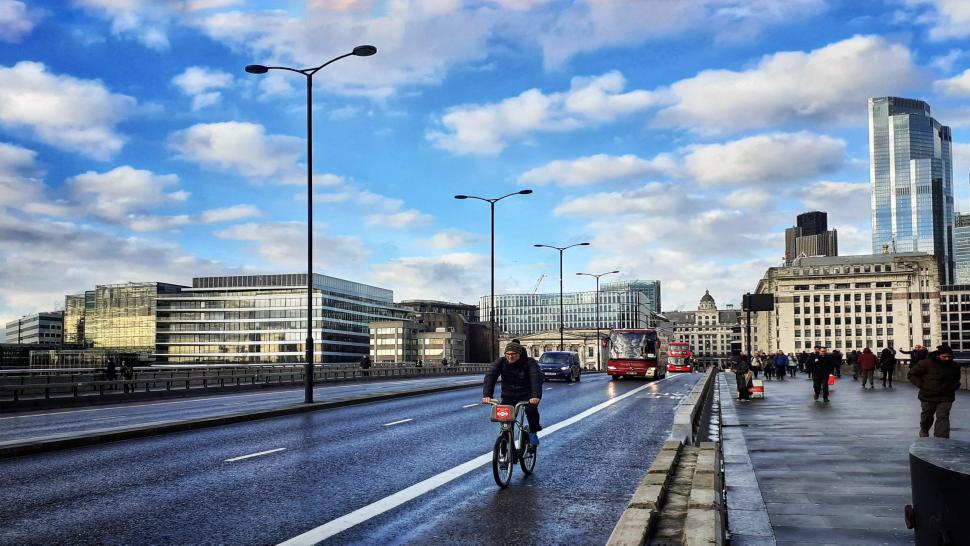
London Bridge (Credit: Simon MacMichael)
Southwark Council’s cycling lead has said that improving cycling safety is no longer optional but essential, as the borough’s population is forecast to rise by more than 50,000 people over the coming years.
Around 60% of current residents do not own a car, and most new developments are set to be car-free, increasing pressure on walking, cycling and public transport.
“There is a limited amount of space on our roads,” said Cllr James McAsh, Southwark’s Cabinet Member for Clean Air, Streets and Waste. “Unless we intervene, that space will simply be taken up by private cars.”
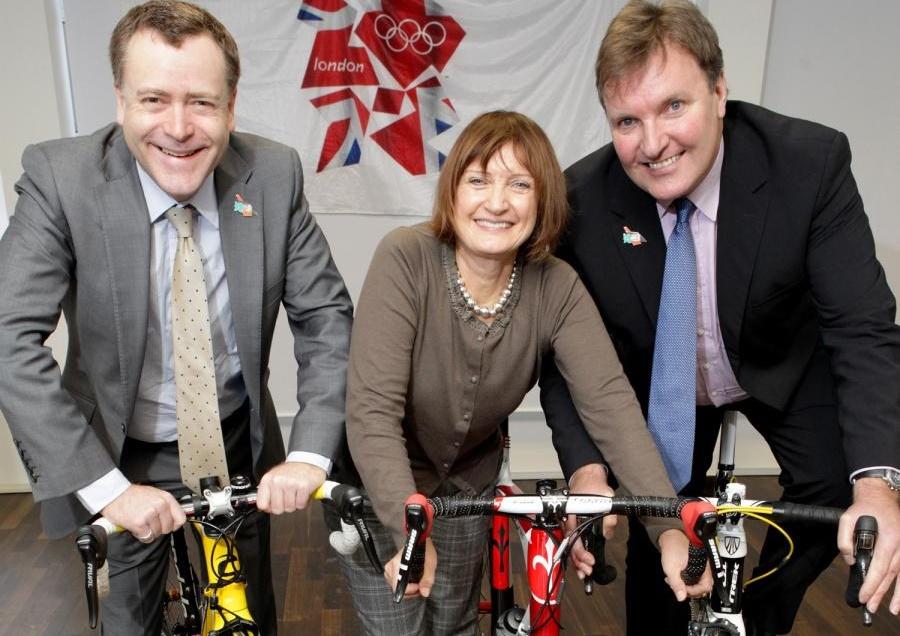
Councillor Peter John, leader of Southwark Council, Tessa Jowell MP, and Tony Doyle MBE
Cycling in the borough has more than doubled over the past decade, rising from one per cent of trips in 2008–11 to five per cent in 2022–24. However, Southwark has also recorded the highest number of cyclist casualties in the capital, with 411 cyclists injured in 2024.
These casualties are especially concentrated in the north of the borough, particularly between London Bridge and Elephant and Castle.
McAsh told the Southwark News that measures such as modal filters, low-traffic neighbourhoods (LTNs) and carefully designed one-way streets are intended to prevent drivers from using residential roads as shortcuts, while still allowing access for residents, emergency services and deliveries.
“Increasingly, people rely on satnavs, which push drivers down streets that were never designed for through-traffic,” he said. “We want longer, strategic journeys to stay on main roads, and neighbourhood streets to feel safe for walking and cycling.”
“On neighbourhood streets, car journeys should mostly be to or from that neighbourhood,” McAsh added. “By removing unnecessary through-traffic, we make streets safer for cycling and walking — and we also make it easier for people who genuinely need to drive to get where they’re going.”
While much of the council’s work has been welcomed, some schemes have faced criticism from local residents. A new cycle lane on Lower Road, for example, has prompted complaints that it has worsened congestion.
.JPG "Cyclehoop - Southwark (pic:Antony Lau)")
Cyclehoop – Southwark (Credit: Antony Lau)
However, McAsh said the congestion could not be blamed solely on the cycle lane. “This is a perfect storm. The cycle lane is the most visible change, but it is far from the only one,” he said.
“If you widen a road, you don’t necessarily fix congestion — you often just attract more vehicles,” he added, pointing to predictions that traffic at the Dartford Crossing could return to current levels within five years of the Lower Thames Crossing opening.
“The opposite is true when we create better conditions for walking and cycling. They move far more people, far more efficiently, using much less space.”