
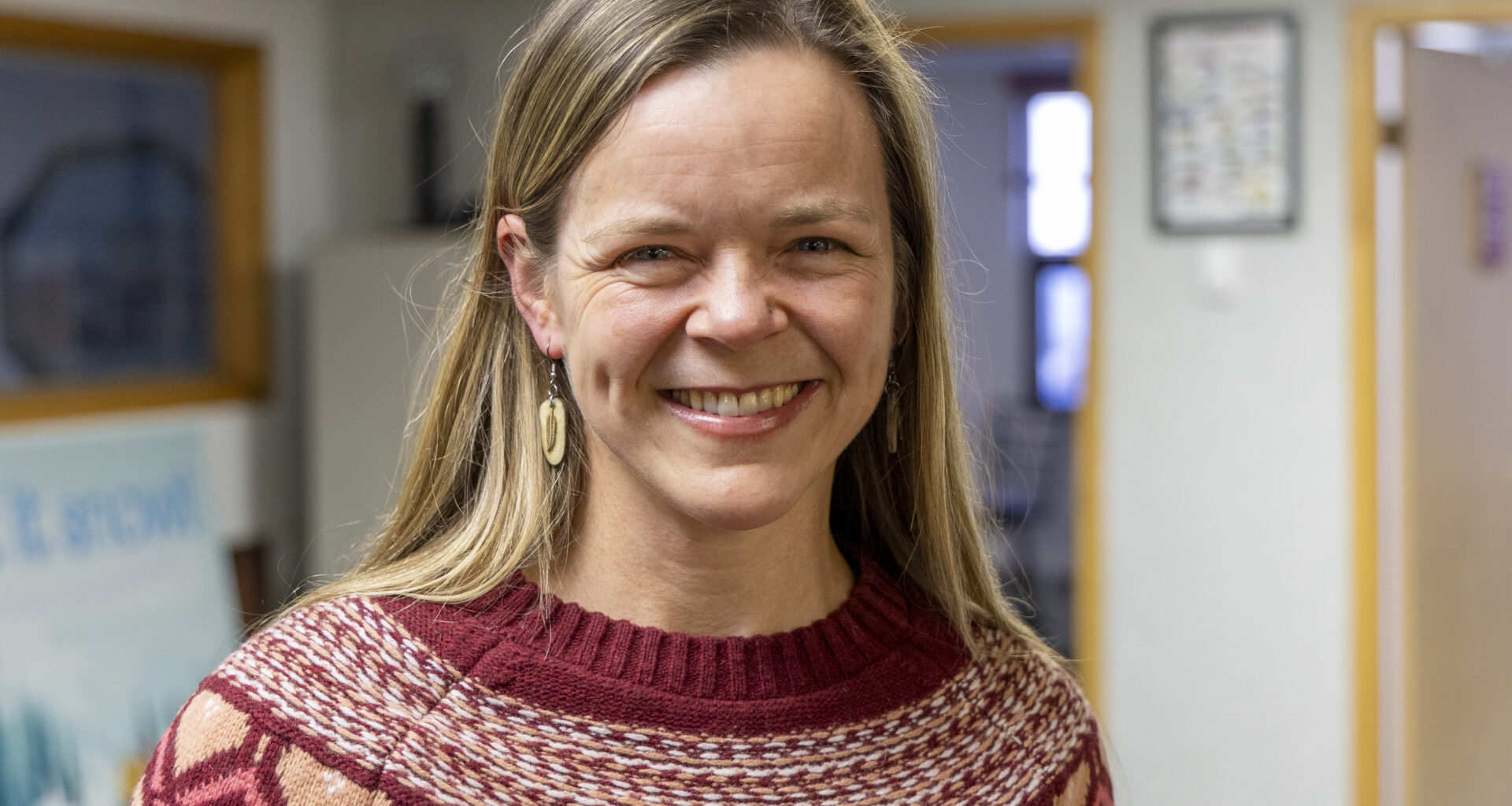
Yellowknife’s Dr Sarah Cook, recently appointed president of a national physicians’ body, is looking ahead to what she can achieve in the role.
Cook is the first person from any territory to lead the College of Family Physicians of Canada.
Cook previously served as Yellowknife’s medical director and the NWT’s first territorial medical director. She will continue as a family physician during her year heading the CFPC.
Cabin Radio sat down with Cook shortly after she was appointed to discuss its responsibilities and systematic issues that affect the quality of care northern patients receive.
She spoke about how practising in the North has provided her a different perspective than physicians from larger urban centres. She believes rural and remote issues are a good starting point by which to examine the “fractured” health system across Canada.
Advertisement.
Advertisement.
This interview was recorded on November 21, 2025. The transcript has been lightly edited for clarity.
Ollie Williams: You are the president now of the College of Family Physicians of Canada. Give us a sense of what that actually is. What does that body of people exist to do?
Dr Sarah Cook: It’s definitely not obvious from the title, necessarily. The College of Family Physicians of Canada is the organization in Canada that represents all family doctors – so over 45,000 family doctors in Canada – and has two main functions.
It is standard-setting, so setting the standard for residency training for family doctors. What does it mean to be a family doctor? And how do people need to be trained? As well as ensuring there’s continuing professional development for family doctors so they remain competent throughout their careers.
Advertisement.
Advertisement.
And the second role of the College of Family Physicians of Canada is advocacy. Advocacy for the patients that we serve, advocacy for the profession, making sure we are able to provide the excellent care we are aiming to provide to our patients.
On a personal level, and setting aside all humility for the next minute or so, what does it mean to you to be the first president of that body from the NWT?
It’s definitely an honour. It’s the first time there’s been a president from any of the territories.
Typically, this organization has had presidents that have come from – usually but not always – urban settings, and often from prestigious academic posts, which, of course, I am not because we don’t have an academic centre here.
I’m very much a front-line clinical family doctor who spent my career doing a variety of different aspects of family medicine and also leadership roles.
It’s definitely an honour to have been asked to take on this role and I think it speaks to the recognition of just how important rural and remote healthcare issues are in terms of understanding the landscape in all of Canada.
Rural and remote healthcare issues really magnify the healthcare issues that exist everywhere, whether it’s urban or rural.
Just to give people a sense of what we mean when we say, ‘from the NWT,’ I believe you moved to Yellowknife in 2008-ish?
Advertisement.
Advertisement.
Yes, you’ve done your homework. Yes, I’m from Nova Scotia originally, born and raised. Went to medical school at Dalhousie. Did my residency in Ottawa and, during my residency in Ottawa, I really was interested in spending time in the North and learning more about Indigenous health and learning from communities. And so I spent time in both in Nunavut and here.
I actually came to Yellowknife at the very end of my residency and worked with Dr Shireen Mansouri, who many people will know. She was here for many, many years, and she was my last preceptor of my training, and was a huge role model for me, and was very influential in my decision to come here after.
As well, I had an uncle, Dave Cook, who was an ear, nose and throat surgeon here for many years, and he had raised his family here. So lots of reasons that pointed to us coming here.
We originally, like many people, came for the two years – “oh, let’s go, it’ll be a really great way to experience living in the North and learning from the North.” And then, of course, we fell in love with it, raised our kids here and have been here for 17 years.
I’m interested in what you hope you can inject into your new role role from your northern experience. What are your objectives?
Given the two arms of this organization – the standard-setting and the advocacy – I look at this in two different ways.
In terms of standard-setting, looking at how do we educate family doctors? Coming from my perspective, I think there are two ways I would look at this – it might be different from somebody who is in an urban academic centre.
One would be the importance of people having training experiences in rural and remote settings, and the second is the importance of cultural safety training and having experience in it with Indigenous health, and looking at the health inequities in our country in terms of Indigenous and non-Indigenous health outcomes.
Advertisement.
Advertisement.
That’s something I bring to every conversation I have. I bring that perspective, and I really try to do so with stories, which can be really impactful.
I’ll share a brief story – that I shared actually in my president installation speech a couple of weeks ago with all of our family physician members – to try to give a sense of why rural and remote issues really are such a good way to look at some of the fractured-health-system issues for all of Canada. We know that access to relationship-based comprehensive primary care is what everyone wants to achieve in Canada, but it’s really an enigma in many parts of the country.
And when we say relationship-based comprehensive primary care, I understand that to mean: “I know my doctor. I feel like I can talk to them on first-name terms. They know me and I know them. And even if it’s not my doctor, maybe it’s someone else instead from my doctor’s surgery. I feel like I can just pick up a phone or send a message and I get heard by them.”
That’s exactly right, thank you for describing that, Ollie. That is exactly what we are trying to achieve in all of Canada and in fact, in primary care around the world, that kind of continuity: you know who your primary care provider and your team are, and having family physician expertise on every team.
When we look at team-based care, what we’re all trying to move towards is having the expertise of the family physician on that team – you know who your family doctor is, but it may not be a family doctor that you have to see for every particular issue. It may be somebody else on the team.
But we don’t have that in lots of parts of the country. One in five Canadians don’t have a family doctor. And so the story I’ll share is really an example of an impact of what happens when you don’t have continuity.
This is a story of a patient I met when I was working on the chemotherapy unit. I am also trained as a GP oncologist, so a family doctor with extra training in cancer care, and I oversee the delivery of chemotherapy and immunotherapy to cancer patients.
I met this patient on the chemotherapy unit. She’s from a remote community and she’s coming to Yellowknife every few weeks now for palliative chemotherapy, and she described to me this story. She was quite angry and very sad when she told me the story of how it came to be that she was on our chemotherapy unit.
Advertisement.
Advertisement.
She told me that in her remote community, she had been going in for two years to her remote health centre – [which is] nurse-run – complaining of abdominal pain, pain in her belly. And every time she went in, she saw a different nurse with a different opinion. I’m sure all very competent nurses, but different opinions every time.
She was often sent home with Tylenol – this is a story we hear often in the North – and was put on the visiting doctors’ list but she kept getting bumped by more urgent issues. Different doctors came. It was always a different doctor who came and went. They didn’t see her.
Eventually, someone saw her. They were concerned. They ordered a CT scan. She came to Yellowknife, had the CT and of course, by then, it was spread – the cancer. So it was cancer, it was metastatic – too late for cure.
She described this to me feeling quite upset and wondering whether it could have been different. This is an example of, you know, had she had a primary care team with consistency and a family doctor that knew her story, a team that knew her story and saw the progression of her symptoms, could it have been different? I think it would have been different.
And it’s not to say that any of the individuals that saw her weren’t doing a good job. It’s that when you don’t know the story and see the progression over time, you’re going to miss these things.
And not to put too fine a point on it – as you say, nobody individually necessarily did anything wrong – but the system essentially has had a massive difference on someone’s life. Really, the only option available to that person was to self-advocate to high heaven to get seen somehow, because they thought something was really wrong. And it ain’t as easy as all that, depending on who you are, where you live, and all these other factors. How do we change that?
I think bringing attention to these types of stories is really important.
A story like that? These stories are everywhere in Canada. The reason why I think the stories sometimes in rural and remote contexts are so powerful is because they they lay bare the issues in a more dramatic way and, in some ways, because there are bigger challenges in terms of distance and resources. So I think being able to share these stories in real ways, that make people understand just how significant these impacts are, is the beginning.
Advertisement.
Advertisement.
That’s some of the work we do at the College of Family Physicians of Canada. We don’t make decisions in this organization – how people are paid or what those models are. Those are provincial and territorial decisions. They’re not federal decisions or national organization decisions. But we can advocate, and we can say we think having team-based care with family physician expertise, interdisciplinary teams and continuity, relationship-based care is foundational to the health of our population in Canada.
Within that, we can advocate for models of payment that are going to facilitate that type of care, and also advocate for aspects of our profession that will hopefully attract more people.
That’s the other challenge with family medicine. We don’t have enough in Canada in part because we’re not training enough. There are lots of pieces of this puzzle, but one of them is that it’s hard to attract people to family medicine when they see challenges with how the profession is.
There is a significant gap in compensation between family physicians, generalists and specialists, so that makes it less attractive already. It’s also a tough job because we do a lot of different things – which is also the beauty of the job, that we have a lot of skills in different areas – but that makes it really challenging as a profession.
There’s also increasing complexity of the patients that we’re serving. Our population is getting sicker. They’re getting older, and so we need to change the model of how we’re doing care. We also have a lot of administrative burden, so spending time – instead of face-to face-with patients – filling out insurance forms, filling out paperwork, things we don’t need to be having physicians do if we had an efficient system. So there are lots of ways we can advocate to try to make the profession more attractive and more sustainable.
Related Articles