

A collapse of the Amoc mega-current wouldn’t just bring back polar-style winters to Europe — Dutch researchers warn there’s an even graver risk.
Once treated with skepticism, the idea that Amoc (the Atlantic Meridional Overturning Circulation) could slow down or even fail is now a central focus of climate science. Earth’s climate hinges on many interconnected systems, including the great ocean currents — and Amoc is one of the most crucial.
This vast conveyor carries warm water from the South Atlantic into the far North Atlantic, where it cools and forms temperature cells that redistribute heat and carbon toward northern waters near the Arctic and Europe. Because the Amoc includes the famed Gulf Stream, it strongly shapes Europe’s weather, especially across the north and west, including France.
Collapse of key Atlantic current could bring extreme drought to Europe for centuries, study finds.
That’s an under-appreciated impact of an #AMOC shutdown, of particular concern given the recent results showing much higher likelihood of this. 1/2https://t.co/thkGepMJIQ pic.twitter.com/RnRowExEJc
— Prof. Stefan Rahmstorf 🌏 🦣 (@rahmstorf) December 5, 2025
That northward flow of warm water is what softens European winters. Without it, winters would look more like Canada’s — far colder, with sea ice pushing down toward the British Isles. In recent years, the debate has shifted from if Amoc is weakening under climate change to when this weakening — or a full collapse, depending on the expert — might occur.
Toward a thousand-year drought!
A new study from Utrecht University asks a different question: beyond colder air, what else happens when Amoc weakens? Earlier research mostly pointed to stronger winter cooling in Europe and the Arctic. But the Dutch team found that Amoc also delivers vital moisture; weaken it, and precipitation patterns shift dramatically. Europe wouldn’t just get colder — it would get drier. The model results are stark: without Amoc, the dry season lengthens by 72% in Sweden and 60% in Spain, with the north hit hardest by droughts.
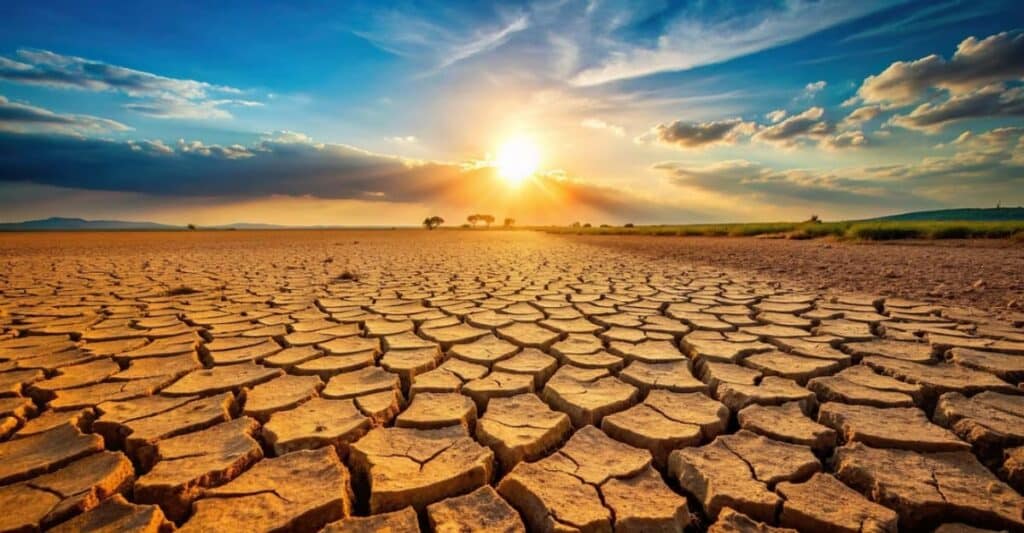
Droughts have far greater consequences for agriculture, the economy, and our society than a simple drop in winter temperatures. © Latsamee, Adobe Stock
While a collapse is unlikely before the next century, the consequences would endure: the resulting aridity could persist for at least a thousand years, reshaping ecosystems, agriculture, and water security across the continent.

Karine Durand
Specialist for extreme weather and environment
A specialist in extreme weather phenomena and environmental issues, this journalist and TV host has been explaining climate topics since 2009. With over 15 years of experience in both French and American media, she is also an international speaker.
Trained in communication and environmental sciences, primarily in the United States, she shares her passion for vast natural landscapes and the impacts of climate change through her work on biodiversity and land management.