
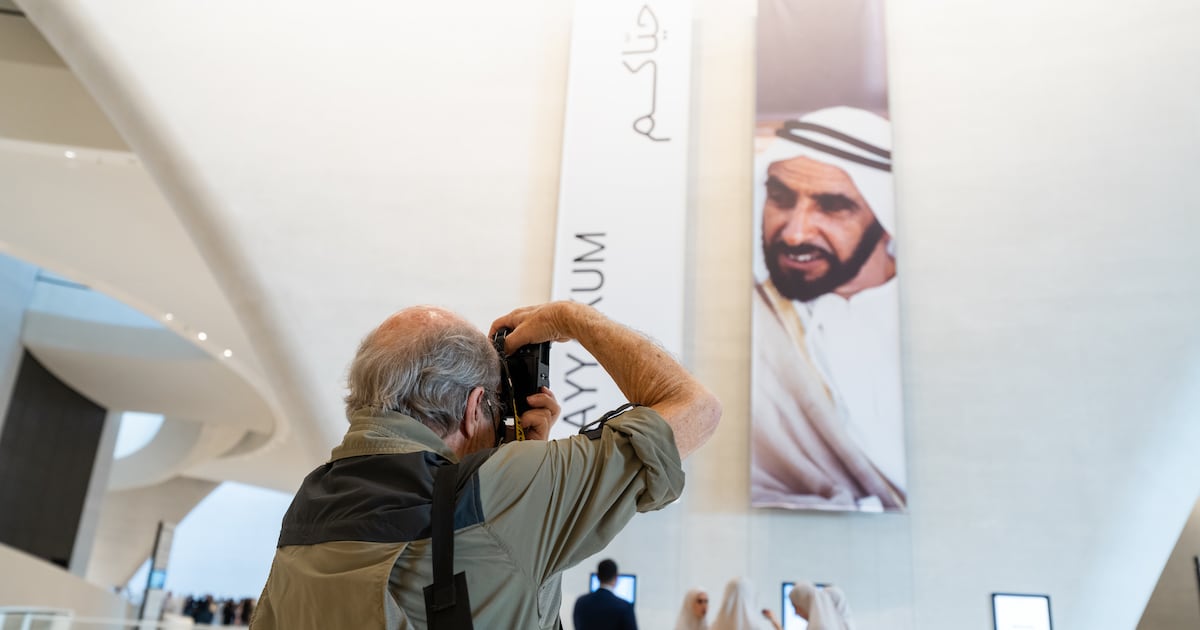
In Abu Dhabi, French photographer Jack Burlot, 78, stands inside the newly opened Zayed National Museum, confronted with a past he did not expect would resonate so deeply. Seeing his photographs of UAE Founding Father, the late Sheikh Zayed bin Sultan Al Nahyan, displayed within a national institution proved more powerful than anticipated.
“I had goosebumps,” he tells The National. “I was almost crying.”
The museum on Saadiyat Cultural District traces the story of the UAE as both land and nation, drawing on artefacts contributed largely by Emirati families and local institutions.
For Burlot, what matters most is not scale or spectacle, but intent. The experience also brought his personal journey with the UAE, and his connection to Sheikh Zayed, into sharper focus.
He reflects on Sheikh Zayed’s Bedouin heritage and vision for the UAE, noting that while oil played a role in the nation’s development, it was leadership that truly shaped its course. “He could see the future of his country,” says Burlot.
That clarity left a lasting impression. Burlot says leadership such as Sheikh Zayed’s is rare, and the photographer often reflects on how different the world might be if more leaders shared that vision. Whenever he returns to Abu Dhabi, he visits Sheikh Zayed’s resting place, something that’s become a personal ritual, not simply a symbolic gesture.
Burlot’s relationship with the UAE began in 1974, when he arrived in Abu Dhabi at a moment when the city – and the country around it – was still taking shape. He did not come as a documentarian of history, but as a young photographer awaiting clearance to take up a role recording work in the oil sector.
“I started taking photographs in the street, just to have something to do,” he says.
What he encountered quickly shifted his focus. The people he met were unlike anywhere else, he says. Their openness, rhythms of daily life and willingness to engage drew him in. Burlot spent long days observing the city, meeting people and photographing what unfolded naturally around him.
In those early years, Burlot recalls curiosity rather than resistance. People were often unsure what a camera meant or what would become of the images. “They were surprised, but not afraid,” he says.
Language was a barrier. Most people did not speak English and Burlot did not speak Arabic. Yet he describes the atmosphere as calm and non-confrontational. Photography, he says, simply was not part of everyday experience yet, which allowed moments to exist without self-consciousness.
Looking back, Burlot acknowledges how unusual some of those photographs now seem: fashion images made in public spaces; portraits captured without formal permission; scenes of daily life unfolding freely. He attributes the access he was given not to skill, but to circumstance. The society he encountered had not yet developed a relationship with the camera.
As his time in Abu Dhabi continued, Burlot’s work eventually brought him into contact with the country’s leadership, including Sheikh Zayed.
Back then, the photographer was a young man with long hair, well aware that he stood out. Sheikh Zayed, he says, found him amusing. Yet the absence of a shared culture did not prevent connection; Burlot describes a sense of immediate humanity, something he says he had not experienced with other heads of state.
Over time, his relationship with the UAE deepened beyond professional work. The people he met became friends. He recalls time spent in the desert, cooking over open fires and talking late into the night. Those experiences remain among his most meaningful memories.
Burlot says that as a photographer, he rarely thinks about legacy while working, but rather responds to what is in front of him. Only later does the meaning settle. Seeing his photographs now positioned as part of the country’s collective memory has allowed him to confront that reality.
Burlot is particularly struck by how the museum presents Sheikh Zayed’s life, from his early years in the desert to the formation of the modern state. That journey invites more reflection than celebration. It asks visitors to consider how nations are built, and what responsibilities come with that inheritance.
Today, Burlot sees a country transformed by technology, business and globalisation, but not disconnected from its roots. “People still go to the desert,” he says. “The approach is different, but the connection remains.”
For Burlot, the museum captures that continuity. It does not freeze the past, but situates it within a longer story. A quote attributed to Sheikh Zayed embedded within the museum – that a future cannot be understood without knowing the past – resonates deeply with him.
For a photographer who arrived by chance and stayed through connection, the recognition feels complete. His work now sits not just in archives, but within the narrative of the country itself.
“It’s an honour to be part of that remembrance,” he says.
UAE v Gibraltar
What: International friendly
When: 7pm kick off
Where: Rugby Park, Dubai Sports City
Admission: Free
Online: The match will be broadcast live on Dubai Exiles’ Facebook page
UAE squad: Lucas Waddington (Dubai Exiles), Gio Fourie (Exiles), Craig Nutt (Abu Dhabi Harlequins), Phil Brady (Harlequins), Daniel Perry (Dubai Hurricanes), Esekaia Dranibota (Harlequins), Matt Mills (Exiles), Jaen Botes (Exiles), Kristian Stinson (Exiles), Murray Reason (Abu Dhabi Saracens), Dave Knight (Hurricanes), Ross Samson (Jebel Ali Dragons), DuRandt Gerber (Exiles), Saki Naisau (Dragons), Andrew Powell (Hurricanes), Emosi Vacanau (Harlequins), Niko Volavola (Dragons), Matt Richards (Dragons), Luke Stevenson (Harlequins), Josh Ives (Dubai Sports City Eagles), Sean Stevens (Saracens), Thinus Steyn (Exiles)
More coverage from the Future ForumThe alternatives
• Founded in 2014, Telr is a payment aggregator and gateway with an office in Silicon Oasis. It’s e-commerce entry plan costs Dh349 monthly (plus VAT). QR codes direct customers to an online payment page and merchants can generate payments through messaging apps.
• Business Bay’s Pallapay claims 40,000-plus active merchants who can invoice customers and receive payment by card. Fees range from 1.99 per cent plus Dh1 per transaction depending on payment method and location, such as online or via UAE mobile.
• Tap started in May 2013 in Kuwait, allowing Middle East businesses to bill, accept, receive and make payments online “easier, faster and smoother” via goSell and goCollect. It supports more than 10,000 merchants. Monthly fees range from US$65-100, plus card charges of 2.75-3.75 per cent and Dh1.2 per sale.
• 2checkout’s “all-in-one payment gateway and merchant account” accepts payments in 200-plus markets for 2.4-3.9 per cent, plus a Dh1.2-Dh1.8 currency conversion charge. The US provider processes online shop and mobile transactions and has 17,000-plus active digital commerce users.
• PayPal is probably the best-known online goods payment method – usually used for eBay purchases – but can be used to receive funds, providing everyone’s signed up. Costs from 2.9 per cent plus Dh1.2 per transaction.
Desert Warrior
Starring: Anthony Mackie, Aiysha Hart, Ben Kingsley
Director: Rupert Wyatt
Rating: 3/5
One in nine do not have enough to eat
Created in 1961, the World Food Programme is pledged to fight hunger worldwide as well as providing emergency food assistance in a crisis.
One of the organisation’s goals is the Zero Hunger Pledge, adopted by the international community in 2015 as one of the 17 Sustainable Goals for Sustainable Development, to end world hunger by 2030.
The WFP, a branch of the United Nations, is funded by voluntary donations from governments, businesses and private donations.
Almost two thirds of its operations currently take place in conflict zones, where it is calculated that people are more than three times likely to suffer from malnutrition than in peaceful countries.
It is currently estimated that one in nine people globally do not have enough to eat.
On any one day, the WFP estimates that it has 5,000 lorries, 20 ships and 70 aircraft on the move.
Outside emergencies, the WFP provides school meals to up to 25 million children in 63 countries, while working with communities to improve nutrition. Where possible, it buys supplies from developing countries to cut down transport cost and boost local economies.
Brief scores:
Manchester City 2
Gundogan 27′, De Bruyne 85′
Crystal Palace 3
Schlupp 33′, Townsend 35′, Milivojevic 51′ (pen)
Man of the Match: Andros Townsend (Crystal Palace)
The details
Colette
Director: Wash Westmoreland
Starring: Keira Knightley, Dominic West
Our take: 3/5
COMPANY%20PROFILE
%3Cp%3E%3Cstrong%3ECompany%20name%3A%3C%2Fstrong%3E%20Bedu%3C%2Fp%3E%0A%3Cp%3E%3Cstrong%3EStarted%3A%3C%2Fstrong%3E%202021%3C%2Fp%3E%0A%3Cp%3E%3Cstrong%3EFounders%3A%3C%2Fstrong%3E%20Khaled%20Al%20Huraimel%2C%20Matti%20Zinder%2C%20Amin%20Al%20Zarouni%3C%2Fp%3E%0A%3Cp%3E%3Cstrong%3EBased%3A%3C%2Fstrong%3E%20Dubai%2C%20UAE%3C%2Fp%3E%0A%3Cp%3E%3Cstrong%3EIndustry%3A%3C%2Fstrong%3E%20AI%2C%20metaverse%2C%20Web3%20and%20blockchain%3C%2Fp%3E%0A%3Cp%3E%3Cstrong%3EFunding%3A%3C%2Fstrong%3E%20Currently%20in%20pre-seed%20round%20to%20raise%20%245%20million%20to%20%247%20million%3C%2Fp%3E%0A%3Cp%3E%3Cstrong%3EInvestors%3A%3C%2Fstrong%3E%20Privately%20funded%3C%2Fp%3E%0A
Zayed Sustainability PrizeUAE cricketers abroad
Sid Jhurani is not the first cricketer from the UAE to go to the UK to try his luck.
Rameez Shahzad Played alongside Ben Stokes and Liam Plunkett in Durham while he was studying there. He also played club cricket as an overseas professional, but his time in the UK stunted his UAE career. The batsman went a decade without playing for the national team.
Yodhin Punja The seam bowler was named in the UAE’s extended World Cup squad in 2015 despite being just 15 at the time. He made his senior UAE debut aged 16, and subsequently took up a scholarship at Claremont High School in the south of England.
Sustainable Development Goals
1. End poverty in all its forms everywhere
2. End hunger, achieve food security and improved nutrition and promote sustainable agriculture
3. Ensure healthy lives and promote well-being for all at all ages
4. Ensure inclusive and equitable quality education and promote lifelong learning opportunities for all
5. Achieve gender equality and empower all women and girls
6. Ensure availability and sustainable management of water and sanitation for all
7. Ensure access to affordable, reliable, sustainable and modern energy for all
8. Promote sustained, inclusive and sustainable economic growth, full and productive employment and decent work for all
9. Build resilient infrastructure, promote inclusive and sustainable industrialisation and foster innovation
10. Reduce inequality within and among countries
11. Make cities and human settlements inclusive, safe, resilient and sustainable
12. Ensure sustainable consumption and production patterns
13. Take urgent action to combat climate change and its effects
14. Conserve and sustainably use the oceans, seas and marine resources for sustainable development
15. Protect, restore and promote sustainable use of terrestrial ecosystems, sustainably manage forests, combat desertification, and halt and reverse land degradation and halt biodiversity loss
16. Promote peaceful and inclusive societies for sustainable development, provide access to justice for all and build effective, accountable and inclusive institutions at all levels
17. Strengthen the means of implementation and revitalise the global partnership for sustainable development
ANDROID%20VERSION%20NAMES%2C%20IN%20ORDER
%3Cp%3EAndroid%20Alpha%3C%2Fp%3E%0A%3Cp%3EAndroid%20Beta%3C%2Fp%3E%0A%3Cp%3EAndroid%20Cupcake%3C%2Fp%3E%0A%3Cp%3EAndroid%20Donut%3C%2Fp%3E%0A%3Cp%3EAndroid%20Eclair%3C%2Fp%3E%0A%3Cp%3EAndroid%20Froyo%3C%2Fp%3E%0A%3Cp%3EAndroid%20Gingerbread%3C%2Fp%3E%0A%3Cp%3EAndroid%20Honeycomb%3C%2Fp%3E%0A%3Cp%3EAndroid%20Ice%20Cream%20Sandwich%3C%2Fp%3E%0A%3Cp%3EAndroid%20Jelly%20Bean%3C%2Fp%3E%0A%3Cp%3EAndroid%20KitKat%3C%2Fp%3E%0A%3Cp%3EAndroid%20Lollipop%3C%2Fp%3E%0A%3Cp%3EAndroid%20Marshmallow%3C%2Fp%3E%0A%3Cp%3EAndroid%20Nougat%3C%2Fp%3E%0A%3Cp%3EAndroid%20Oreo%3C%2Fp%3E%0A%3Cp%3EAndroid%20Pie%3C%2Fp%3E%0A%3Cp%3EAndroid%2010%20(Quince%20Tart*)%3C%2Fp%3E%0A%3Cp%3EAndroid%2011%20(Red%20Velvet%20Cake*)%3C%2Fp%3E%0A%3Cp%3EAndroid%2012%20(Snow%20Cone*)%3C%2Fp%3E%0A%3Cp%3EAndroid%2013%20(Tiramisu*)%3C%2Fp%3E%0A%3Cp%3EAndroid%2014%20(Upside%20Down%20Cake*)%3C%2Fp%3E%0A%3Cp%3EAndroid%2015%20(Vanilla%20Ice%20Cream*)%3C%2Fp%3E%0A%3Cp%3E%3Cem%3E*%20internal%20codenames%3C%2Fem%3E%3C%2Fp%3E%0A
PROFILE OF INVYGO
Started: 2018
Founders: Eslam Hussein and Pulkit Ganjoo
Based: Dubai
Sector: Transport
Size: 9 employees
Investment: $1,275,000
Investors: Class 5 Global, Equitrust, Gulf Islamic Investments, Kairos K50 and William Zeqiri
Explainer: Tanween Design Programme
Non-profit arts studio Tashkeel launched this annual initiative with the intention of supporting budding designers in the UAE. This year, three talents were chosen from hundreds of applicants to be a part of the sixth creative development programme. These are architect Abdulla Al Mulla, interior designer Lana El Samman and graphic designer Yara Habib.
The trio have been guided by experts from the industry over the course of nine months, as they developed their own products that merge their unique styles with traditional elements of Emirati design. This includes laboratory sessions, experimental and collaborative practice, investigation of new business models and evaluation.
It is led by British contemporary design project specialist Helen Voce and mentor Kevin Badni, and offers participants access to experts from across the world, including the likes of UK designer Gareth Neal and multidisciplinary designer and entrepreneur, Sheikh Salem Al Qassimi.
The final pieces are being revealed in a worldwide limited-edition release on the first day of Downtown Designs at Dubai Design Week 2019. Tashkeel will be at stand E31 at the exhibition.
Lisa Ball-Lechgar, deputy director of Tashkeel, said: “The diversity and calibre of the applicants this year … is reflective of the dynamic change that the UAE art and design industry is witnessing, with young creators resolute in making their bold design ideas a reality.”
if you go
Libya’s Gold
UN Panel of Experts found regime secretly sold a fifth of the country’s gold reserves.
The panel’s 2017 report followed a trail to West Africa where large sums of cash and gold were hidden by Abdullah Al Senussi, Qaddafi’s former intelligence chief, in 2011.
Cases filled with cash that was said to amount to $560m in 100 dollar notes, that was kept by a group of Libyans in Ouagadougou, Burkina Faso.
A second stash was said to have been held in Accra, Ghana, inside boxes at the local offices of an international human rights organisation based in France.
Real estate tokenisation project
Dubai launched the pilot phase of its real estate tokenisation project last month.
The initiative focuses on converting real estate assets into digital tokens recorded on blockchain technology and helps in streamlining the process of buying, selling and investing, the Dubai Land Department said.
Dubai’s real estate tokenisation market is projected to reach Dh60 billion ($16.33 billion) by 2033, representing 7 per cent of the emirate’s total property transactions, according to the DLD.
DAY%20ONE%20RESULT
%3Cp%3E%3Cbr%3E1.%20Charlotte%20Kool%20(NED)%20%E2%80%93%20Team%20DSM%3A%202hrs%2C%2047min%2C%2014sec%3Cbr%3E2.%20Lorena%20Wiebes%20(NED)%20%E2%80%93%20Team%20SD%20Worx%3A%20%2B4%20secs%3Cbr%3E3.%20Chiara%20Consonni%20(ITA)%20%E2%80%93%20UAE%20Team%20ADQ%3A%20%2B5%20secs%3C%2Fp%3E%0A
Cricket World Cup League 2 Fixtures
Saturday March 5, UAE v Oman, ICC Academy (all matches start at 9.30am)
Sunday March 6, Oman v Namibia, ICC Academy
Tuesday March 8, UAE v Namibia, ICC Academy
Wednesday March 9, UAE v Oman, ICC Academy
Friday March 11, Oman v Namibia, Sharjah Cricket Stadium
Saturday March 12, UAE v Namibia, Sharjah Cricket Stadium
UAE squad
Ahmed Raza (captain), Chirag Suri, Muhammad Waseem, CP Rizwan, Vriitya Aravind, Asif Khan, Basil Hameed, Rohan Mustafa, Kashif Daud, Zahoor Khan, Junaid Siddique, Karthik Meiyappan, Akif Raja, Rahul Bhatia
Ten tax points to be aware of in 2026
1. Domestic VAT refund amendments: request your refund within five years
If a business does not apply for the refund on time, they lose their credit.
2. E-invoicing in the UAE
Businesses should continue preparing for the implementation of e-invoicing in the UAE, with 2026 a preparation and transition period ahead of phased mandatory adoption.
3. More tax audits
Tax authorities are increasingly using data already available across multiple filings to identify audit risks.
4. More beneficial VAT and excise tax penalty regime
Tax disputes are expected to become more frequent and more structured, with clearer administrative objection and appeal processes. The UAE has adopted a new penalty regime for VAT and excise disputes, which now mirrors the penalty regime for corporate tax.
5. Greater emphasis on statutory audit
There is a greater need for the accuracy of financial statements. The International Financial Reporting Standards standards need to be strictly adhered to and, as a result, the quality of the audits will need to increase.
6. Further transfer pricing enforcement
Transfer pricing enforcement, which refers to the practice of establishing prices for internal transactions between related entities, is expected to broaden in scope. The UAE will shortly open the possibility to negotiate advance pricing agreements, or essentially rulings for transfer pricing purposes.
7. Limited time periods for audits
Recent amendments also introduce a default five-year limitation period for tax audits and assessments, subject to specific statutory exceptions. While the standard audit and assessment period is five years, this may be extended to up to 15 years in cases involving fraud or tax evasion.
8. Pillar 2 implementation
Many multinational groups will begin to feel the practical effect of the Domestic Minimum Top-Up Tax (DMTT), the UAE’s implementation of the OECD’s global minimum tax under Pillar 2. While the rules apply for financial years starting on or after January 1, 2025, it is 2026 that marks the transition to an operational phase.
9. Reduced compliance obligations for imported goods and services
Businesses that apply the reverse-charge mechanism for VAT purposes in the UAE may benefit from reduced compliance obligations.
10. Substance and CbC reporting focus
Tax authorities are expected to continue strengthening the enforcement of economic substance and Country-by-Country (CbC) reporting frameworks. In the UAE, these regimes are increasingly being used as risk-assessment tools, providing tax authorities with a comprehensive view of multinational groups’ global footprints and enabling them to assess whether profits are aligned with real economic activity.
Contributed by Thomas Vanhee and Hend Rashwan, Aurifer
Quick facts on cancer
Cancer is the second-leading cause of death worldwide, after cardiovascular diseases
About one in five men and one in six women will develop cancer in their lifetime
By 2040, global cancer cases are on track to reach 30 million
70 per cent of cancer deaths occur in low and middle-income countries
This rate is expected to increase to 75 per cent by 2030
At least one third of common cancers are preventable
Genetic mutations play a role in 5 per cent to 10 per cent of cancers
Up to 3.7 million lives could be saved annually by implementing the right health
strategies
The total annual economic cost of cancer is $1.16 trillion
Navdeep Suri, India’s Ambassador to the UAE
There has been a longstanding need from the Indian community to have a religious premises where they can practise their beliefs. Currently there is a very, very small temple in Bur Dubai and the community has outgrown this. So this will be a major temple and open to all denominations and a place should reflect India’s diversity.
It fits so well into the UAE’s own commitment to tolerance and pluralism and coming in the year of tolerance gives it that extra dimension.
What we will see on April 20 is the foundation ceremony and we expect a pretty broad cross section of the Indian community to be present, both from the UAE and abroad. The Hindu group that is building the temple will have their holiest leader attending – and we expect very senior representation from the leadership of the UAE.
When the designs were taken to the leadership, there were two clear options. There was a New Jersey model with a rectangular structure with the temple recessed inside so it was not too visible from the outside and another was the Neasden temple in London with the spires in its classical shape. And they said: look we said we wanted a temple so it should look like a temple. So this should be a classical style temple in all its glory.
It is beautifully located – 30 minutes outside of Abu Dhabi and barely 45 minutes to Dubai so it serves the needs of both communities.
This is going to be the big temple where I expect people to come from across the country at major festivals and occasions.
It is hugely important – it will take a couple of years to complete given the scale. It is going to be remarkable and will contribute something not just to the landscape in terms of visual architecture but also to the ethos. Here will be a real representation of UAE’s pluralism.