
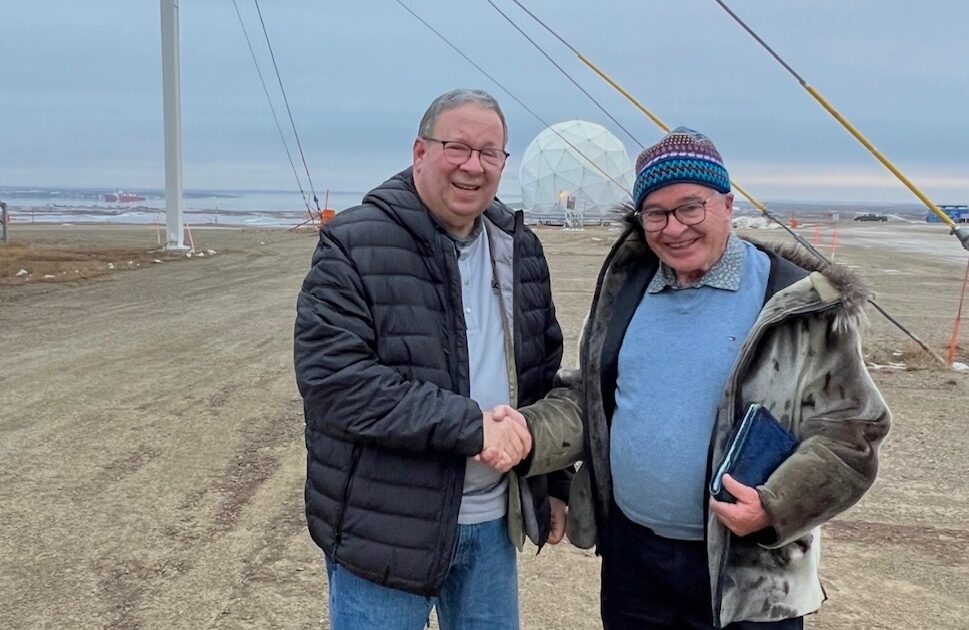
Former U.S. ambassador to Canada David Cohen, left, and former senator Dennis Patterson pose for a picture at the CAM – MAIN North Warning Site in Cambridge Bay in 2023. (Photo courtesy of Dennis Patterson)
Arctic Matters | Sovereignty and security dominate international relations because of foreign threats
As we look ahead to 2026 for Canada and its great North, I am reflecting on how things have changed in my nearly 50 years of looking at our country from a northern perspective.
In the 1980s, Canada’s then-Circumpolar Affairs Program of Indian and Northern Affairs supported northern Canadians and territorial governments to engage with our friends and neighbours in the Russian Arctic.
With goodwill, we worked to see what we could learn from one another.
Notably, on one visit to the Republic of Yakutia in the far North, we visited a huge institute devoted to the study of permafrost. We learned about Russian techniques for rapidly building ice roads, and that everyday kerosene could also be used to provide the refrigerant for thermal piles now used extensively in northern Canada to insulate larger buildings from permafrost heave.
The Russians were so impressed when they visited the community of Lac La Martre (now Whati) that they hired then Yellowknife-based engineers and architects Ferguson Simek and Clark to build an identical village in Yakutia: a school, 20 houses and a local electrical grid to exactly replicate the community infrastructure in Whati.
Ferguson Simek and Clark then went on to build an air terminal and more than 1,000 housing units in Russia, generating over $100 million in revenue.
We bonded with our Russian neighbours on those visits, marvelling at the words in common between the traditional languages of Yakutia, Chukhotia and Inuktut, stating, as we did in toasts and speeches, that we were two great northern nations which had more in common than the things which divided us!

That was also when Soviet leader Mikhail Gorbachev boldly ushered in a new era of glasnost — meaning openness.
I was thrilled with Gorbachev’s speech in Murmansk in 1987, where he proposed an Arctic Zone of Peace, saying: “Let the North of the globe, the Arctic, become a zone of peace. We suggest that all interested states start talks on the limitation and scaling down of military activity in the North … a nuclear free zone.”
Closer to home, then-prime minister Brian Mulroney worked with then-U.S. president Ronald Reagan on legislation to largely eliminate acid rain from sulphur emissions in Great Lakes industries, which had begun to turn Ontario’s lakes into dead zones.
When the U.S. proposed to test cruise missiles in the N.W.T. as part of a joint defence agreement in the 1980s, there was a lot of negative reaction in the North and in Ottawa to this.
The view which prevailed in Ottawa and in the N.W.T. when I was government leader was that the Americans were our allies in NATO and Norad. There would be no threat to our northern communities, because it was only the navigation systems of the unarmed missiles that were being tested.
Then former prime minister Justin Trudeau and his bro, former U.S. president Barack Obama, collaborated secretly on a joint declaration in 2016 to establish a moratorium on oil and gas development to protect our common Arctic environment.
In 2023, former U.S. president Joe Biden’s ambassador to Canada, David Cohen, visited Iqaluit and Cambridge Bay, pledging to work with us to modernize our Norad North Warning System and expressed strong interest in the Kitikmeot project to develop a deepsea port which could help assert sovereignty in the Northwest Passage.
That was then. But now, how things have changed!
U.S. President Donald Trump has warned, singling out Canada, that unless NATO countries increase their defence spending, the U.S. will no longer defend us if we are threatened.
Trump also began his latest term insulting and belittling Trudeau by calling him “governor” and repeatedly stating his ambition to make Canada the 51st state while not ruling out the use of force to “take” our neighbour Greenland in the name of U.S. security.
Thirteen years of Russian President Vladimir Putin’s singular focus on developing the Soviet North now sees its Arctic coast bristling with military airfields, bases, ports and launching sites for hypersonic missiles which our aging North Warning System will not be able to detect until they are over the horizon at speeds too fast to warn their targets.

Putin’s unprovoked attack on Ukraine has alarmed Russia’s European and Nordic neighbours, who have begun major defence spending increases and spurred longtime neutral countries Sweden and Finland to join NATO.
I once hosted Russian delegations to the N.W.T., where we staged a mock Canada-Russia floor hockey match at the opening of a new school in Sanikiluaq. Now, I am wearing a “badge of honour” for being singled out by Putin in 2023 as one of several Canadian political leaders banned from travelling to Russia.
This year, Prime Minister Mark Carney pledged to increase defence spending from our current level of less than two per cent to five per cent of Canada’s gross domestic product, and recently announced Canada will create a new reservist army that’s 300,000 strong.
How could these developments — a warmongering Russian leader and a Russia-friendly U.S. president — impact the Arctic?
Several reports speculate Trump’s friendliness with Putin and questionable support for Ukraine has a hidden agenda: the U.S. will support a peace deal giving Russia the roughly 20 per cent of Ukraine it has occupied during their war of aggression, and in return Putin will grant the U.S. government and American companies access to Russia’s North — its critical minerals and oil and gas.
The Wall Street Journal reports that those plans are outlined in appendices to the recent U.S. peace proposal for Ukraine. And a senior columnist in Singapore fears a U.S.-Russia deal to open up the Arctic will also result in new shorter shipping routes to Asia, bypassing Singapore, currently the world’s second-busiest port.
In this sinister scenario, Greenland and northern Canada will be next on the U.S. radar under the American mantra of dominance in the western hemisphere.
I am not such an alarmist.
However, looking ahead to 2026, let us recognize that this perhaps far-fetched scenario seems to have put northern Canada on the national radar as never before. Anita Anand, our global affairs minister, has stated the Arctic is Canada’s top foreign policy priority and has announced plans to open a new consulate in Greenland.
Let’s hope this renewed focus on the Arctic will result in infrastructure investments that will strengthen Canada’s security and sovereignty in the Arctic while providing benefits to communities.
Dennis Patterson was the senator for Nunavut from 2009 to 2023 and was premier of the Northwest Territories from 1987 to 1991.