
Minutes after the Denver Broncos secured the AFC’s top seed Sunday, my old college roommate, a huge fan of the team dating to the Orange Crush days, sent a text that sounded like an insult but actually reflected what could be one of the most fun playoff fields in memory.
“I cannot believe this Broncos team has the No. 1 seed,” the text read.
Two emojis followed: 🤦😆
No offense, Broncos, even if sweating out a Week 18 home victory over the Los Angeles Chargers, who were resting starters, would have seemed unbecoming of a top seed in most years.
No offense, any other team in the playoffs this season.
You’ve all got a shot, especially in the AFC (well, maybe not you, Pittsburgh).
“This is a great year for a wild-card team,” a veteran coach said. “You win one game in the AFC, you have a chance.”
After an alternately confounding and exhilarating Sunday night game in which Aaron Rodgers’ Steelers outlasted Lamar Jackson’s Baltimore Ravens for the AFC North title and the final playoff spot, the Pick Six column leans into the unpredictable fun that awaits, especially on the AFC side.
We’ll run through both conferences, sprinkling in thoughts from executives around the league, before ending with Raheem Morris’ firing and the futures of John Harbaugh and Mike Tomlin.
The full menu:
• Leaning into playoff madness
• What Sean McVay’s Rams can learn
• Jets’ INT total: Zero point zero
• Panthers to playoffs; is that good?
• Myles Garrett, meet Al Baker
• Two-minute drill: Morris and beyond
1. The Seahawks are in prime position to win it all in coach Mike Macdonald’s second season. I’m not sure we know much more than that.
The Seahawks’ 13-3 throttling of the 49ers on Saturday night felt like 27-3, except Seattle missed two field-goal tries and turned the ball over on downs after blowing a first-and-goal from the 1 on the opening drive. That’s the thing about the Seahawks: They can beat themselves.
“You’re like, ‘Man, they turn it over enough that they feel beatable, especially given (Sam) Darnold’s track record in the playoffs,’” an exec from another team said. “But then on the other hand, you’re thinking, ‘Wait, they’re the 1 seed with all those turnovers. What if they don’t turn it over? Then how much harder are they to beat?’”
It’s been a while since opposing teams have experienced Seattle in the playoffs, but it’s different there. Outside of the 2020 season, when fan attendance was limited because of the COVID-19 pandemic and the Seahawks lost in the wild-card round to the Rams, Seattle is 10-0 at home in the playoffs since 2005, reaching the Super Bowl three times in three chances as the top seed.
Looking at the NFC field, Seattle could plausibly host the Rams or Eagles in the championship game. If the Rams get there, they will have traveled across the country twice, first to Carolina and then to Philadelphia or Chicago, before visiting Seattle. That’s a tough road. (L.A. could also visit Seattle in the divisional round.)
The Eagles would be banking on their struggling offense against a Seahawks defense that handled Brock Purdy, Christian McCaffrey and the red-hot 49ers’ offense easily without playing a snap of base defense. Philly might have to beat the 49ers, Rams and Seahawks to get back to the Super Bowl.
“I like Seattle,” another coach said. “They are complete on defense. They play hard. They run the ball, so the game is pretty short.”
The Seahawks’ defensive versatility was key to shutting down both Jacksonville (20-12 victory in a game that was 20-6 in the fourth quarter) and Houston (27-19 victory in a game that was 27-12 until the Texans scored with 2:04 remaining). The Rams beat those teams as well, holding both under 10 points, so they could also match up favorably against the top AFC teams.
But let’s not get ahead of ourselves. There are wild-card games to play.
The chart below compares the distribution of teams’ chances at winning the NFC this season to the past three seasons, per The Athletic’s model. Only three teams have better than a 7 percent chance in 2025.
• Packers at Bears: Green Bay last won Dec. 7 against Chicago when the Bears’ Caleb Williams was intercepted on fourth-and-1 from the Packers’ 14 with 27 seconds remaining. They lost star pass rusher Micah Parsons to a season-ending injury a week later and haven’t had quarterback Jordan Love in the lineup since Chicago concussed him in Week 16.
The Bears, meanwhile, lost three of their final five and were much better outside the NFC North (9-2 record) than inside it (2-4 after getting swept by Detroit). Chicago is the second team this century to win its division with a sub-.500 division record, joining the 2010 Chiefs, who lost 30-7 to Baltimore in their playoff opener.
“Green Bay really edged out Chicago twice but messed up the onside kick and lost a fumble inside the 5,” another exec said. “The Packers won’t be intimidated going to Chicago. I think Green Bay closes them out, which puts them in Seattle the next week.”
• 49ers at Eagles: Philadelphia entered the playoffs last season ranked seventh in offensive EPA per play and second on the defensive side. They rank 19th and ninth, respectively, entering the playoffs this time, and appear one defeat away from interviewing potential offensive coordinators. Execs were conflicted on which team would win this game.
“I like the 49ers,” one said. “There’s less dysfunction going on, you know? I don’t expect Philly to magically turn it on. And as good as (Vic) Fangio and their defense is, I feel like what happened to the 49ers against Seattle was an aberration. Philly’s gonna have to score points, and I’m not sure they’ll be able to do that.”
• Rams at Panthers: Carolina beat the Rams, 31-28, in Week 13. The teams are a combined 4-5 since then. Scroll down for full items dedicated to each of these teams and the questions they face not only this week but in the coming offseason.
“I think the Rams have the highest highs of any team in the playoffs, but can they have the consistency to win the Super Bowl?” another exec said. “I don’t know if I could say that.”
The AFC side looks different. The Athletic’s playoff model gives the top two seeds, Denver and New England, a relatively low 51 percent combined chance of reaching the Super Bowl. That’s down from 66 percent for the top two seeds last season (Chiefs 45 percent, Bills 21 percent) and 71 percent in 2023 (Ravens 50 percent, Bills 21 percent).
Five teams have at least a 13 percent shot on the AFC side. The chart below compares the distribution this season to the past three seasons.
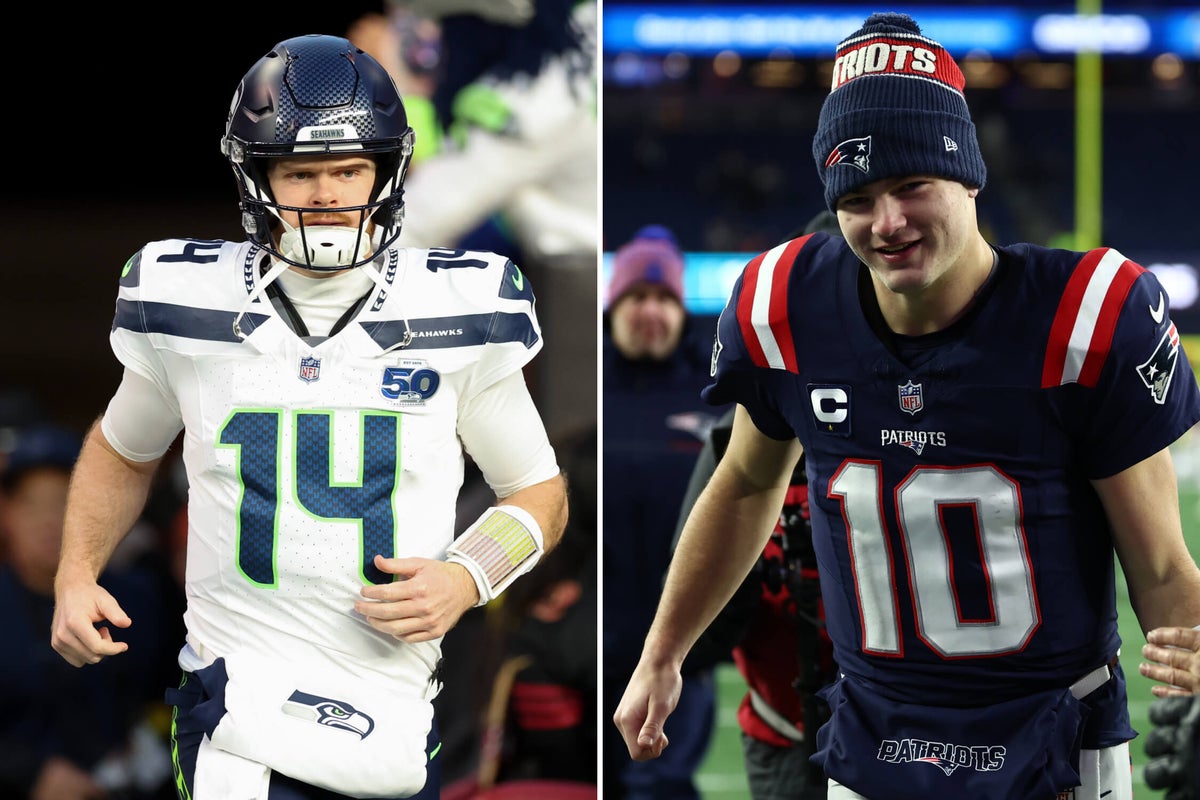
The 2022 field appears similar on paper, but not in real life: Patrick Mahomes’ Chiefs, Josh Allen’s Bills and Joe Burrow’s Bengals were seeded 1-2-3. The AFC was wide open, but only among the best quarterbacks of their generation. This year, it’s Bo Nix’s Broncos, Drake Maye’s Patriots and Trevor Lawrence’s Jaguars — the type of wide open that makes, say, No. 5 Houston think this might be its season to finally reach a Super Bowl.
If my Broncos-fan college roommate is skeptical, you can imagine how NFL execs feel.
“Denver has looked horrible on offense, and they looked horrible again today,” one said.
• Chargers at Patriots: It’s tough to envision this Chargers team, with its patched-together offensive line, making a deep run. One exec called them “fool’s gold,” even though the Chargers won seven of eight from late October to Christmas.
“New England has been doing it all year,” this exec said. “(Mike) Vrabel is a been-there, done-that coach, which offsets the inexperience of his team. Same with Josh McDaniels, who knows how to come up with a game plan in the playoffs. He’s got his MVP quarterback (Maye) playing out of his mind. They’re going to be tough to beat.”
New England’s easy schedule is one caveat. The Patriots own one victory this season over a team that finished with a winning record (Buffalo). That is tied for 24th in the NFL and last among playoff teams. The Chargers are tied for fifth with four such victories, not that beating Minnesota or Pittsburgh should count for much.
• Bills at Jaguars: This is by far the most fascinating game in the first round. Jacksonville is the only team to rank among the NFL’s top six in EPA per play on both sides of the ball since Week 11, going 8-0 in that span. But Buffalo ranks fourth and 11th over that span, respectively, and Josh Allen can win just about any game.
“If I am (Jaguars coach) Liam Coen, I am thinking, ‘Wait, my reward for winning the division is to play the most dangerous quarterback in the entire playoff field in Round 1? Really?’” an exec said. “Houston must be thinking, ‘Sweet, we get 42-year-old Aaron Rodgers instead of prime Josh Allen.’ I’d take that every day.”
A veteran coach said he liked the Jaguars as much as he liked anyone in the AFC.
“Jacksonville is playing with confidence, and Buffalo has the look of a prizefighter that has been knocked out, was kind of almost a champion but is weary,” another exec said. “I just don’t know if Buffalo can take it. If Jacksonville pops Buffalo, does that make them the favorite?”
• Texans at Steelers: Think the Texans were rooting for the Steelers on Sunday night? Execs do.
“You could have seen Baltimore getting a 200-yard game from Derrick Henry against Houston’s smaller front,” one said. “That’s a matchup where Baltimore has come out on top before.”
Instead of facing Henry and Jackson, Houston’s cat-quick defense draws the ancient Rodgers.
“You have Rodgers at 42, Cam Heyward is 36 and T.J. Watt hardly makes plays except when the ball lands in his belly like it did Sunday night,” one exec said. “Those three guys are just about shot. I think Houston chokes them out.”
This exec said he thinks Houston beats Denver in the divisional round, with Jacksonville or New England reaching the Super Bowl.
“I’m thinking it’s maybe New England that comes out,” he said.
2. A collapse, then a reckoning: McVay’s Rams and the lesson of Holmgren’s Seahawks.
A loss is a loss, right? The standings say yes, but some defeats carry sufficient emotional devastation to define a season and trigger difficult introspection.
The Rams have struggled to regain their footing since blowing a 30-14 lead with 8:22 left in regulation to lose 38-37 in overtime at Seattle in Week 16. They went from looking like the best team in the NFL to appearing fragile as the playoffs draw near. The loss didn’t just change the standings. It challenged who the Rams believed themselves to be.
A week later, the Rams fell behind Atlanta 21-0 and lost 27-24.
“This is a humbling league, and we got humbled,” coach Sean McVay said.
The Rams blew any shot at the top seed in the NFC and face longer odds to win another Lombardi Trophy. In Sunday’s regular-season finale, they trailed the 3-13 Cardinals at home late in the third quarter before pulling away in the fourth.
The collapse in Seattle and its ramifications recalled a similar situation involving these teams two decades ago.
In 2004, the Mike Holmgren-coached Seahawks had allowed a league-low 13 points during a 3-0 start when the Rams visited.
Seattle led 27-10 with 5:48 remaining in regulation when the game — and a promising season — went sideways.
Seattle led 27-17 with 3:51 left, punting on fourth-and-1 from its own 30. The Rams’ 39-yard punt return and 41-yard touchdown pass on the next play produced a 6.5 EPA swing, similar to the 6.2 EPA boost the 2025 Seahawks got against the Rams from a 58-yard punt return for a touchdown and two-point conversion with 8:03 to play in regulation.
In both cases, the swings came not from sustained dominance, but from moments of chaos that the leading team struggled to reconcile with its own presumed identity.
The 2004 Seahawks finished 9-7 and reached the playoffs, only to lose again to the Rams in the wild-card round. Their collapse remained unresolved.
Seattle reached the Super Bowl a year later, but not without introspection.
The Seahawks retained Holmgren, but general manager Bob Ferguson — who took the job two years earlier when Holmgren was stripped of the GM title — resigned.
Tim Ruskell’s hiring as GM brought a strategic shift as Seattle prioritized emotional stability and communication. The team drafted undersized-but-instinctive middle linebacker Lofa Tatupu and signed solid-but-unspectacular veterans, including defensive tackle Chuck Darby and receiver Joe Jurevicius. That departed from the higher-risk strategy Seattle implemented when using first-round picks on Koren Robinson and Jerramy Stevens.
The Rams do not need to change McVay’s title or hire a new GM, obviously. They could still reach their goals this season. But if their late-season collapse continues, they’ll face questions similar to the ones Seattle faced two decades ago, including whether even a Hall of Fame-caliber coach benefits from redistributing responsibility.
Holmgren’s breakthrough didn’t come from better play design, but from accepting that elite coaches don’t have to control everything. Ruskell, more than Ferguson, represented a break from Holmgren’s 1999-2002 run in the GM chair.
Holmgren, who called plays when Joe Montana and Brett Favre combined to win five MVPs, leaned into the run game in 2005, helping Shaun Alexander win the award as Seattle reached the Super Bowl.
McVay, another offensive savant, seems to treat special teams as a necessary evil. The Rams have forced touchbacks on 57 percent of kickoffs this season, lapping the field (New Orleans is next at 34 percent). McVay’s Rams rank first with a 73 percent touchback rate since he became coach in 2017.
Opposing coaches see this as a tell.
“McVay would rather not have special teams plays in the game than have to deal with it,” one said.
The Rams rank third in offensive EPA per play under McVay, eighth on defense and fifth in winning percentage. They rank last in special teams EPA since letting special teams coordinator John Fassel, a holdover from previous coach Jeff Fisher, leave after the 2019 season (the Rams ranked eighth during McVay’s first three seasons, when Fassel was in the role).
The Seattle game two weeks ago never would have gotten away from McVay’s Rams without that punt return for a touchdown. McVay, who fired special teams coordinator Chase Blackburn two days later, is on his fifth since Fassel’s departure. If McVay is the common denominator, he’s also the team’s best hope for preventing moments like that from threatening future seasons.
3. The 1973 Jets collected eight interceptions in a single game, most for any team since the AFL-NFL merger. Aaron Glenn’s inaugural Jets team set another record: zero picks all season.
There have been 2,151 individual team seasons since the NFL began tracking interceptions in 1940. Every team but the 2025 Jets picked off at least two passes in a season, per Pro Football Reference.
That’s 2,050 out of 2,151 teams since the 1940 season, when “Slinging” Sammy Baugh led the league in passing and future Supreme Court justice Byron “Whizzer” White led the league in rushing.
The Jets somehow picked off zero this season, a record cemented during their 35-8 loss to the Bills’ backups in Buffalo, where Mitch Trubisky brought the Jets to their knees with four touchdown passes.
For as long as the forward pass has been part of football, interceptions have been part of the game. Pro Football Reference credits three Chicago Cardinals with interceptions in the opening week of 1940.
Dick “Night Train” Lane once had 14 in a season, a record.
When the Jets hired Glenn as coach, they were getting a former cornerback with at least one interception in 13 consecutive seasons, seven of those with the Jets.
They also were about to get much worse on both sides of the ball.
The Jets suffered the fourth-largest year-over-year drop in offensive EPA per game (-7.0) and the fourth-largest on defense (-5.5).
As the table above shows, opponents attempted 515 passes against the Jets this season without Glenn’s defense catching any of them. The 18 QBs in the table tossed 125 interceptions against everyone else this season, but none against the Jets.
It defies logic.
Interceptions can happen almost randomly. A ball glances off a defensive lineman’s helmet, slips through a receiver’s hands or sails off course when the wind shifts and a defender happens to be in the right place at the right time.
Sometimes, opponents offer up end-of-half Hail Marys, a situation where the offense doesn’t mind if the other team comes down with the football.
Watt’s interception for the Steelers on Sunday night almost seemed accidental, the ball bouncing off players from both teams before somehow finding him.
When the Jets collected eight picks against the Colts in Week 2 of the 1973 season, most for any defense in a game since 1970, one pass bounced off a running back against the blitz, before the back had turned around. Another was tipped high in the air.
Howard Schnellenberger, the Colts’ coach at the time, replaced Bert Jones after his fourth interception. Backup Marty Domres threw four more.
“I thought Domres might have a hot hand,” Schnellenberger said afterward, “but it didn’t turn out that way.”
In classic Jets fashion, the team could not celebrate its 34-10 victory that day. Quarterback Joe Namath suffered a shoulder injury that sidelined him for seven games.
4. The Panthers are headed to the playoffs. Is that a good thing?
Last season, the Panthers felt better about their outlook after Bryce Young’s return to the lineup in Week 8 sparked an offensive revival. Carolina ranked 10th in offensive EPA per play over its final nine games, ahead of the Rams (13th) and Chiefs (14th).
Carolina took another step this season by winning the NFC South and reaching the playoffs.
But it felt like one step forward with two steps back.
Carolina’s offense ranked 25th in EPA per play this season. Young ranked 28th in EPA per pass play, one spot ahead of Spencer Rattler, whom the Saints benched. The team’s 8-9 record wasn’t much better than the 4-5 finishing mark last season, and the Panthers still needed help to win the division, sweating out Atlanta’s victory over New Orleans to prevail over Tampa Bay.
Evidence points to Carolina’s offense transitioning from one that was comfortable with volatility late last season, when expectations were low and the defense was struggling, toward one that lost upside without gaining efficiency.
“Don’t get fooled by the final games of a season when you are out of it and the teams you are playing are out of it,” a veteran coach said of Young in 2025 Quarterback Tiers, which published in August. “That is where his production came from. Everyone is excited about it. Now, you start the season over again, you are playing teams that are game-planning seriously, that have a lot to play for, and it’s different.”
Those differences jump out in the table below, which compares Young’s production for Weeks 9-18 last season (final nine games, excluding his Week 8 start) to his production in 16 starts this season.
Young’s average air yards per attempt dropped from 9.0 over the final nine games last season to 6.5 this season, despite the team investing a first-round choice in receiver Tetairoa McMillan.
Young completed roughly the same rate of passes across the various air-yards buckets. The team continued to run play-action at a similar rate.
But as the table below shows, 70.1 percent of Young’s passes traveled less than 10 yards past the line of scrimmage, up from 59.5 percent last season. Nearly 5 percent of Young’s yardage this season came on screen passes, up from 2.2 percent over the final nine games of 2024.
How much of that reflected confidence in the offensive line?
Despite the perceived shift toward safety, Young’s interception rate increased.
Carolina reached the playoffs because its defense improved from abysmal in 2024 to near league average, and because the NFC South was so weak.
Tough conversations await Carolina in the offseason, provided a postseason berth does not delude them into thinking the team’s trajectory remains upward.
5. Myles Garrett’s 23rd sack was legitimate, but this record is difficult to contextualize. Bonus points if you remember Coy Bacon and Al Baker.
Garrett’s record 23rd sack was thankfully a legitimate one against a top quarterback in a game his Cleveland Browns won.
Garrett beat Bengals tackle Orlando Brown Jr. outside, flashing what Next Gen Stats logged as his quickest get-off of the season (0.23 seconds, per ESPN) on his way to taking down Joe Burrow. Elapsed time from snap to sack: 2.3 seconds, in a season when the average sack occurs 3.7 seconds after the snap, per TruMedia. Garrett turned the corner just 8 yards beyond the line of scrimmage, despite Brown getting out of his stance slightly before the ball was snapped.
MYLES GARRETT IS THE NEW SACK RECORD KING.
CLEvsCIN on CBS/Paramount+https://t.co/HkKw7uXVnt pic.twitter.com/Jaa4aBGrIl
— NFL (@NFL) January 4, 2026
This was not Brett Favre controversially sitting down for Michael Strahan’s then-record sack No. 22.5 in 2001 (since matched by T.J. Watt in 2021).
But sacks are difficult to contextualize, no matter how they are recorded. Especially across eras.
Teams pass more now than in the distant past, but quarterbacks also get rid of the football more quickly. Good teams lead more, creating obvious passing situations for their opponents, a help for pass rushers. The best defensive players face more double-team blocks and schemes designed to stop them.
It’s fashionable to say sacks are overrated, but every great pass rusher has lots of them. Bruce Smith and Reggie White did not combine for 398 of them by being overrated. They dominated like few others. Garrett had three more than the entire 49ers team this season. He’s clearly one of the greatest linemen in league history. But how does he compare?
The league began tracking sacks in 1982. Pro Football Reference has them logged unofficially since 1960. Those unofficial stats show Garrett’s 23 tied for first with Al Baker’s 23 with the Detroit Lions in 1978, the year the NFL expanded from 14 to 16 games in the regular season.
Myles Garrett’s 23 sacks tied the unofficial total this 6-foot-6, 260-pound #Lions rookie posted in 1978
Al “Bubba” Baker had 131 career sacks per @pfref pic.twitter.com/mAINlfWNqV
— Mike Sando (@SandoNFL) January 5, 2026
Baker got his sacks against teams that attempted 350 passes against the Lions that season. Garrett got his against teams that attempted 487 passes.
How best to resolve such things? Well …
Garrett is tied with 1968 Deacon Jones for fourth behind 1978 Baker, 2021 Watt and 2008 DeMarcus Ware in my attempt to adjust for eras and opportunities.
The table above shows all 23 seasons (by 19 players) with at least 20 official or unofficial sacks in a season since 1960. Players are ranked by how their personal sack rates compared to league-average rates in the same season.
We don’t know how many snaps each player logged on pass plays, especially long ago. But the difference between Baker’s sack rate (6.6 percent, which is 23 sacks divided by the 350 pass attempts his Lions faced in the games he played) was only 1.4 percentage points lower than the 8.0 percent league rate in 1978. That was the best in the sample.
The most fun part of contextualizing this production is stumbling across names we might otherwise forget.
With Bengals fans lamenting their team’s inability to find an elite pass rusher beyond Trey Hendrickson this season, Coy Bacon becomes an interesting player to revisit. The Bengals badly needed pass-rush help entering 1976 and responded by trading future Hall of Fame receiver Charlie Joiner to the Chargers for Bacon, who had 21.5 sacks in his first season with Cincy.
Bacon was traded four times for packages that included Joiner, All-Pro quarterback John Hadl and a first-round draft choice. He played alongside Deacon Jones and Merlin Olsen on the Rams’ Fearsome Foursome line, and unofficially finished with 130.5 sacks.
Garrett has 125.5 sacks, which is tied with Dwight Freeney for 20th on the official list and 28th on the unofficial one. He’s one sack away from tying Derrick Thomas and 16.5 from passing Strahan for sixth on the official list. He’s got a great shot at challenging Kevin Greene’s No. 3 spot (160 sacks) but could have a tough time approaching Smith (200) or White (198).
6. Two-minute drill: Raheem Morris and Terry Fontenot are out, but what awaits AFC North legends John Harbaugh and Mike Tomlin?
A check of records since 2000 shows Morris and five other head coaches left their jobs after winning at least four consecutive games to end a season.
Morris belongs in his own category after his Atlanta Falcons won their final four, then fired him anyway.
Tony Dungy and Joe Gibbs retired after winning at least their final four. Rich Bisaccia was only the interim coach for Las Vegas when the Raiders won their final four in 2021 and went in another direction, hiring Josh McDaniels.
One other firing on the list isn’t a great comp because, while Marty Schottenheimer won his final 10 regular-season games with the Chargers in 2006, the team fired him after he suffered an upset loss at home to New England in the playoffs.
That leaves Morris alone with Anthony Lynn as the only non-interim coaches fired since 2000 after winning at least their final four games.
Lynn was in his fourth season with the Chargers in 2020 when they won their final four to finish 7-9. He had gone 9-7, 12-4 and 5-11 previously.
Morris had completed only two seasons with the Falcons when owner Arthur Blank decided to start over. Fontenot, the GM, had been on the job five seasons without posting a winning record, while making unconventional moves early in drafts and at the quarterback position.
Morris, 16-18 in two seasons, might have been collateral damage for an organization looking to start fresh with both roles in sync.
Whatever the case, he leaves as one of four coaches to close the 2025 season with four victories, joining Mike Macdonald, Liam Coen, DeMeco Ryans and Kevin O’Connell.
• Harbaugh vs. Tomlin: Mike Tomlin is headed to the playoffs after his Steelers outlasted John Harbaugh’s Ravens, 26-24, in a wild game to win the AFC North.
What will be the consequences for Harbaugh, whose Ravens have now gone 13 full seasons without reaching a Super Bowl? And what if Tomlin, riding a six-game playoff losing streak, goes one-and-done again this season?
These are the sorts of questions teams with long-tenured successful coaches ask themselves after the postseason success dries up.
Harbaugh and Tomlin, like Hall of Famers Don Shula and Chuck Noll, along with Mike Shanahan and Pete Carroll, loaded up on postseason victories early in their tenures, then struggled to make deep pushes in the postseason thereafter. That could change for Tomlin this season, but as the chart below shows, he claimed six of his eight playoff wins in the first half of his tenure, and then only barely, as the two victories were after the 2016 season.
• Morris in reverse: While Morris went 4-0 over his final four games, five coaches finished this regular season on four-game skids.
That list includes Shane Steichen, who will return to the Colts; Andy Reid, who is obviously returning to the Chiefs; Matt LaFleur, who appears on solid ground in Green Bay; Glenn, who is expected back for a second season with the Jets; and Jonathan Gannon, whose future with the Cardinals remains in some question.
• Jags’ not-so-secret weapon: The Ravens missed the playoffs when their rookie kicker missed the go-ahead try from 44 yards on the final play. Earlier Sunday, Jaguars kicker Cam Little connected from 67 yards, the longest outdoor make in league history. Little already owns the league record (68 yards). He connected from 70 in the preseason.
Little did miss four times in nine tries from 45-50 yards, but those misses came in Weeks 3-7.
Imagine the Jaguars taking possession in Denver at their own 35, needing a field goal in the mile-high air to win. How many yards do they need to gain? Ten?