
ST. PAUL, Minn. — Luc Tardif wouldn’t guarantee that the construction of the Olympic ice hockey arena in Milan will be fully ready in time for puck drop in about a month. That, the IIHF president said in fielding the very first question of his end-of-World Juniors news conference on Monday, is on the International Olympic Committee and the Milan Games’ organizing committee.
But he did say this: “We’re going to have a tournament in this building. The infrastructure for ice hockey — the dressing rooms, the practice area and the field of play — that’s going to be ready.”
It wasn’t reassuring, but it was something for the IIHF president, who admitted to some sleepless nights.
Tuesday, Tardif, together with Hockey Canada’s Scott Salmond and other leaders in hockey, will travel to Milan from the World Juniors in St. Paul to take in the planned test event, which is scheduled to begin on Jan. 9. Maybe, after the event, he said he could guarantee the rest — from concessions to concourses.
“We supervise and the experts of NHL, NHLPA, us are following it day by day. But the quality of the ice, the quality of the infrastructure is there. You can be confident on that,” Tardif said. “The (test event) will not be exactly what I expected, but it will be a nice setup for the Olympic Games. We will be able to sleep much better.”
Attendance in Minnesota addressed
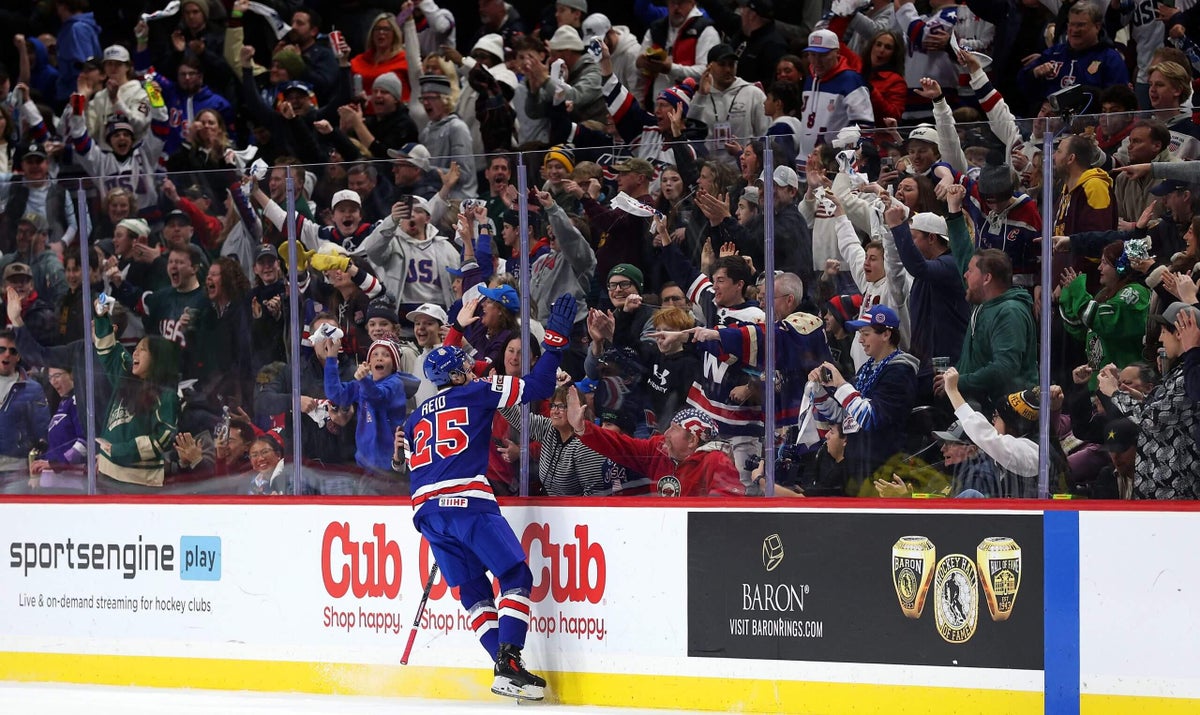
While the Olympics led the IIHF’s news conference on Monday, disappointing attendance here in Minnesota was the key World Juniors topic.
None of Tardif, his lieutenants or USA Hockey’s executive director Pat Kelleher praised it in their opening remarks when they gave their usual credits to the host cities, the organizing committees, the volunteers, the Minnesota Wild and the University of Minnesota. There was no raving about the energy in the building, as there usually is when this event is a hit.
“The Wild gave us a fantastic arena, and sometimes you get good crowds, but you can see empty seats,” Tardif said, repeatedly pointing to how the numbers in the NHL rink here would have looked fuller in the smaller rinks that often host this tournament in Europe. “We’re satisfied. And we’re satisfied also about the quality of the infrastructure.”
Both Tardif and Kelleher alluded to a smaller-than-usual traveling crowd from Canada, too.
“It’s winter time, it’s cold, and we cannot forget the geopolitical situation makes it not so easy,” Tardif said. “I think you understand what I want to say (and) I don’t want to go further, but that was important.”
Kelleher also defended USA Hockey’s decision to move Canada, who were seeded to play in USA’s group at Grand Casino Arena coming out of last year’s tournament, at 3M Arena at Mariucci in Minneapolis, where crowds were especially light.
“Our plan was to have Canada anchor the Mariucci bracket, and I think there were a lot of factors that went into the challenge. But we feel comfortable with that decision and thought it was where we needed to go,” Kelleher said. “First and foremost, though, we said we were going to rely on American fans and hope for some visitors to augment that.”
Entering Monday’s medal round games, attendance in Minnesota was 167,657 for the tournament, or 6,209 per game. Before USA was bounced in the quarterfinals, their games had averaged 14,341.
That’s well below the 18,240 Canada, who were also bounced in the quarters as hosts, averaged in Ottawa last year.
The year before, the host Swedes averaged 11,512 for their games, but the capacity for the Scandinavium in Gothenburg is just 12,044, and so it felt packed. It was a similar story in Halifax, where Canada averaged 10,354 in the 10,595-capacity Scotiabank Centre, but that tournament averaged 7,396 despite having a smaller ceiling for the host’s games.
It hasn’t always been a major hit in Canadian markets, though. At the 2017 World Juniors in Montreal, Canada averaged just 15,288, nowhere near capacity at the Bell Centre, and the Canada-USA gold medal game didn’t sell out.
This World Juniors also outperformed the last U.S.-held tournament in Buffalo in 2018 — a tournament that finished with better overall numbers but was buoyed by its outdoor game attendance and still only averaged 12,679 for USA’s games.
“They call it the State of Hockey for a reason, and I think the atmosphere that they put on here was incredible. We’ll end up having more than 200,000 fans that came through the building, which was a goal for our organizing committee,” Kelleher said. “Minnesotans love hockey, maybe more than any place else in our country, and they did a great job of showing that and supporting all the teams here.”
But he also acknowledged some of the optics of how the arena looked, including for two poorly attended and exciting semifinal games. The numbers were going to be “where they needed to be,” he said, but he wasn’t lauding their success.
“You always want more people in the stands. Coming into this weekend, I think if our team was playing we obviously would have had bigger crowds here in the end,” he said. “Certainly in some cases, in some games, you’d like to see a little bit bigger in some of the crowds.”
USA Hockey will next host the World Juniors in 2031, and that bidding process won’t start for a couple of years. Kelleher wouldn’t tip his hand on potential front-runners, but he did say that he expects a couple of new NHL markets (see: Seattle and Vegas, though he didn’t name them) to be interested. I expect Tampa and Detroit will also be a part of that process.
Tournament looks ahead to return to Alberta
Hockey Canada senior vice president Dean McIntosh, who leads their events, began his opening remarks by answering another elephant in the room: Why Edmonton and Red Deer, again?
He also admitted to lessons learned from pricing the summer World Juniors, held in August 2022, like they do a winter tournament.
“We had a community there that hosted an event in an 18,000-seat building there that had zero people in it. We had an event during Omicron that in the middle of the even we had to say, ‘Enough is enough, and we stepped aside.’ And then we had an event in the summer that, after two strange events, it might have been the strangest of the three,” he said.
Registering for the priority draw for tickets for next year closes Tuesday and organizers expect tickets to be made available to winners of the draw as early as late January.
Season ticket holders for the WHL’s Edmonton Oil Kings and Red Deer Rebels, as well as the NHL’s Edmonton Oilers, have already had first crack at tickets, and McIntosh said uptake has been fantastic.
In the coming months, Hockey Canada will also open up a request for proposal process for other Alberta markets interested in applying to host the slate of pre-tournament games they plan to host around the province in early December.