
WNBA players remain on a war footing. The Women’s National Basketball Association (WNBA) and the Women’s National Basketball Players Association (WNBPA) have been negotiating a new collective bargaining agreement for more than a year, yet no final deal has been reached.
Two deadline extensions have already been granted, with January 9 now looming as the final cutoff, while the threat of a players’ strike or an owners’ lockout hangs over the premier women’s basketball league.
The dispute dates back to October 2024, when WNBA players opted out of the collective bargaining agreement signed in 2020, which was originally set to run through 2027.
That decision triggered a one-year negotiation window involving the players, the union (WNBPA), and the league (WNBA) to forge a new agreement.
From the outset, players have voiced frustration over the limited share of revenues they receive from a league experiencing sustained growth.
Base salaries remain around $75,000, with even the league’s top stars barely exceeding $250,000 annually, figures that pale in comparison to those earned by their male counterparts.
Overall, player compensation represents between 9% and 25% of total league revenue, a share economists widely view as exceptionally low.
This is particularly striking given the WNBA’s commercial momentum, highlighted by record attendance figures, rising television viewership, and a new media rights deal with Disney, Amazon Prime, and NBC valued at $200 million and set to begin in 2026.
In April, WNBA commissioner Cathy Engelbert confirmed that talks with the players’ union were ongoing and described the anticipated agreement as “transformational” for the league’s future.
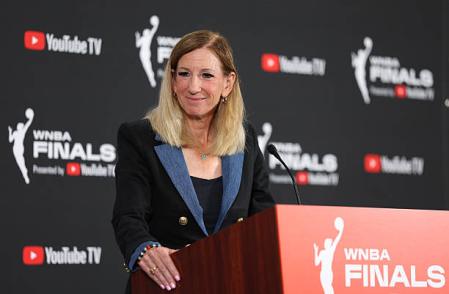
WNBA Commissioner Cathy Engelbert
Getty Images
That optimism quickly faded after the league’s initial proposal drew sharp criticism from player and union representative Satou Sabally.
Speaking on behalf of the union, Indiana Fever stated that “as the league grows, it’s time for an agreement that reflects our true value; we are fighting for a fair share of the business we have built.”
The union later submitted a proposal centered on fair revenue sharing, improved salaries, working conditions, and benefits.
However, it did not receive what it deemed a meaningful counteroffer until June, further intensifying tensions as the original October 31 deadline approached.
At that stage, the prospect of a players’ strike began to gain traction, an outcome not seen since the NBA labor dispute in 2011, when negotiations between players and team owners collapsed.
That lockout lasted 161 days, halting training camps and trades while forcing the cancellation of the preseason and the opening weeks of the regular season.
In an effort to avoid a similar scenario, the WNBA extended the deadline by one month. An October proposal introduced a “supermax” salary nearing $850,000 and a veteran minimum of approximately $300,000.
The proposed revenue-sharing framework largely mirrored the existing system, activating only if certain cumulative benchmarks were met, and applied exclusively to league-generated income, excluding team revenues.
That offer was also rejected. Following a second extension pushing the deadline to January 9, the league presented a revised proposal under which total compensation for maximum-salary players could surpass $1.2 million when revenue-sharing incentives were included, an increase over the previous cap of roughly $1.1 million.
The league additionally proposed a revenue-sharing model granting players 50% of a revenue metric that excluded certain income streams and deducted specific expenses.
Under this structure, players would ultimately receive less than 15% of total league revenues, leaving the proposal without the approval of either the players or the union.
The impasse has grown so entrenched that NBA commissioner Adam Silver has stepped in, offering assistance to help break the deadlock and stating that “we are available to do whatever is necessary to get a deal done.”
With January 9 fast approaching and no agreement in sight, the WNBA faces a defining moment. The path forward leads either to a landmark collective bargaining agreement—or to a lockout that would freeze competition and potentially result in multimillion-dollar losses.