When the time comes to turn the page to a new year, it is natural to take a moment to reflect on what the past year has offered, from the individual to the largest of organizations. As the passing of time forces everyone to adapt and move forward so as to not get left behind, New Year’s always brings some examination of what the past year has offered, what has been gained or lost — and whether one should be grateful for the year that has passed or just glad to finally move on from it.
In the case of NASCAR and the ecosystem that makes the sport of stock car racing what it is, the sum of the year 2025 is not especially pleasant. From beginning to end, there existed certain and discernible negative forces — from abstract existential struggle to grim realty — that make it a calendar year worth leaving behind.
The undercurrent that existed in NASCAR’s 2025 stemmed from its 2024, specifically what happened at the end of it. When Joey Logano won his third NASCAR Cup Series championship through improbable opportunism despite a statistically unremarkable season, the ensuing consternation was enough that it finally prompted NASCAR to reevaluate how the sport determines its champions and rewards its best drivers in a given year.
From the start of the year onward, the solution to the problems of the playoff system was sought by committee: The formation of NASCAR’s playoff committee, comprised of some of the sport’s most influential figures and a variety of different ideas and philosophies, signaled a serious and deliberate approach to charting a new long-term direction for the sport’s championship system in 2026 and beyond.
The playoff committee was a welcome and ultimately necessary step. After a decade of use, the flaws of the playoff system — namely the winner-take-all finale in which the sum of an entire season and individual greatness was more than once invalidated by the third- or fourth-best driver nailing their setup for the weekend or catching a caution at exactly the right time — were playing out too much to be tolerated. The residual spawn of the committee’s season-long deliberation, however, was a struggle over NASCAR’s future (and arguably its very soul) playing out in the public theater.

I Want To Miss NASCAR
Early on, it became apparent that there were three different factions of ideas for what the playoff committee should do: Alter the current playoff system to better reward year-long consistency and lessen the chances of arbitrary outcomes; return to a Chase-style system like the ones used from 2004 to 2013; or return to a season-long championship over the course of 36 races.
Naturally, a season-long points system earned many supporters, including on the playoff committee itself, and it’s easy to understand why, as the so-called purity of the system almost invariably would crown the best driver all season as NASCAR’s champion.
What happened, however, is that advocates of such a system (namely among fans on certain online platforms) became increasingly militant in trying to push their ideas forward to the point of resembling a religious fervor that demanded nonbelievers either be turned or destroyed.
Full-season points advocates came to be overrepresented in conversations about the playoff committee not necessarily by pure consensus, but by being overzealous to the point of excluding Chase and/or playoff proponents from the conversation and pressuring them into silence, lest you be subject to a purity test, or be accused of being a shill or mouthpiece for the same sanctioning body that signaled a perfect willingness to move on from the playoff system to begin with.
The other head of the dragon was Next Gen car fatigue, which fully matured in the fourth season of the Cup Series’ current generation car as its car’s warts — namely in terms of aerodynamics and chassis character — became not only fully obvious but also more pronounced as it came of age and its newness wore off.
Some of that was just a natural part of the evolution of a car and rules package, as by 2025 the top teams in NASCAR were able to gain a full grasp of how to optimize a platform that hadn’t significantly changed since being introduced in 2022, something NASCAR President Steve O’Donnell alluded to in August.
The platform and its potential for future change and improvement, however, was afforded little to no grace by fans (again, mostly on certain online platforms) and even industry people who decried the car and its effect on the racing product from a series of lackluster events in the springtime onward. Even when races saw a fair amount of action and intrigue, just the slightest hint of dirty air and other aero effects influencing the outcome of a race led to week-long derision over the car and the racing and how all of these things had never, ever, been worse (just like they’d never been worse when the Car of Tomorrow was introduced or when the Gen 6 didn’t prove to be an instant panacea).
And NASCAR racing in 2025 wasn’t even that bad; 14 different drivers won races in Cup, and the work of Goodyear in optimizing its tire compounds led to a clear positive direction on short tracks and road courses. The racing in the NASCAR Xfinity Series remained remarkable, highlighted by Connor Zilisch going on a generational run of success and signaling his emergence as a future superstar. Corey Heim had the single greatest individual season in the history of the NASCAR Craftsman Truck Series, with his seven-wide pass to wrestle victory from the jaws of defeat and win the championship making for one more marvel that will forever live in series lore.
The problem was very little of that was given the time of day, as by midseason it was clear that malcontentment had seized control of the narrative surrounding everything from the week-to-week racing product to the overall big picture of the sport’s business. Speak of Zilisch or Heim’s dominance and how enjoyable it was in the moment, and the cold water of, “Well, they might not even win the championship!” was instantly thrown on you. Evaluate the first year of NASCAR’s new media rights deal — which included outstanding coverage from Amazon Prime Video in a package of midseason races — and you’d be drowned out by those angry about stream-exclusive races or over a decline in TV ratings influenced by a move away from network television and a media ecosystem that continues to change.
None of this was more pronounced and more real, of course, than on championship weekend. While NASCAR avoided a potential nightmare scenario when Heim was able to win the Truck championship despite a mid-pack truck bringing out a caution unnecessarily to set up overtime, it did not get so lucky when Jesse Love won the Xfinity championship over Connor Zilisch — despite Love’s championship run, or Zilisch not winning the title despite winning 10 races, being far from unprecedented.
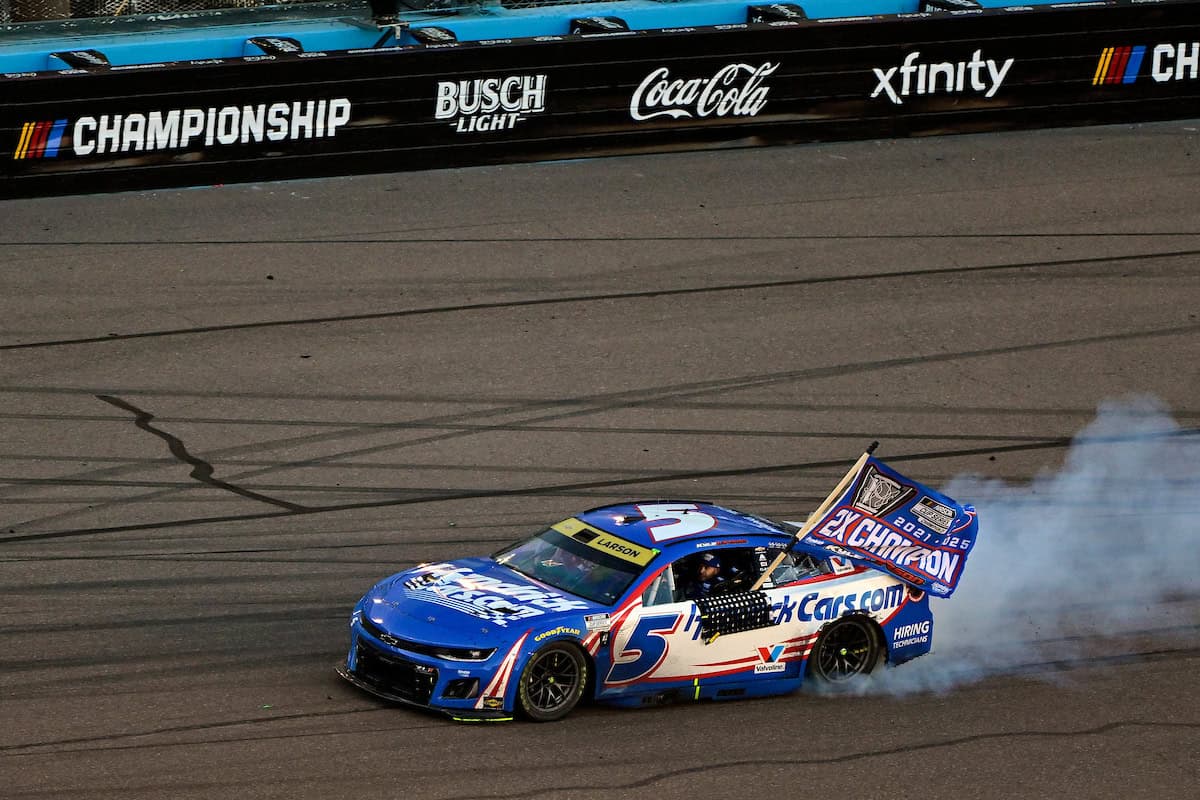
Nor did NASCAR catch a break when an inopportune caution in the final laps of the Cup championship race created a scenario where Denny Hamlin lost the title in rip-your-heart-out-while-it’s-still-beating fashion to Kyle Larson thanks to a two-tire call by Larson’s team allowing him to get out front and stay there despite never being the lead Championship 4 car the entire race up to that point, undermining Larson’s second championship and making it feel like a fluke in the moment, despite Larson having earned the most points of any driver the entire season.
By the end of the weekend and the end of the season, NASCAR was left with no more choice but to acknowledge that a non-insignificant amount of people could not trust who the champion of each series was, a major problem for the sport, and one that it is imperative the sport’s decision makers must solve.
On the subject of NASCAR’s decision makers, the 2025 season also took place amid the specter of an antitrust lawsuit levied against the sanctioning body by 23XI Racing and Front Row Motorsports after negotiations on a new charter agreement broke down late in 2024. From virtually the beginning of the year to its end, there was a steady trickle of legal developments — many of them dry and procedural, but some rather consequential — that kept the lawsuit firmly in the news cycle and dangling like the Sword of Damocles not only over stock-car racing’s leadership, but also over the entire industry as the matter came closer and closer to trial.
By the time December began and a settlement had not been reached, steady concern turned to imminent dread that NASCAR as we have known it could be blown to pieces, scattered into the wind and turned into something either akin to the aftershock of the IRL-CART split of the 1990s or something unrecognizable entirely.
Fortunately, NASCAR relented, the teams called the dogs off, and a settlement was reached before a verdict was, but only after NASCAR was made uncomfortable in court, raked across the coals of public opinion and several of its most prominent executives were deeply embarrassed.
The outcome of the ordeal should be a net positive for the industry, as it led to permanent charters, more money and an overall better revenue sharing deal for NASCAR’s race teams. It is regrettable, however, that NASCAR’s leadership — namely CEO Jim France, who approached charter negotiations with the iron fists of his father and brother despite the pleas of his own executives for a more reasonable approach — did not reach that conclusion to begin with.
Instead, the bitterness of the legal feud and the fallout from what was revealed took attention away from NASCAR’s product, adversely affected public confidence in the state of the sport and undermined most all of the good work and ways NASCAR has grown since a particularly low point in 2018 led to its leadership being restructured. If there is anything that can’t be left in 2025 fast enough, it is the (admittedly cleverly coined) term NASCOURT and everything that went with it.
At any other moment at any other year’s end, it would be easy enough to gloss over the unpleasant parts of what influenced NASCAR in 2025 and focus on the positives instead. One could consider all that fans complained about and tell themselves, “Well, fans have always complained in every era,” or they could chalk some of the more big picture existential angst up to overwrought sports talk radio pronouncements rather than a canary in the coal mine. Unfortunately, that isn’t the case this time around.
Why Greg Biffle’s Death Hits So Hard
The month of December was tinged with somberness when news came that Michael Annett, a full-time competitor from 2009 to 2021 and a fixture of the Cup and Xfinity garages in those years, had passed away far too young at the age of 39. Then, 10 days at year’s end brought not one, but two devastating tragedies: On Dec. 18, the great Greg Biffle, his family and several friends were among seven people killed in a plane crash in Statesville, N.C. A little over a week later, a house fire took the life of Hamlin’s father Dennis while also seriously injuring his mother, Mary Lou.
All too quickly, both incidents put 2025 in a league with 1993, 2000 and other years in which NASCAR has been rocked to its core by loss and commiseration. And for a post-Dale Earnhardt generation that has not had to be reminded that auto racing carries with it the risk of death, it has been especially difficult to cope given the way the two tragedies have devastated families and communities well beyond the confines of a racetrack.
It is one thing when a racer, whether in or out of a racecar, loses their life before their time. In certain respects, anyone who associates themselves with racing likely has a defense mechanism in place to reconcile with such losses and honor the deceased for the life they lived and the glory they achieved. It is a different matter entirely when wives, children and parents are lost as well, and in especially violent and public ways. Even for those who know how to grapple with loss, whether through religion or community comfort or by hardening their heart, what has happened with the Biffle and Hamlin families feels especially cruel and almost unbearable, and will make the calendar turning away from December 2025 for good a major relief.
That isn’t to say, despite of the final impression of the past weeks, that NASCAR’s 2025 is forever to be associated with the macabre and the deep sadness that comes with it. It does, however, underscore that the year 2025 was not an especially pleasant one in stock-car racing circles. Though this spate of overwhelming tragedy serves an important reminder that much of the reactionism and arguments over what racing is and what it ought to be are ultimately silly, there was already too much to lament about the past year even before this grim turn. Too much animus, too much bitterness and too much left unappreciated.
Once 2026 begins, and once the commiseration subsides and those lost in the past week receive their dignity, hopefully the page can be turned to the novelty and optimism that a new year always provides. Soon enough, a decision will be made on a long-term championship format that everyone can agree on, or at least concede and come to terms with. An increase in horsepower for the Cup Series, something that has been clamored for throughout the past several years, will likely help the on-track product and mark the first big leap toward the evolution of this current generation car. And for the most part, all of this will take place with NASCAR in a state of (relative) harmony and within the framework of a system that now works sufficiently for everyone and is no longer being fought over.
Maybe then, the focus can be not on warring factions, trials of the century, angry doomsayers or all else that colored NASCAR’s 2025, but on what there is to appreciate about the sport in the present and what there is to look forward to in the year to come, whether it’s the first points race for North Wilkesboro Speedway in 30 years, a return to Chicagoland Speedway or a brand new event in San Diego that should draw intrigue from far more than just the dedicated fans that support stock car racing from week to week.
And hopefully then, 2026 can serve as a time of rejuvenation, contentment and optimism for the future to come beyond the next 12 months.