
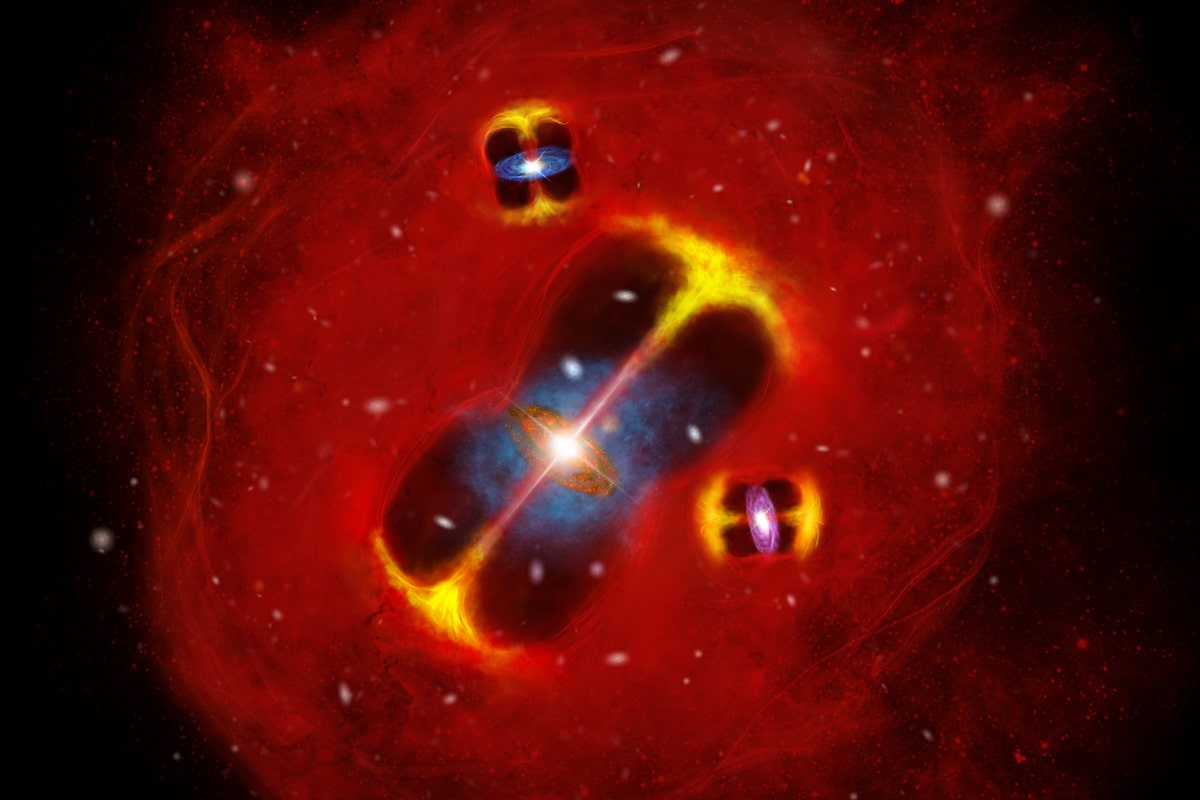
Artist’s impression of a baby galaxy cluster in the early Universe. Active galaxies and their radio jets lie within a hot intracluster atmosphere, highlighting the large amount of hot gas in this young cluster.Supplied
By chasing shadows in the farthest reaches of space, a team led by astronomers at the University of British Columbia has discovered that the early universe can be a hot mess.
More specifically, the researchers measured the energy of hot gas within a remote group of galaxies – the most distant such measurement ever made. The result reinforces the importance of giant black holes in galaxy formation and shows that in at least some cases the process was energized to a degree that computer simulations do not predict.
“It forces us to rethink our current understanding of how these large structures formed and evolved in the earliest times,” said Dazhi Zhou, a doctoral student at the University of British Columbia and first author of a study describing the work, published Monday in the journal Nature.
Astronomers have long known that matter is not evenly distributed in the cosmos but rather tends to be clumped into clusters of galaxies. In turn, the galaxies contain many billions of stars – trillions when it comes to the largest galaxies.
What is less clear is how clusters of galaxies first arose out of a nearly uniform sea of atoms that was present immediately after the birth of our universe an estimated 13.8 billion years ago.
To shed light on the question, Mr. Zhou and his colleagues turned to ALMA, a giant array of radio dishes located on a high plateau among the Andes mountains in Chile.
An Atacama Large Millimeter/submillimeter Array (ALMA) image of 14 galaxies forming a protocluster known as SPT2349-56 in an undated handout photo.B. Saxton/The Canadian Press
Their target was SPT2349–56. It is a cluster of galaxies located a staggering 12.4 billion light years away. That means light from the cluster took so long to reach us that it appears to us as it existed when the universe was only about 10 per cent of its current age.
While SPT2349–56 may be a baby in chronological terms, it is no lightweight. It is a massive and densely packed cluster, with more than 30 galaxies flying around in a volume of space only a few times larger than our own single Milky Way galaxy.
The big surprise for the UBC team was not the number of galaxies, however, but what was found between them. Mr. Zhou’s observations showed that the galaxies are embedded within a cloud of superheated gas.
The gas cannot be observed directly but it forms a silhouette that blocks the background glow of radio waves coming from even farther away. The hotter the gas, the darker the shadow. Because of this effect, Mr. Zhou could estimate how much energy was present throughout the cluster.
A handout photo released on April 25, 2018 by the European Southern Observatory shows an artist’s impression of SPT2349-56.M. KOMMESSER/Getty Images
Computer simulations suggest that such shadows shouldn’t exist at such early times because it should take a while for galaxies to warm up the gas around them. In this case, however, at least three of the galaxies in the cluster are harbouring giant black holes that are helping to energize their environment.
“There have been many indirect hints that active black holes have helped to heat the gas in galaxy clusters at very early times,” said Evan Scannapieco, a professor at Arizona State University who was not involved in the find. He said that the UBC team’s results “not only imply that they are seeing this process in action, but also that the energy input is even higher than expected.”
The takeaway, Dr. Scannapieco added, is that the method provides the first direct view of a key early chapter in cosmic history.
Mr. Zhou is set to present his results this week at a meeting of the American Astronomical Society in Phoenix, the largest annual gathering of professional astronomers in the world.