

Inflation is driven by supply-side, structural issues
TBS Report
05 January, 2026, 04:50 pm
Last modified: 06 January, 2026, 01:02 am
Infographic: TBS
“>
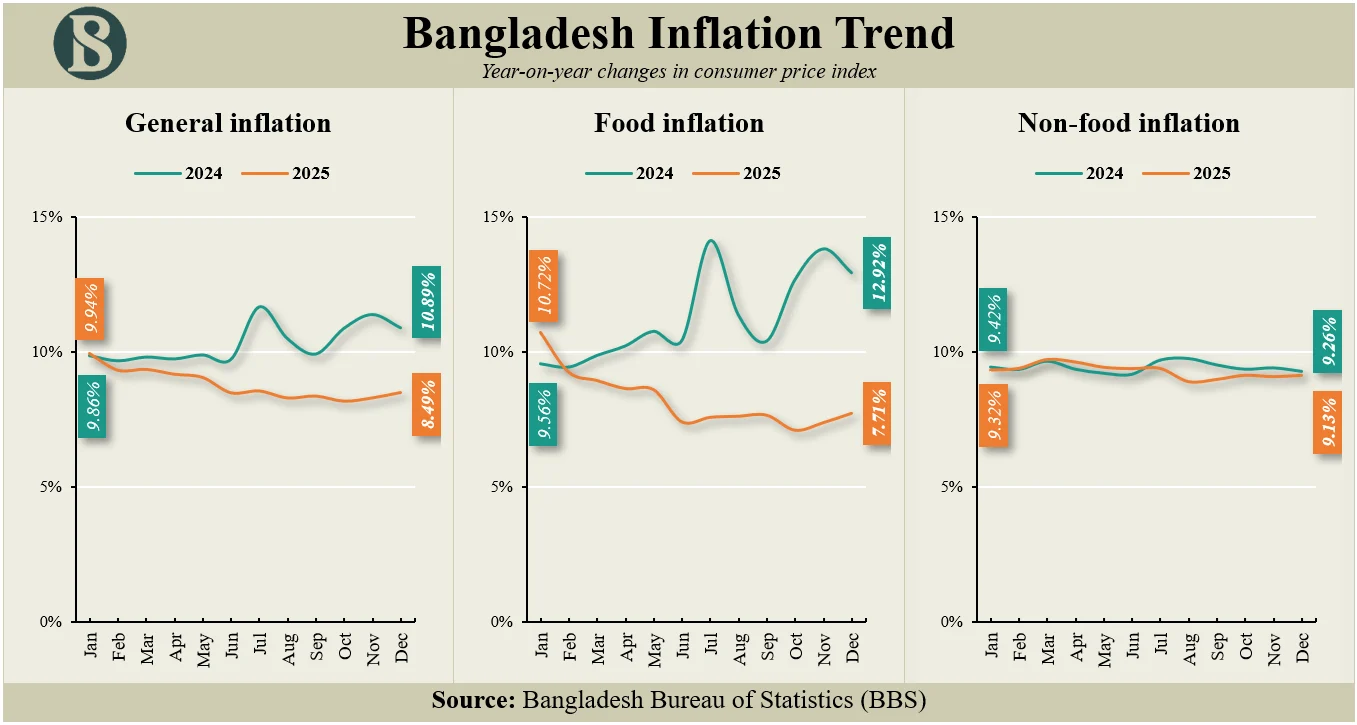
Infographic: TBS
Inflation climbed again last month, extending a prolonged period of high prices driven by supply-side bottlenecks, structural inefficiencies, and rising production costs.
The latest price index from the Bangladesh Bureau of Statistics (BBS) shows point-to-point inflation rose to 8.49% in December 2025, up from 8.29% in November. In December 2024, inflation stood at 10.89%.
Data released today (5 January) show inflation has remained above 8% for 41 consecutive months.
Food inflation in December rose to 7.71%, while non-food inflation reached 9.13%, compared with 7.36% and 9.08% respectively in November. A year earlier, these rates were 12.92% for food and 9.26% for non-food items. December’s food inflation was the highest in seven months.

Keep updated, follow The Business Standard’s Google news channel
Fahmida Khatun, executive director of the Centre for Policy Dialogue (CPD), said monetary policy has been tight for more than one and a half years, while fiscal policy remains largely contractionary. “Yet Bangladesh’s inflation is driven by supply-side and structural issues, not demand pressures,” she said.
She said falling international commodity prices have not translated into lower domestic prices due to transport costs, logistics, middlemen, extortion, and other supply-chain inefficiencies.
“Non-food inflation is also rising, influenced by behavioural patterns where businesses maintain prices even when production costs fall, anticipating future cost increases,” she added.
Fahmida said persistent inflation points to structural problems, including weak market management, inadequate storage facilities, crop wastage, high transport costs, and limited regulatory oversight.
She said rice remains a key in controlling food inflation. “If the government collects and stores adequate rice in time, it sends a strong message that artificial shortages cannot be created,” she said.
She said supply-side management, improved storage, and structural reforms are essential alongside monetary and fiscal measures for sustainable inflation control.
M Masrur Reaz, chairman and CEO of Policy Exchange, said December’s rise shows the battle against inflation is far from over, with early successes this year overshadowed by the latest uptick.
He said the taka has remained stable over the past year, suggesting other forces are driving inflation.
“A major factor is supply shortages of raw materials and intermediate goods, combined with disruptions in the supply chain. Weak domestic demand has reduced production, creating a trap where demand suppression aims to curb inflation, but lower output pushing prices higher,” he said.
Reaz urged authorities to adopt policies that gradually restore domestic demand while encouraging production in industry and services. “This would boost supply and ease inflationary pressures,” he added.
Urban and rural inflation
BBS data show rural inflation rose to 8.48% in December from 8.26% in November, though far lower than 11.09% a year earlier.
In rural areas, food inflation reached 7.67% and non-food inflation stood at 9.26% in December, compared with 7.27% and 9.24% in November. In December 2024, these rates were 12.63% and 9.65%.
Urban inflation rose to 8.55% in December from 8.39% in November, according to BBS. In cities, food inflation increased to 7.87% and non-food inflation to 8.99%, up from 7.61% and 8.91% a month earlier.
Nationally, the general point-to-point wage growth rate edged up to 8.07% in December from 8.04% in November, but remained below the 8.14% recorded a year earlier.
This marked the 47th consecutive month in which wage growth lagged behind inflation. By sector, wage growth stood at 8.16% in agriculture, 7.91% in industry, and 8.24% in services.
Masrur Reaz said persistently weak wage growth is hitting low- and middle-income groups hardest. He urged the government to expand support beyond open market sales, including transport subsidies, temporary relief on power and fuel bills, and coordinated wage adjustments with the private sector.