
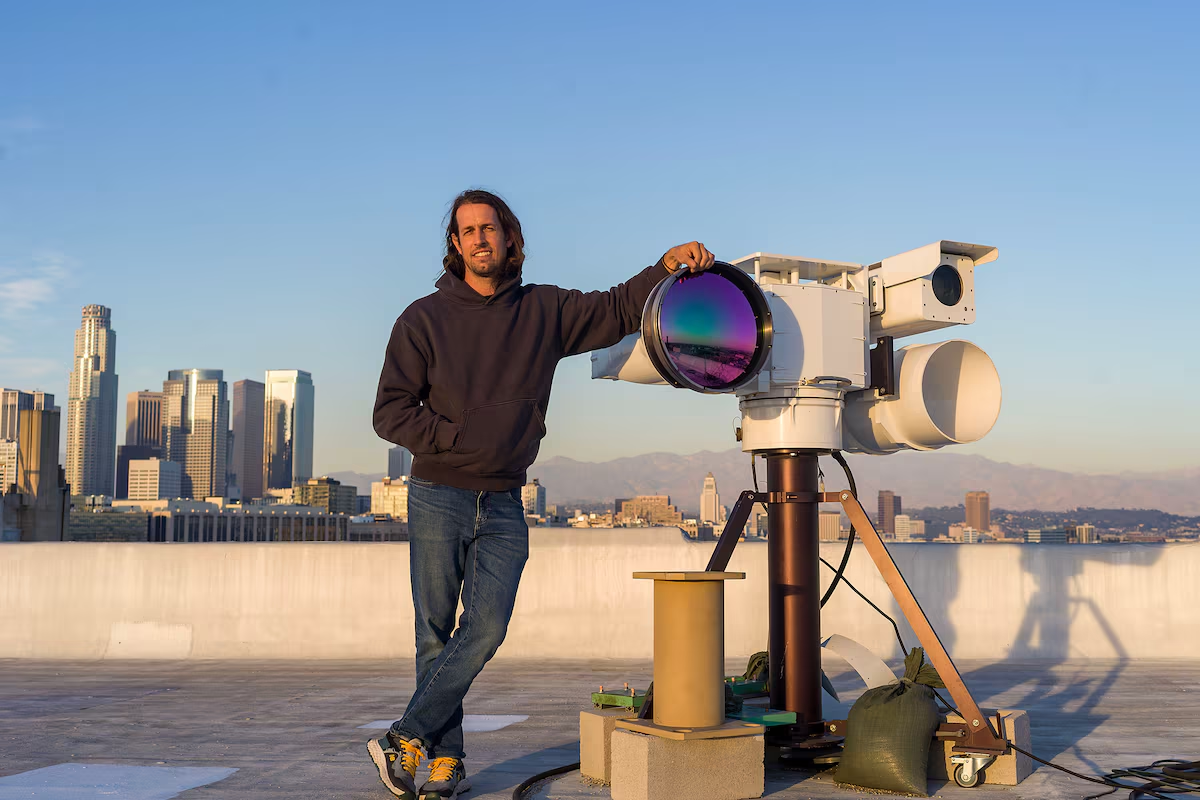
Matt Rabinovitch, CEO at Teleidoscope, poses with an artificial intelligence-powered airspace monitoring system on the roof of his downtown Los Angeles building on Dec. 3. The company is looking to expand into Canada.Barbara Davidson/The Globe and Mail
From the rooftop of his office in downtown Los Angeles, Canadian Matt Rabinovitch is monitoring the airspace around him. Positioned with a clear view of the flight path for planes travelling to and from the Los Angeles International Airport, it’s the ideal testing ground for his counter-drone technology.
The Toronto-born entrepreneur founded his company, Teleidoscope, in 2017. Back then, he was focused on tapping into the growing augmented-reality headset market. Today, the business has evolved and become known for its tracking, sensing and targeting systems, and autonomous products, with a customer base that includes Swedish defence company Saab and the U.S. Air Force, Army and Special Forces.
While Mr. Rabinovitch once left Canada to pursue his startup dreams, he’s now looking north for new markets to expand into as his native country becomes more serious about defence. Teleidoscope is ready and willing to grow north, he said. That is, if Canada wants it.
Ottawa to prioritize tech with civilian and defence applications in new strategy
Teleidoscope’s product roster includes artificial intelligence-enabled long-range tracking cameras, as well as a rocket-based drone interceptor based on technology it developed alongside the Ukrainian Ministry of Defence. Its interceptor can identify potential threats using cameras and other sensors and, after confirmation from an operator, can autonomously fly into or within range of an enemy drone.
Teleidoscope’s specialty is its ability to adapt to its customers’ needs, Mr. Rabinovitch said. For example, it can provide complete systems or integrate its software with its customers’ existing hardware.
“I think that’s a pretty unique differentiator, because most companies in this space are really focused on building airframes, whereas we look at the airframe as a subcomponent,” he said.
Teleidoscope’s evolution from headsets to drones meets the moment. As the war in Ukraine and its heavy use of drones continues to inform decisions being made by countries all over the world about unmanned systems and counter-drone capabilities, Teleidoscope is rising to the occasion.
Software engineer Bruce Wu works on a ground control station for a drone.Barbara Davidson/The Globe and Mail
Its first contract with the U.S.’s Department of War, worth up to US$100-million and with a significant amount already obligated, led to its technology being used to monitor the controlled airspace around Washington. Teleidoscope was awarded the contract in 2023 after an eight-month prototyping phase and subsequent demonstration phase, during which the first-time vendor beat out other high-profile U.S. defence contractors. More recently, it won a contract with the American Army Application Laboratory, an incubator for defence tech companies, to develop a tank protection system.
Meanwhile, in Canada, the federal government recently set aside $17.9-billion over five years to expand its military capabilities, including investments in counter-drone and long-range precision strike capabilities.
Despite a clearly stated need, Mr. Rabinovitch said Teleidoscope has yet to see the business case make sense for expanding into Canada.
The company’s first engagement with the U.S. government began with it receiving US$2-million to develop a prototype and ended in a contract that has the potential to grow to as much as US$100-million.
Meanwhile, opportunities in Canada are being presented as government grants worth between $50,000 and $500,000 with no clear transition into a contract afterward.
Mr. Rabinovitch said he sees a lot of potential for Teleidoscope to grow north but his decision to run the company without taking on any venture capital means he has to be careful about the risks he takes.
Since Teleidoscope outsources its manufacturing, Mr. Rabinovitch said it would be fairly easy for the company to partner with Canadian manufacturers to make hardware to go with its software and fulfill contracts there, aligning nicely with the federal government’s mission to create Canadian jobs from its defence spending splurge. But until the right opportunity – with the right paycheque – avails itself, Teleidoscope’s expansion north will have to wait.
“It’s a little frustrating. I‘m hoping that with the way things are moving on the government side that changes and they’ll have larger buckets of money for more non-traditional companies to get involved,” he said.
Barbara Davidson/The Globe and Mail
Mr. Rabinovitch’s entrepreneurship journey started in Canada around 2007. He spent summers on a lake in Ontario’s Muskoka area, peddling ice cream from a boat.
After a gap year spent working and travelling, he attended Queen’s University in Kingston to pursue a dual degree in commerce and computer science. Mr. Rabinovitch left during his third year to follow the money first to Montreal and then down south, after raising venture capital for his first startup from L.A.-based investors.
He worked on a number of ventures before landing on Teleidoscope eight years ago. His time in one particular tech incubator even led to him becoming inspiration for Mike Judge, creator of the sitcom Silicon Valley, who visited the incubator several times.
Back then, Mr. Rabinovitch was sharing a two-bedroom apartment with five other people. Mr. Judge later described his visits to this apartment as exactly the kind of absurd startup founder lifestyle he was trying to capture for his show.
“They would do all of their laundry together and then they would just wear whatever clothes came out of the bag, like interchangeably. Even though they were very different sizes,” Mr. Judge said on stage at Silicon Valley’s annual startup showcase TechCrunch Disrupt in 2014.
Mr. Rabinovitch has come a long way since shared laundry. But his earliest entrepreneurial memories are still rooted in Canada.
With the federal government setting up projects to increase domestic access to uncrewed systems, Mr. Rabinovitch said he’s excited to see the direction Canada is headed in.
Now, he’s just waiting for the right opportunity to build at home.