
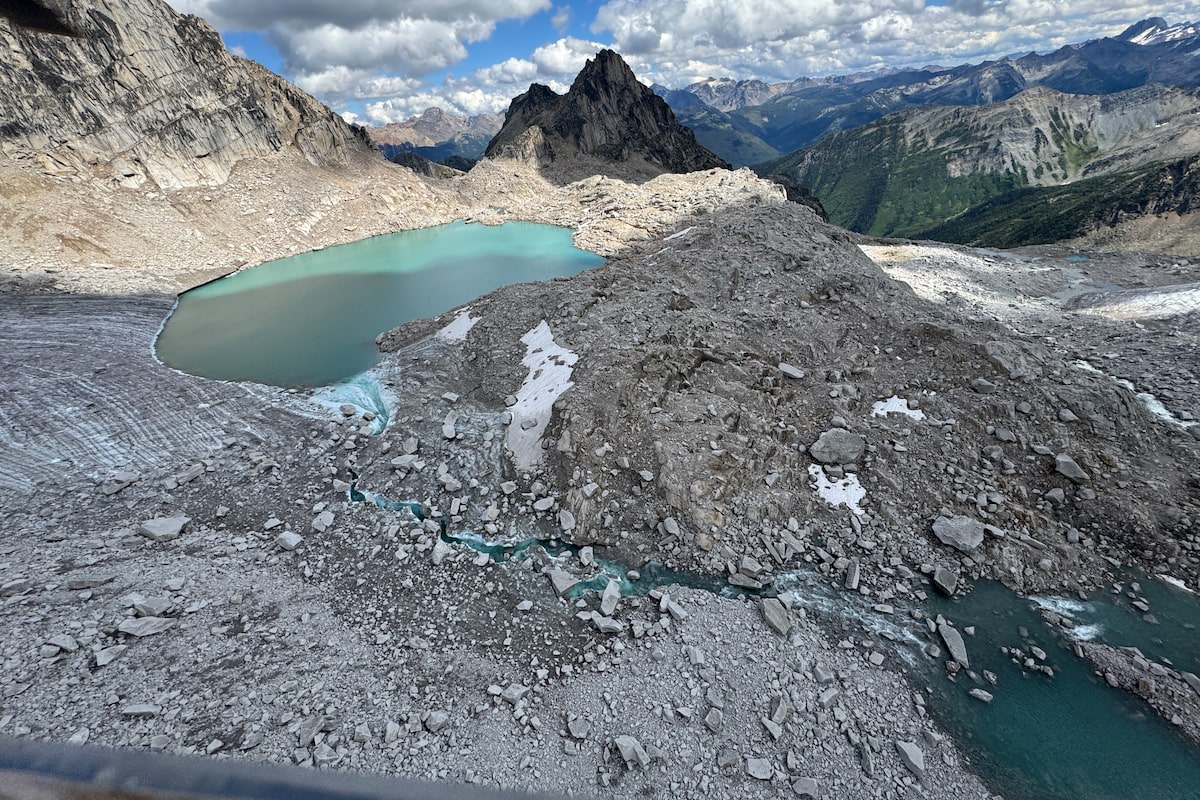
Brian Menounos is watching tens of thousands of years of ice shrink in a matter of a few years.
The professor of earth sciences at the University of Northern British Columbia has been increasingly urgent about the problem, a real-world, observable impact of climate change.
So it was bitter irony that 2025, the second-worst year on record for shrinkage, was also declared by the United Nations the “international year of glaciers preservation.”
As Justine Hunter writes, last year, an estimated 30 gigatonnes of mass washed away.
Menounos is part of a research team that studied glacier mass in Western Canada, the United States and Switzerland over 2021-24. Over that period, only 2023 was worse.
“We are not preserving glaciers. In fact, we’re accelerating the loss,” Menounos said.
The warnings from Menounos and other scientists aren’t abstract.
Last August, more than 60 hikers and climbers were rescued by helicopter from Bugaboo Provincial Park after the glacial ice dam that held a lake gave way, unleashing a flash flood that destroyed their only path out of the mountains in southeastern B.C.
Western Canada is home to more than 18,000 individual glaciers. In Bugaboo Provincial Park, which features several major glaciers, the government has hired a geotechnical consultant to assess the August flood.
A similar incident in the park occurred in 2017, when the natural dam holding the side of a lake created by the fast-retreating Vowell Glacier suddenly failed, triggering a flood. The park declared an emergency, but no hikers were trapped.
Shrinking glaciers are also contributing to droughts, which are threatening fresh water supply in communities from Merritt, B.C. to Cowley, Alta. When glaciers melt faster than they are replenished, the hydrologic cycles that reliably replenish fresh water supplies are disrupted.
Mountain glaciers, which scientists have warned are on track to lose half of their mass by the year 2100, are a critical water resource for nearly two billion people around the globe.
Glaciers have been the saviours for some of B.C.’s watersheds because they replenish water supply when the seasonal snowpack is gone. Menounos described them as “Mother Nature’s natural reservoirs.”
“They release cool, plentiful water when it’s needed,” Menounos said.
In 2023, Justine spent some time with Menounos as he worked on an ice-coring project aimed at retrieving hundreds of years of climate data – a historical record that currently exists only in small fragments in this region.
Ice cores from polar regions preserve data of the Earth’s atmosphere going back tens of thousands of years.
Mountain glaciers in Western Canada have trapped evidence of climate events that can help forecast the future in the region where millions live. Recorded in the ice are hundreds of years of temperatures and precipitation, and the scale and frequency of wildfires before modern fire suppression tactics began.
In 2023, the record loss of glaciers coincided with record fires.
When soot and ash from wildfires leave a dark blanket on the glaciers, the darker surfaces absorb more sunlight in the summer, causing the ice to melt faster.
“We haven’t really fully appreciated how important these feedback loops are,” Menounos said, “but we’re starting to see that play out in real time.”
The coming year is proving to be a tough one for progress on climate action. The election of Donald Trump as U.S. president has introduced a threat to Canada’s sovereignty the likes of which it’s difficult to compare.
The federal and provincial governments have raced to develop the Canadian economy away from exports to the United States in an effort to inoculate the threat.
That has meant a focus on resource extraction, including oil and gas. Environmental measures such as federal and provincial carbon taxes have been eliminated.
In June, tankers filled with liquified natural gas from B.C. began travelling nearly 300 kilometres toward Asia, marking the launch of the province’s LNG industry.
And in early December, Canada negotiated a framework with Alberta with a goal of building a new oil pipeline across northern B.C.
Justine notes: “These developments didn’t change the weather. But they demonstrate a set of priorities that don’t fit with what climate scientists say is needed to slow global warming.”
This is the weekly British Columbia newsletter written by B.C. Editor Wendy Cox. If you’re reading this on the web, or it was forwarded to you from someone else, you can sign up for it and all Globe newsletters here.