
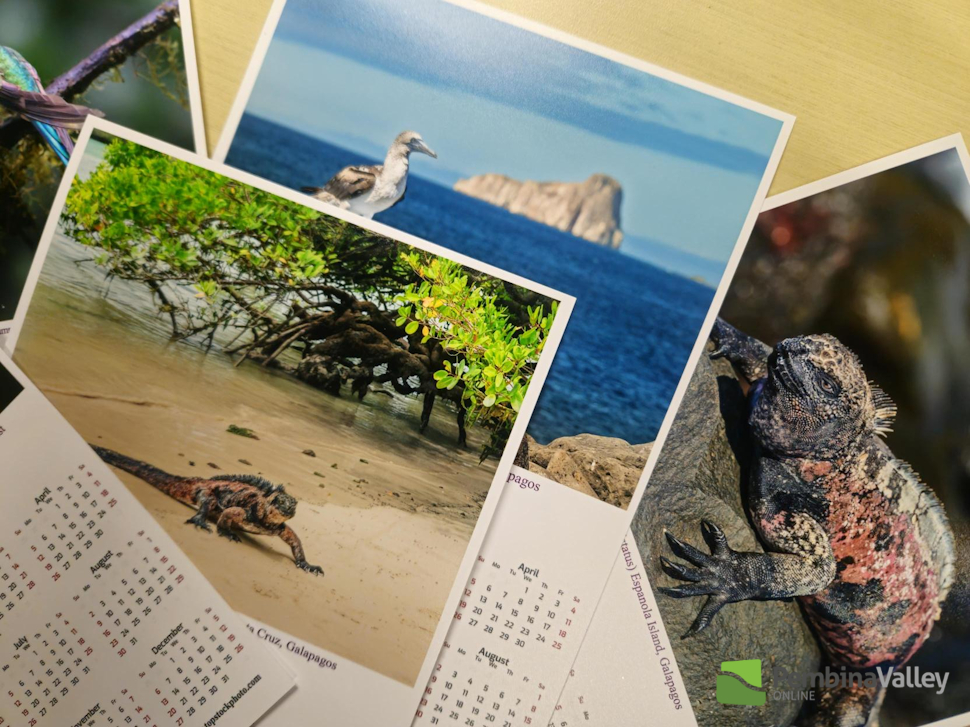
Terrance Klassen and his wife Esther Anne Klassen are well known in the Pembina Valley for their stunning travel photography. They license their images for use in corporate and editorial publications, audiovisuals, fine art décor, and web sites.
Terrance spoke at the start of this year of their two-week bucket list trip to Ecuador and the Galapagos Islands, which provided them with an abundance of wildlife to photograph.
“All of our trips are for photography. We always say, what other reason is there to travel than to photograph?” Klassen shared. “We went to Ecuador and the Galapagos Islands to photograph.
“The Galapagos Islands are a group of 25 to 30 islands, about 600 miles off the coast of Ecuador. The highlight there mainly is the wildlife, and the accessibility of wildlife.”
Animals unconcerned by tourists
A common denominator over the Klassens’ time there was working with their model subjects, each and every one of them entirely indifferent to their presence.
“The birds and animals are tame. You can walk right up to them, or in fact they’ll walk right up to you.” Klassen said “The Galapagos Highlands are a national park. Everywhere you go, you need a park guide. You can’t go anywhere without a guide. It’s very ecological and environmentally friendly.
“You may know the Galapagos Islands from the history books of Charles Darwin. He went to the Galapagos Islands and formulated the theory of evolution.”
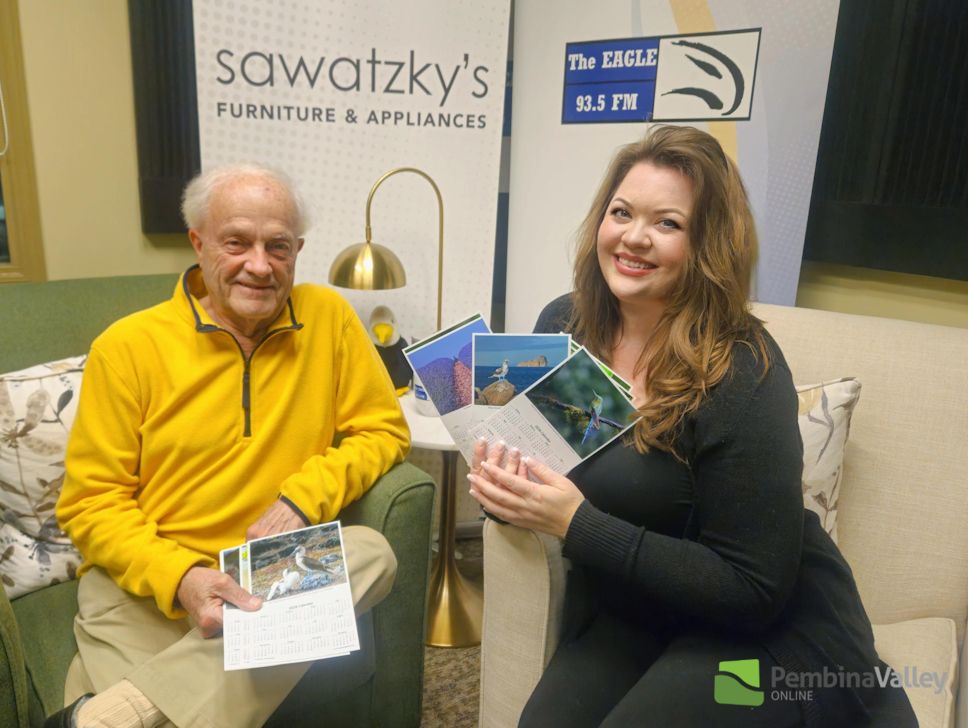 Terrance Klassen, Jayme Giesbrecht
A wide variety of wildlife to view
A rich biosphere for diverse wildlife populations, the national park features a research station on Santa Cruz Island, one of the Galapagos Islands.
“They research animals, turtles, mainly the giant tortoise is researched there. We went to see that.” Klassen said. “For us, it wasn’t a study of evolution. It was a confirmation of creation. But that’s what we saw. We’re not wildlife photographers, but we don’t pass up the opportunity when we have it. On the Galapagos Islands, it’s just so easy to photograph wildlife.”
Easy to photograph, as all of the varied species of animals essentially ignore the curious humans around them. Marine iguanas were just one example of how easy the Klassens’ task was.
“You’ll see the marine iguanas coming out of the water.” Klassen shared. “They live in the water, but they come onto land and they’re not afraid of you. They’ll come right by you and walk right by you.
“The rules of the national park are that we’re not supposed to touch the animals. But we can’t control if they want to come up to you, so we just got out of their way. It’s a unique experience.”
Experiencing wildlife
Klassen went on to describe other wildlife highlights.
“Hummingbirds are on mainland Ecuador,” he explained. “There’s a number of hummingbird farms or ranches, and they’ll eat out of your hand. You’ll hold your hand out with a little feeder in your hand, and they’ll come; three or four birds will sit on your hand and feed.
“They hover or they perch on your hand. They’re very tiny little birds, but you see with our pictures, they’re very vibrant colors. Fluorescent, almost holographic.”
Related stories:
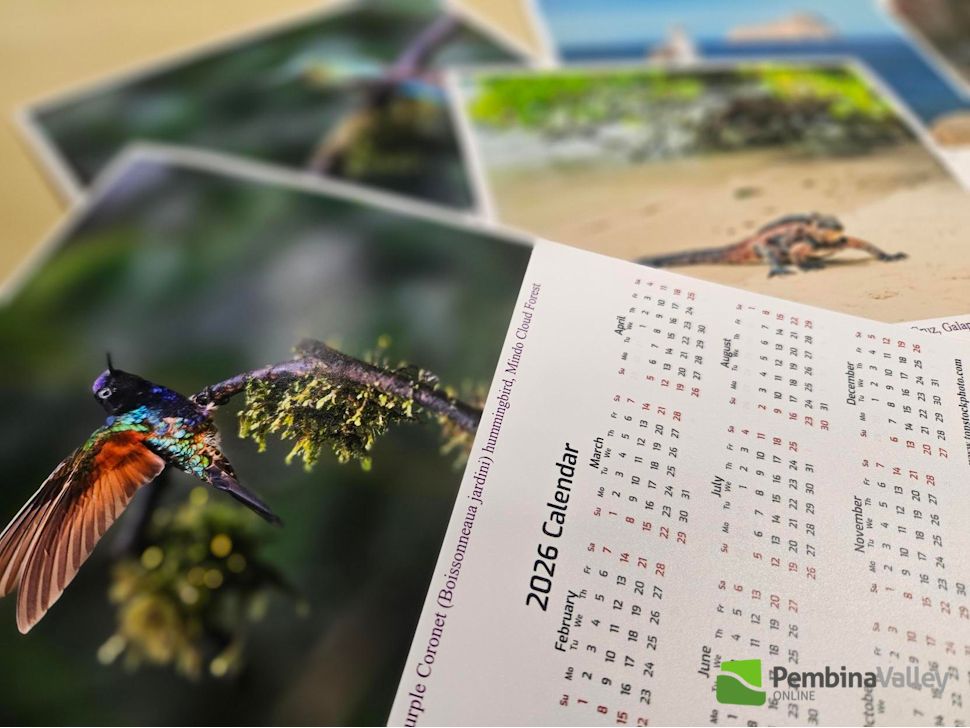 2026 wildlife calendar
The waters are home to so many different creatures.
“Sea lions are mainly on San Cristobal Island.” Klassen said. “Some pictures we’re sitting on a park bench and they’re lying beside us, like a dog. They’re quite at home, they’re sleeping. They don’t even open their eyes to see who’s next to them. They just feel that they’re not going to be harmed.”
You can’t think about the Galapagos without thinking of boobies.
The blue-footed booby bird that is, on Espanola. There’s also a red-footed booby, and a Nazca booby.
“Their feet are really blue.” Klassen shared. “They turn blue about two years into maturity. They nest right beside the path that you walk beside. They don’t bother with you, they’re sleeping on their nest.”
“It’s not just animals.” Klassen explained. “The flora is incredible. The Galapagos are volcanic base, so the black rock allows you to see all kinds of things. The vegetation is sparse, but it’s a desert vegetation. There’s a lot of cactus on the island and some shrubbery, but mainly it is the wildlife that attracts you there.”
Be prepared, explorers
If you are considering a trip yourself, Klassen outlined highlights of the working vacation that he and his wife undertook.
“There’s a couple of inhabited islands in the Galapagos. Most of them are uninhabited for the wildlife, but there’s a few cities where you stay at.” Klassen said.
“There’s comfortable hotels. You stay at a hotel on one of these islands. There are tour boats. They’re outfitted like yachts. They’re large enough for a group of 12 to 16 people, and some of the islands are far away. We spent four to six hours on the boat to get to Espanola Island, for instance.
“We did a land-based trip, got on a boat to go from island to island. You come back to the hotel, but you can do a sea-based tour where you live on the boat and you go from island to island that way. You live on a boat and you scuba dive and you snorkel. There’s a whole other world under the water of the Galapagos.”
 Terrance Klassen, Jayme Giesbrecht
Unlike other sun destinations, sandy beaches aren’t the norm in this wildlife paradise. At almost 80 years old, Klassen described what visitors should expect.
“You realize that on the islands you have to walk or hike around on is made-up of lava rocks.” Klassen said. “So you’re scrambling on the rocks. There’s no nice little smooth paths to walk on.”
Next up on the itinerary
With this Galapagos bucket list checked off, the Klassens have an eye to other inspiring locations for their photographer’s eyes.
“A possibility right now is, we’re keeping an eye on California and Arizona deserts.
“If you’ve paid attention to the weather forecast, they’ve had multiple storms go through there.” Klassen said. “They had a three day winter rain end of November and yesterday the second one just finished they had over Christmas. When the desert gets rain they get a wonderful super blooming of flowers in the desert. The whole desert blooms with flowers.
“That occurs every eight to 10 years. We’ve photographed two of them in our lifetime. So this year is another possibility. End of February, March, and into April, the desert will bloom, if the conditions are right. They need some more rain into January, February to keep things going. But they’ve had a very good start.”
Further from home, even more exotic locations are being considered.
“The other possibility is we’re keeping an eye on Saudi Arabia.” Klassen shared. “It’s open for tourism now. They’re trying to welcome tourists. That’s something new for them. We have kind of a pet project to photograph where the children of Israel came out of Egypt.
“During COVID, we were in Egypt photographing the Red Sea crossing on the Egyptian side. The other side is in Saudi Arabia, in Midian, so we’d like to go to Saudi Arabia and photograph the western, the eastern side of the Red Sea crossing.”
View more from this trip
The Galapagos bucket list trip led to a wealth of photo opportunities for the Klassens.
“I took thousands of pictures, so it’s a month or two of editing.” Klassen said. “ I’ve probably done just over half of them right now. I post them on my website topstockphoto.com.”
The Klassens created 2026 calendars from the trip. Visit their website to see what they’ve created, and for more information.
with files from Jayme Giesbrecht and Ty Hildebrand