
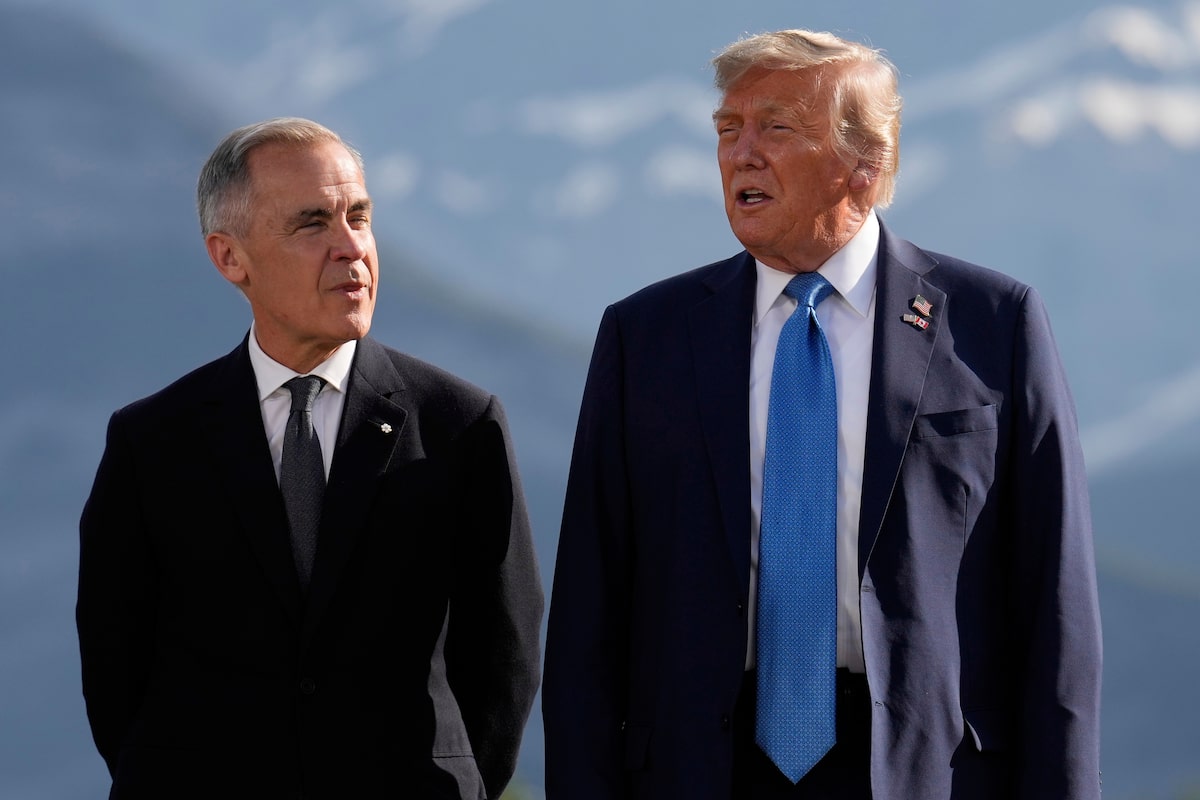
Prime Minister Mark Carney, left, with U.S. President Donald Trump at the G7 Summit in June in Kananaskis, Alta.Mark Schiefelbein/The Associated Press
The monster of Venezuela, Nicolás Maduro, is gone. Good. Most can agree on that, despite the trashing of international law employed by the Donald Trump administration to get him.
But as the predator President of the United States warns of toppling other nations – which, for one thing, distracts from afflictions in his own broken country – the task will be much more difficult.
Among the leaders of other places in his sightline – Greenland, Cuba, Colombia, Panama – none are international pariahs like Mr. Maduro, who maintained power by force. Excepting Cuba, they are all democratically elected. Aggression against any of them will prompt far more opposition.
The expertly executed abduction of Mr. Maduro has not given Mr. Trump the boost in the polls that was expected, either. Americans aren’t buying the White House propaganda that he was a threat to them.
Canada faces existential challenge from Trump’s hemisphere strategy, former envoy warns
The chest-thumping Mr. Trump’s newfound embrace of the Monroe Doctrine, and the return to 19th century colonial muscle-flexing by him and his genuflectors such as Marco Rubio and cement-head Stephen Miller, has renewed fears in Canada that he will move to make good on his talk of making this country the 51st state.
For a raft of reasons, however, the fears are overstated.
There are two years and 10 months until the next presidential election. There are surely about a half-dozen countries on Mr. Trump’s mused-about target list ahead of Canada. Are we to believe that he will forgo taking action against them and suddenly turn on Canada, where many of his grievances are being addressed? Or that he will gobble up many of the other territories in the limited time frame and still have the resources and support to move militarily against the northern neighbour as well?
One of the motivating factors for Mr. Trump’s annexation talk was Canada’s oil resources. The Venezuela operation was a successful oil grab. The need for the Canadian resource has fallen.
Only 17 per cent of Americans favour Canada becoming the 51st state, according to a YouGov/Yahoo poll. If Americans were asked if they wanted to use force against Canada, the number would even be tinier. Are we to believe Mr. Trump would risk the wrath and opposition of the vast majority of his population, not to mention all of NATO, in embarking on naked aggression against a historic friend and ally?
John Rapley: Trump’s thirst for Venezuelan crude will hasten the death of oil
Andrew Coyne: When it comes to Trump’s behaviour, the most plausible explanation is the stupidest
Mr. Trump bases many of his decisions on personal relations. His annexation talk began with Justin Trudeau, whom he didn’t like. He appears to have respect for Prime Minister Mark Carney who, last we checked, is not a narco-terrorist.
To be noted also is that in the Trump administration’s recent and belligerent national security strategy paper asserting American dominance over the Western Hemisphere, Canada received scant mention.
Mr. Trump’s major complaints with Canada have been about drugs, trade and defence spending. The overstated problem of the trickle of fentanyl entering his country from our border has been dealt with. On defence spending, Ottawa has pledged huge boosts. On trade, the USMCA is about to be renegotiated, giving Mr. Trump the opportunity to recast it to his liking.
The President is still irked by the ad run by Ontario Premier Doug Ford, which cited former U.S. president Ronald Reagan decrying tariffs. Mr. Carney has apologized for it.
It’s possible Mr. Trump could be enticed to offer support to the Alberta separatist movement. Members have reportedly had meetings in Washington with Republican officials. But rather than help, support from MAGA would be more likely to hurt the campaign, which has very little chance of success to begin with.
Certainly, the question of superpower rivalries in the Arctic could prompt Mr. Trump to make moves affecting Canadian sovereignty. At a meeting of NATO leaders in Paris, Mr. Carney made the point that whatever security concerns Mr. Trump has about the increasing presence of China and Russia in the Arctic can be addressed through the alliance: “We are partners in NATO. It’s a mutual defence alliance. We can provide that security.”
All said, there is still little cause for comfort in Canada. The President has further destabilized the international order by setting a precedent that makes it okay for a foreign country to indict another country’s leader in their courts and send in their special forces to abduct said leader.
Though there is little chance of military aggression from Mr. Trump against Canada, untold havoc can flow from his new imperialism. It makes it imperative that our economic and military capacities are built up to help safeguard our sovereignty. And it makes it imperative that we don’t antagonize the trigger-happy demagogue in the process.