
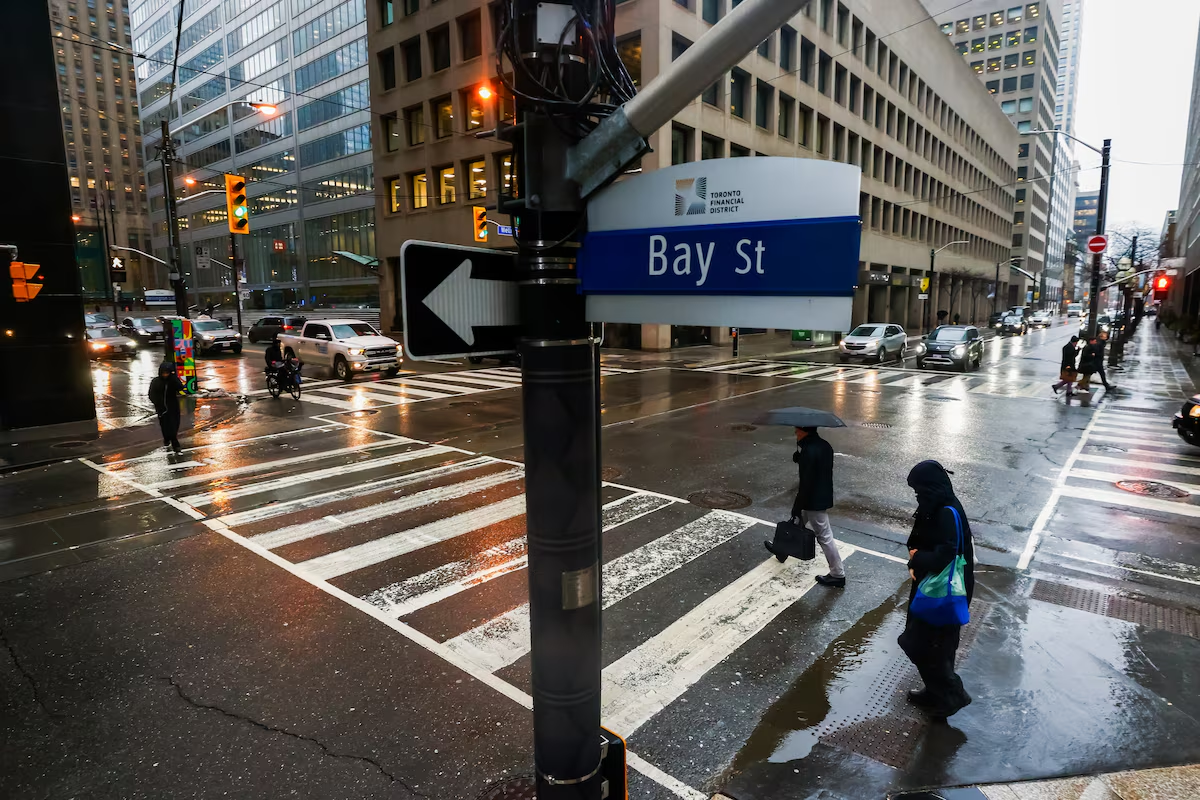
Some economists suggest Ottawa is not going far enough to really spur business investment and begin to address the country’s long-standing productivity problems.Cole Burston/The Globe and Mail
The Canadian economy is entering 2026 on a sturdier footing than expected and Ottawa and the provinces are finally taking steps to improve the country’s business climate, according to Bay Street’s top economists.
Still, U.S. tariffs are hammering some regions of the country – notably Southwestern Ontario – much harder than others, and efforts to reorient economic policy and encourage business investment remain at an early and fragile stage, they said.
The chief economists at Canada’s six largest banks struck a cautiously optimistic note at the Economic Club of Canada’s annual look-ahead event in Toronto on Wednesday, where they outlined expectations for slow but positive economic growth, steady interest rates and the hope that stock markets keep rising, despite concerns about an AI-fuelled bubble.
A year ago, most were expecting U.S. President Donald Trump’s protectionist policies to push the Canadian economy into a recession.
What actually unfolded was less severe. Broad tariff exemptions for Canadian exports, resilient household spending buoyed by a rising stock market, government support measures and a series of interest rate cuts combined to put the economy on track for around 1-per-cent growth last year.
Opinion: Carney wants to build big, but will Bay Street follow?
At the same time, U.S. threats have led to a shift in economic policy, with Prime Minister Mark Carney and his provincial counterparts pursuing a more business friendly agenda of deregulation, infrastructure building and tax incentives for investment.
“Whatever the U.S. did made the federal government realize that something was wrong with our economy, and it led to the most important repositioning of Canadian economic policy at the federal level in a generation,” Stéfane Marion, chief economist at National Bank of Canada, said in a panel discussion at the Economic Club of Canada event.
This economic resilience comes with caveats. Mr. Marion said that the Canadian economy continues to underperform, even as the Toronto Stock Exchange is hitting record highs in response to policy changes and strong metals prices.
Frances Donald, chief economist at Royal Bank of Canada, noted the regional disparities caused by U.S. tariffs. While most Canadian goods and services remain free of U.S. tariffs, the sectoral duties on steel, aluminum and automobiles have been a major drag on the country’s manufacturing heartland in Ontario and Quebec.
“As we head into 2026, we have to be cautious about saying the economy is resilient. In some places, the economy is growing twice as fast as the national average, like in Alberta. And other places, there’s still a lot of pain that’s going to take a lot of time to sort of recoup,” Ms. Donald said.
Opinion: Beware the rosy 2026 economic forecasts, for pride comes before a fall
There was broad agreement among the six economists that the federal government is moving in a positive direction from the perspective of economic growth. But several suggested Ottawa is not going far enough to really spur business investment and begin to address the country’s long-standing productivity problems.
“What they’ve done so far is unwind previous bad policy, or they are trying to unwind it,” said Toronto-Dominion Bank chief economist Beata Caranci. “But we’re not in the phase, I believe, of accelerating growth. We haven’t really done a review and a revisiting of our corporate tax structure or personal income tax structure. I do not think we can get into high growth mode without this.”
She pointed to small business tax rules that discourage companies from growing beyond a certain size as an example.
Looking ahead, none of the economists expect further interest-rate cuts from the Bank of Canada in 2026, although several think the central bank may start increasing rates in the back half of the year to deal with inflation that has remained stuck several notches above 2 per cent.
Douglas Porter, chief economist at the Bank of Montreal, expects the central bank to remain on hold. While inflation is proving somewhat sticky, weak oil prices should keep overall Consumer Price Index inflation in check.
“It’s incredibly rare to get real inflation when energy prices are going the other way, as they are right now. So, I am not that concerned about the inflation outlook,” he said.
Canada’s sluggish housing market could benefit from interest-rate stability. However, Avery Shenfeld, chief economist at Canadian Imperial Bank of Commerce, said he isn’t expecting a rebound in housing market activity any time soon – although there could be regional variations.
“We still have an overhang of existing and planned supply, downward pressure on condo prices. And I think therefore nationally, even if we do get a bit of a pickup at single-family-housing starts in some parts of the country, overall, housing is still going to be a drag,” Mr. Shenfeld said.
Ultimately much of the path forward for interest rates and the Canadian economy more broadly will depend on developments in U.S. trade policy.
Canada, the U.S. and Mexico are entering negotiations in the coming months over the renewal of the continental free-trade agreement, the USMCA. There is a range of possible outcomes, from minor tweaks to the complete U.S. withdrawal from the agreement.
Jean-François Perrault, chief economist at Bank of Nova Scotia, said he isn’t particularly worried about the USMCA discussions. There’s going to be the “inevitable Trump noise about ripping it up,” he said. But the President’s decision to exempt most Canadian and Mexican goods from tariffs suggests he understands how painful it would be for U.S. businesses and consumers if the deal collapsed, Mr. Perrault said.
His bigger concern is that Canada squanders a rare political moment, when politicians at all levels and in all regions seem aligned on the need to improve internal markets, encourage investment and boost productivity.
What keeps him up at night, he said, is that “we revert to the path that we have been on forever … [and] find ways to put sticks in our wheels.”