
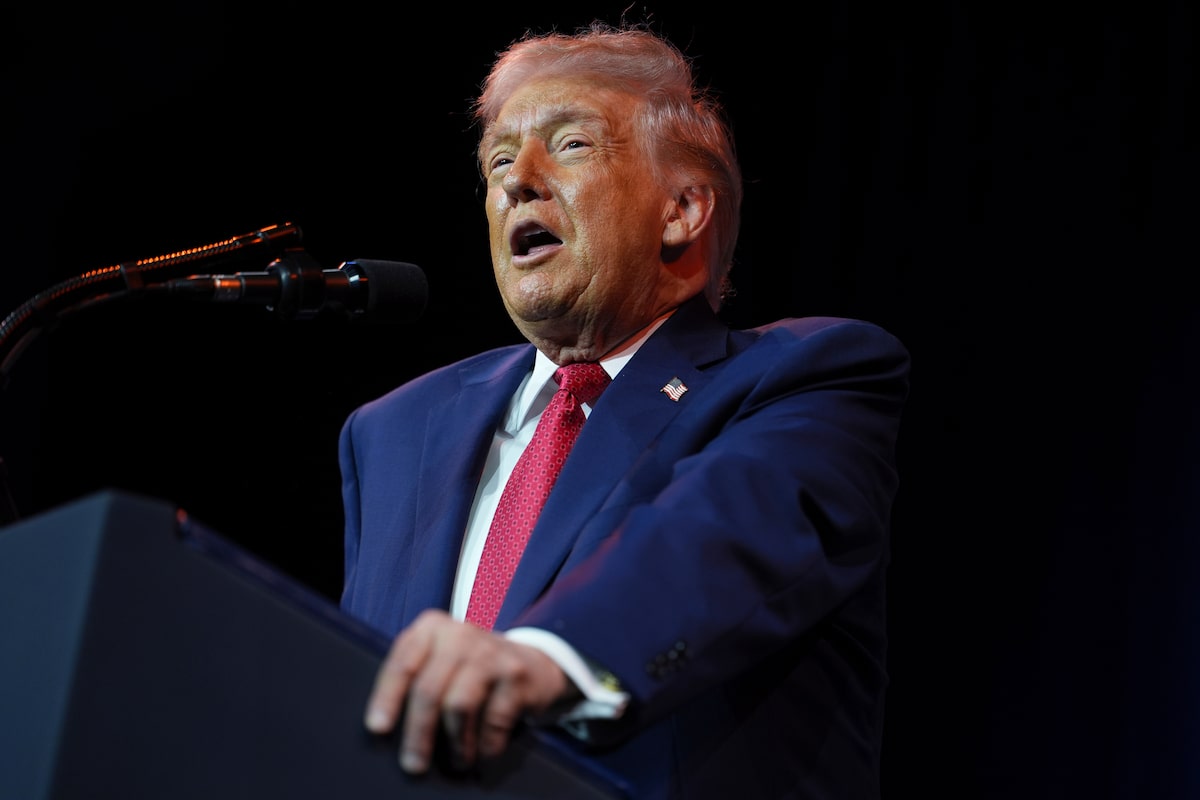
U.S. President Donald Trump speaks to House Republican lawmakers during their annual policy retreat in Washington on Tuesday.Evan Vucci/The Associated Press
If it came in isolation, one might look at the toothless debates over the legality of the U.S. abduction of Venezuelan President Nicolás Maduro and chalk it up as another American intervention in Latin America. But the context is not the same.
It’s not just that U.S. President Donald Trump warned Colombian President Gustavo Petro that he could be next. He left the rest of Mr. Maduro’s repressive regime in power, under threat, and, according to his social-media post on Tuesday, extracted a payoff of US$2-billion in Venezuelan oil. Then he told reporters he still doesn’t rule out taking Greenland from Denmark by force – not for the benefit of Greenlanders, but because the United States wants it.
No one should shed a tear for Mr. Maduro. But so far, there is no sign of a U.S. intention to free Venezuelans from tyranny. There is certainly no need to liberate Greenlanders from the Danes. There is no pretense of nation-building or even much of a globo-cop claim to the cause of justice.
Lawrence Martin: If it’s any consolation, Canada is far down on Trump’s takeover list
Mr. Trump has effectively declared the United States to be a predator nation. And the U.S. Congress and the rest of the American polity aren’t standing in the way.
This is no longer a world where there is a “West” led by a United States that, however imperfectly, sees itself as acting for the greater good of the world. Now we are in a shark tank.
There are predators – China, Russia and now the U.S. – and others, such as Canada, trying to swim safely.
Look at the reports that European leaders, meeting in Paris over peace proposals for Ukraine, would work together to try to figure out ways to respond should the U.S. act on its threats to take Greenland.
Konrad Yakabuski: U.S. Secretary of State charts Trump’s surprisingly hawkish foreign policy
What they have come up with so far is a joint statement from leaders of a half-dozen European nations that declared the future of Greenland would be decided by Denmark and Greenland, “and them only.”
Yet there wasn’t much direct criticism of Mr. Trump for threatening to invade a democracy and a NATO ally. They fear the punitive response of a volatile president.
That was clearly the case for Prime Minister Mark Carney, too. He voiced backing for Denmark’s sovereignty over Greenland and asserted that NATO could protect it – but he didn’t dare point the finger at the President threatening to send his military to invade a democracy.
Would a Canadian prime minister seeking to extend a vital trade agreement with the U.S. take the risk of poking Mr. Trump? What about European leaders whose countries depend on the U.S. for security? How do smaller non-predators conduct foreign policy in a shark tank?
Mr. Carney has already turned toward Europe. Canada and NATO allies have pledged to build their militaries, but it will take time. Mr. Carney travels to China next week – to be followed by Britain’s Keir Starmer and Germany’s Friedrich Merz – as part of efforts to diversify trade ties. But in geopolitical terms, it’s dangerous to balance one predator with another. Is there a kind of diplomacy that can contain Mr. Trump?
Even if it still seems unthinkable that the U.S. President would follow through on taking Greenland by force, his threats are changing international relations.
What’s happening in Venezuela? Submit your questions here
Andrew Coyne: When it comes to Trump’s behaviour, the most plausible explanation is the stupidest
The U.S. no longer claims exceptionalism, a role as a global policeman that supposedly justified its breaches of the sovereignty of others, in wars, and interventions such as the invasion of Panama to abduct strongman Manuel Noriega 36 years ago. Mr. Trump just doesn’t accept the sovereignty of other countries except as asserted by power.
His deputy chief of staff, Stephen Miller, insisted that Denmark has no “claim” to Greenland, in much the same way that Vladimir Putin insisted that Ukraine is not a real country.
That’s unsettling to the world’s democracies – particularly Denmark, of course. But Canadians might also be a little perturbed to note that Mr. Trump claims the U.S. needs to own Greenland, rather than leaving it in the hands of a NATO ally, because of its strategic polar location at a crossroads with Russian and Chinese ambitions. The thing strategically located between Greenland and the U.S. state of Alaska is Canada’s Far North.
It still really is unthinkable that the U.S. would invade Canada. But it’s getting easier to imagine Mr. Trump employing heavy-handed tactics to coerce Canada, or contest its Arctic sovereignty, or cause a rupture in the security alliances that have been foundations of this country’s foreign policy for 80 years.