
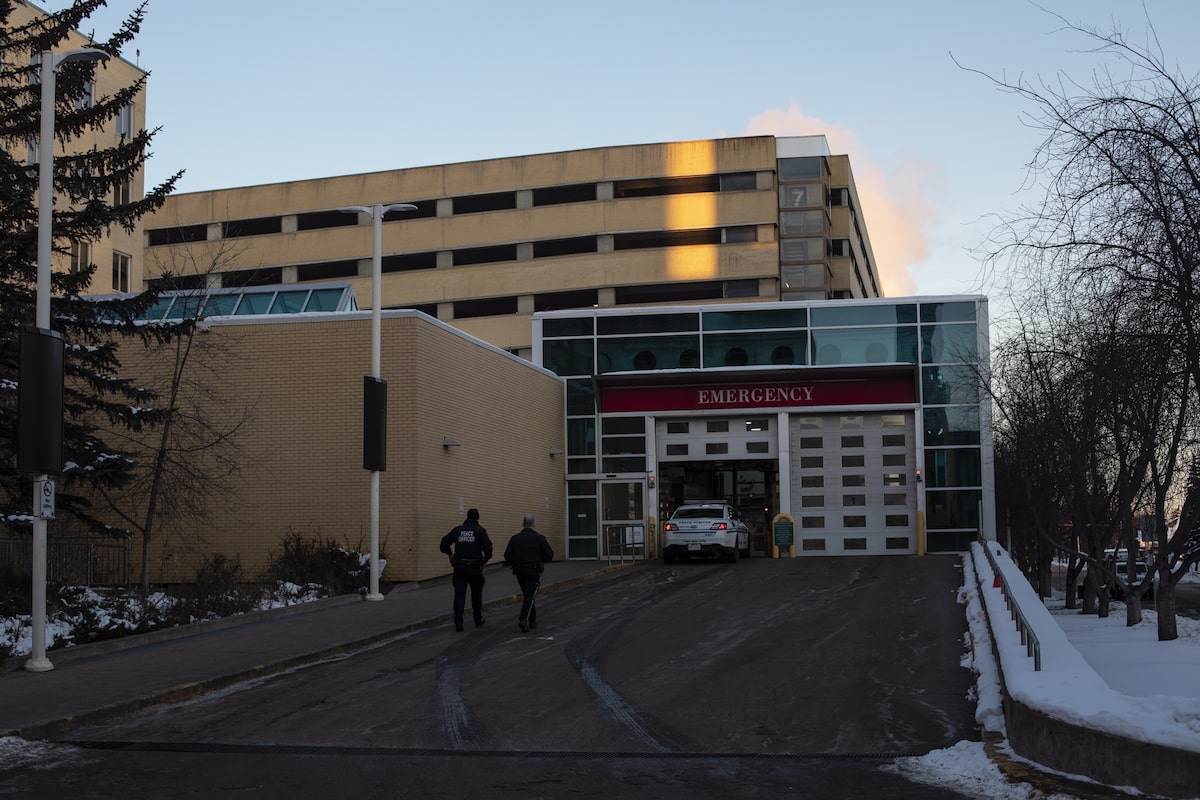
Emergency and internal medicine physicians in Edmonton have exhausted all options to meet patient demand, says Paul Parks, president-elect of the emergency physicians section of the Alberta Medical Association.Amber Bracken/The Globe and Mail
Doctors working in Edmonton’s major hospitals are calling on the Alberta government to declare a state of emergency because there is no more room to safely accept patients.
The call comes shortly after the much-publicized death of Prashant Sreekumar, who died on Dec. 22 after spending eight hours in the emergency room at Edmonton’s Grey Nuns Community Hospital. On Wednesday, The Globe and Mail learned that he was actually one of three people who died in the Grey Nuns ER that day.
Hospitals in Edmonton have been struggling for years to keep up with patient demand, especially in the wake of the COVID-19 pandemic. But added pressures, such as rapid population growth, underfunding and the strain of alternative level of care, or ALC, patients, have pushed them to the brink.
Patients are designated as ALC when they no longer require hospital care but still occupy a hospital bed until they can be transferred to another setting, such as a long-term care home.
Family grieving, government investigating after man dies waiting in Edmonton ER
Edmonton also serves as a referral centre for patients from all of Northern Alberta and the Northwest Territories who need specialized treatment, a catchment area that is significantly larger than Calgary’s. The annual influenza season – one that is shaping up to be the worst in years – is adding to the strain.
Paul Parks, president-elect of the emergency physicians section of the Alberta Medical Association, said emergency and internal medicine physicians in Edmonton have exhausted all options to meet patient demand. He said the situation is putting patients at serious risk of harm, which prompted the call to action.
“We’re operating in disaster mode everyday,” Dr. Parks said. “We’re at this point where the only way that we can safely take care of new patients coming in is we have to activate an emergency plan.”
Mr. Sreekumar, a 44-year-old father of three, died from suspected cardiac arrest. Covenant Health, a publicly funded Catholic health care provider that operates Grey Nuns, said in a statement on Wednesday that two others died on Dec. 22 in the Grey Nuns ER “while receiving active care.”
Covenant Health did not provide any additional details and said it was not permitted to comment on the types of care the patients received.
The Alberta government is investigating the circumstances of Mr. Sreekumar’s death. It is unclear if it will extend to the other deaths.
A state of emergency can be declared under Alberta’s Public Health Act and would grant broad but temporary powers to protect public health, allowing, for example, the allocation of emergency funding and the ability to co-ordinate the delivery of health services. Former premier Jason Kenney declared states of emergency twice during COVID.
Alberta using selective data to mask health care failings, Auditor-General says
Dr. Parks said, in practical terms, this could mean opening up beds in other wards, transferring patients from north of Edmonton to Calgary, funding additional staff and beds or postponing surgeries, which he said is an “action of last resort.”
“But, in order for us to take that next really sick person with influenza or pneumonia or stroke, we have to use surgical beds,” he said.
Maddison McKee, press secretary to Primary and Preventative Health Services Minister Adriana LaGrange, linked the “exceptionally busy” hospital system to the flu season. She said measures taken to ease pressure, such as cancelling some scheduled surgeries, are in line with past winters and have been required on a limited scale.
“Calls for a ‘state of emergency’ are misguided and would add nothing to what is already being done,” Ms. McKee said, adding that “comparisons to the pandemic emergency are rhetorical and not based on evidence.”
Dr. Parks said Edmonton physicians have been asking for help, but restructuring of the health system under Premier Danielle Smith’s government has caused “constant chaos.” He said many front-line providers are “paralyzed” because they don’t know who to bring their concerns to, or are scared of professional repercussions if they do so.
The province has replaced Alberta Health Services, which used to be the province’s sole health authority, with four health agencies (Acute Care Alberta, Primary Care Alberta, Recovery Alberta and Assisted Living Alberta).
Opinion: Too many Canadians are leaving ERs before getting assessed
A doctor working in one of Edmonton’s inner-city hospitals said patients are getting stuck in precarious positions. The Globe and Mail is not naming the doctor because of concerns that speaking publicly would affect their employment.
They said patients are gridlocked between the ER and inpatient units. For example, people who arrive by ambulance are being offloaded into hallways and patients already admitted are on stretchers in the ER because there is no room on the wards.
Physicians in all five of the city’s major hospitals can no longer keep up with the volume and have said no to accepting patients from outside of Edmonton in recent weeks – though sometimes they have no choice.
As of early Wednesday afternoon, Dr. Parks said provincial data showed 60 patients were admitted and 13 others were pending consultation at the University of Alberta Hospital, which only has 65 official beds. Similarly, at Misericordia Community Hospital, which has 55 beds, there were 52 people admitted and 14 pending consultation. Other hospitals were in similar positions.
At the university hospital, he said two patients offloaded in the EMS waiting area, who require additional care and movement to a ward, had been there for 70 and 65 hours respectively. Another patient at Misericordia was at the 43-hour mark.
Raj Sherman, an emergency physician at WestView Health Centre in Stony Plain, west of Edmonton, said sick patients who live minutes away from Edmonton hospitals are being diverted to WestView, which is already packed with patients from the area and lacks specialized services.
“I have never seen it this bad in 35 years of front-line medical practice in the emergency department,” said Dr. Sherman, a former provincial politician.