
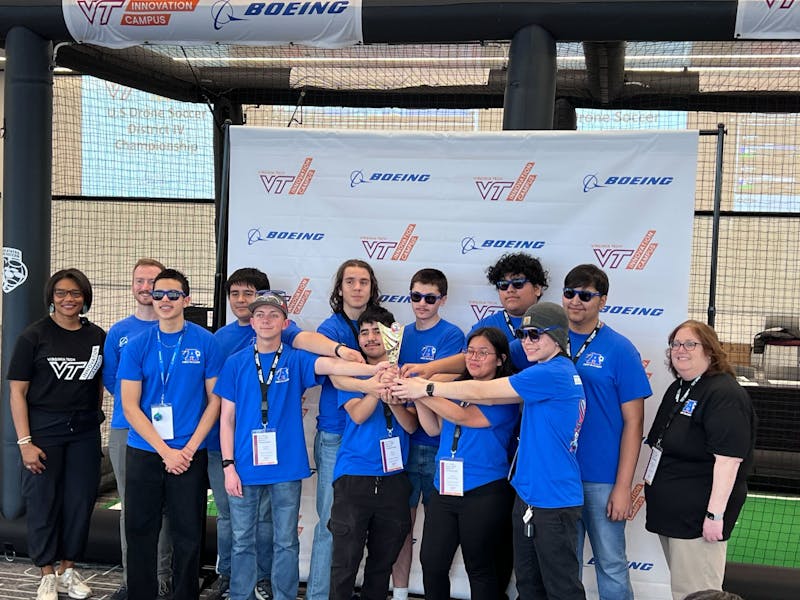
Anthony Woodyard, chief information officer for Asheboro City Schools, was searching for a new program to bring to the high school — something hands-on, academic-driven and fun. While exploring potential options he heard about an organization that pushed him in an unexpected direction, introducing an entirely different opportunity — drone soccer. The idea would eventually make Asheboro High School a trailblazer for Science, Technology, Engineering, and Mathematics or STEM or extracurriculars in North Carolina.
“It was just a passing comment, but I immediately keyed in on it and wrote it down,” Woodyard said. “I did a little research on U.S. Drone Soccer and knew it was something we had to bring to our city schools.”
Drone soccer began in South Korea and has since evolved into a globally competitive sport. It blends engineering and aviation principles with the pace and strategy of traditional team sports. Players pilot 20-centimeter quadcopter drones that maneuver inside protective spheres, scoring goals much like in soccer — but in mid-air.
The U.S. Drone Soccer Association includes about 270 institutions nationwide. According to the organization, its mission is to “inspire students to pursue education and careers in aerospace and science by leading students to build, program, fly and become successful team members.”
Woodyard believed the program offered exactly what Asheboro students needed. Working with other administrators, he helped secure the equipment to form the first high school drone soccer team in North Carolina.
“They have to build their drones. They have to program their drones,” Woodyard said. “It really is the full STEM continuum.”
The program launched in 2023 with 12 drones and only five or six students. Now in its third season, Asheboro fields three teams of students across all four high school grade levels. Competing against teams from Virginia, Delaware, Maryland and Washington, D.C. — Asheboro often ranks high on national leaderboards and currently sits at No. 26 as of January 2026.
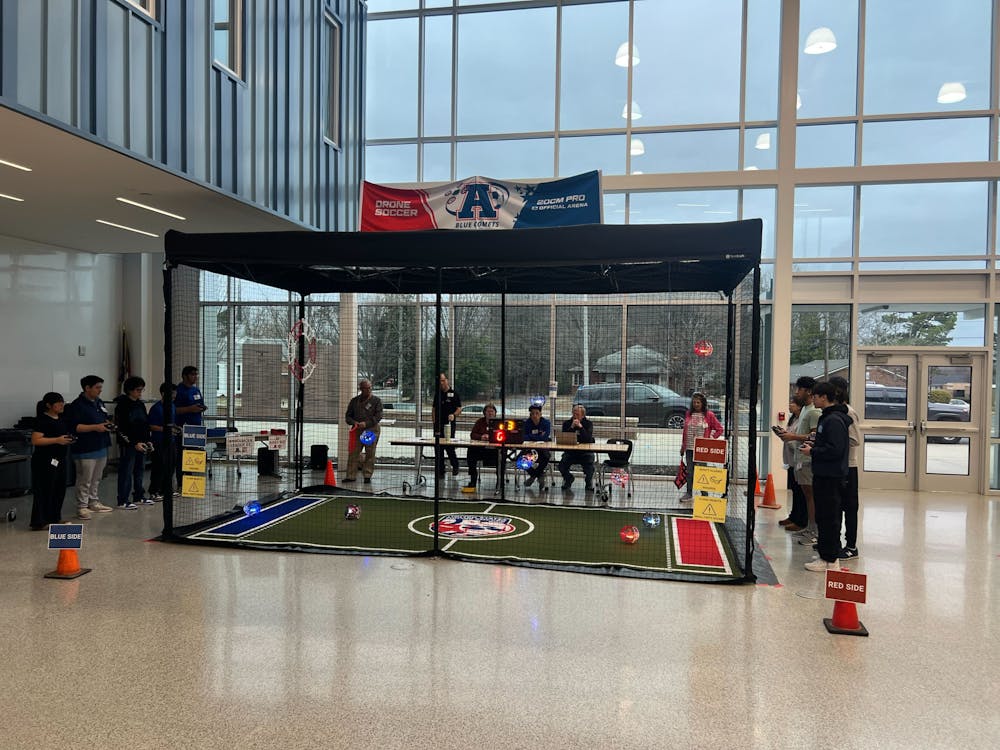
The net set up for the 2025 Regionals Drone Soccer Tournament. Photo courtesy of Anthony Woodyard.
Once the program began gaining momentum among students in fall 2024, the team found success quickly. For its first-ever competition, the team traveled to Virginia to participate in regionals. To the surprise of Woodyard and head coach Wendy Graham, the team took home first place.
“That speaks to the power of the program, but it also speaks to the commitment of those students to really learn the sport,” Woodyard said.
Their success at regionals not only showed the potential of Asheboro’s program, but also highlighted what the team was missing — girls on the roster.
“We knew that it was coed and that you wanted to have boys and girls, but we didn’t understand that during the competition there had to be girls and guys competing,” Graham said. “And we didn’t have any girls.”
That realization prompted Graham and the team to make sure girls knew about the program and felt comfortable joining. They even hosted girls-only practices where participants could get familiar with the technology before officially joining the team.
Asheboro High School senior Jenny Gabriel has been on the team for two years. When she joined the program was still new, making her one of the only girls. Gabriel said one of her goals was to help make the space more inclusive.
“One thing that really sparked my decision going into it was that there weren’t many girls there,” Gabriel said. “It kind of shook me because I thought this was so interesting. There should definitely be girls here.”
During the beginning of their 2024 season, the team had two girls and 16 boys. But through outreach and encouragement, Gabriel said more young women have joined, transforming the program into both an extracurricular and an example of female representation in STEM.
“The more girls we got into the program, the more comfortable I felt,” she said. “It showed me that it’s okay we’re going to reach out and have girls involved in this STEM-based program.”
As she prepares for graduation, Gabriel said drone soccer has taught her lessons in both engineering and leadership.
“Being a leader is not only listening,” Gabriel said. “It’s taking part in the team and having my own ideas.”
For Woodyard, the success of drone soccer has been undeniable. Even as a young program, he said it has opened doors for students who never considered careers in STEM.
“Everyone around the community really just rallied around the team,” Woodyard said. “That created even more momentum for us in having a successful program.”