
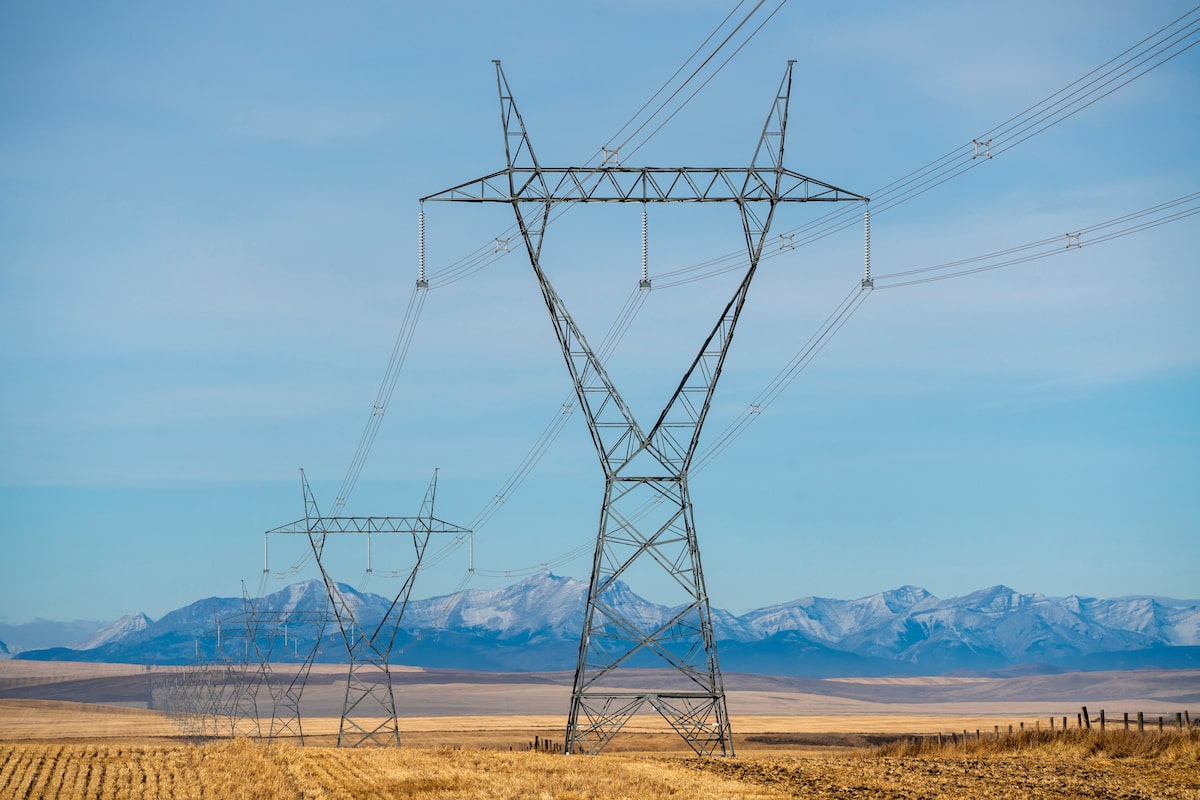
Hydro power lines in southern Alberta in October, 2025. Berkshire Hathaway Energy Canada has accused Alberta’s grid operator of limiting electricity imports from Montana.Todd Korol/The Globe and Mail
Alberta is disputing the Trump administration’s claim that the province is treating Montana power providers unfairly, a sore point that has been singled out ahead of the renegotiation of the North American free-trade agreement.
The point of contention stems from a complaint made in February, 2024, by an energy company owned by Warren Buffett’s Berkshire Hathaway Inc. BRK-B-N
In its complaint, Berkshire Hathaway Energy Canada accused Alberta’s grid operator of limiting electricity imports from Montana, thereby jeopardizing renewable power investment in the state and potentially costing Alberta consumers billions of dollars.
United States Trade Representative Jamieson Greer highlighted the issue during a December presentation to the Senate finance committee about the United States-Mexico-Canada Agreement, which is up for renegotiation this year.
A successful joint review of the agreement will depend on the resolution of several issues, he said, including “Alberta’s unfair treatment of electrical power distribution providers in Montana.”
How Trump’s protectionist trade regime could survive a U.S. Supreme Court setback
Calgary company eyes power generation for bitcoin mining as stranded oil and gas well solution
Nathan Neudorf, Alberta’s Affordability and Utilities Minister, said while the provincial government takes the concerns seriously, “our perspective is that, ‘No, we are not treating you differently in terms of trade.’ ”
Alberta is not limiting imports of power from Montana, Mr. Neudorf said in an interview Thursday. Rather, he continued, the entire nature of the province’s electricity supply and demand has “changed dramatically” over the past few years – well beyond what the grid operator predicted.
“For the first time in nearly a dozen years, Alberta became a net exporter of electricity in 2024, instead of a net importer. That’s not a trade relationship decision. That’s a practical change in the generation capacity.”
Mr. Neudorf pointed to Alberta’s rapid population growth and skyrocketing demand for power driven by people and industry, which have had a major impact on how electricity is consumed and where it is shipped.
Yet Alberta has added 7,000 megawatts of renewable generation over the past four years, along with 3,000 megawatts of dispatchable generation, Mr. Neudorf said, which has reshaped the province’s power market.
“We’re trying to grapple with radical, huge change,” he said. “And given the global supply chain, it might take a little while before we figure it out.”
Mr. Neudorf said he understands the criticism from the U.S., though he isn’t overly concerned about how it might play out.
“Obviously, if you have a famous name and a few billion dollars behind it, you have more access to the federal U.S. administration than a lowly carpenter from Lethbridge who happens to be the minister in Alberta,” he said, referring to Berkshire Hathaway Energy Canada.
“This is the process. We have regulators that govern it. We are not going to back down,” he said. “We’re here to stand up for Albertans. I’m happy to do that, and we’ll make sure that they are protected.”
Mr. Neudorf said he has shared Alberta’s “rational, reasonable, well-explained response” to the concerns in Washington and in Montana’s capital, Helena, where he spent two days this week at the state’s annual Chamber of Commerce event.
Berkshire Hathaway Energy (BHE) Canada’s allegations are still making their way through the complaints process of the Alberta Utilities Commission (AUC).
The Alberta Electric System Operator (AESO) has accused the company of trying to use the case and the commission’s processes “for U.S. trade complaint and lobbying purposes” in the USMCA renegotiation.
More than 180 documents have so far been filed in the case. The commission is in the process of dealing with information requests.
BHE Canada argued in December that several responses from the AESO to information requests made by the company were “insufficient.”
The grid operator has “failed to provide full and adequate responses,” lawyers from Fasken Martineau DuMoulin LLP representing BHE Canada wrote in a December letter to the AUC, urging the commission to force the AESO to deliver more detailed information.
“BHE Canada has asked relevant and material questions, none of which demand unreasonable effort on the part of the AESO to provide the requested information,” it wrote.
Counsel for the AESO, Norton Rose Fulbright Canada LLP, countered in a letter to the commission this week that BHE Canada has failed to prove that its information requests are relevant.
“BHE has sidestepped its responsibility to explain in sufficient detail why the information requested is relevant and material to the issues before the commission,” the firm wrote, calling it a “fatal flaw” in the company’s requests.
Further, the firm argued, BHE Canada has demonstrated disregard for the commission’s decisions and its regulatory efficiency.
Written reply arguments from all parties in the case are due in February.