
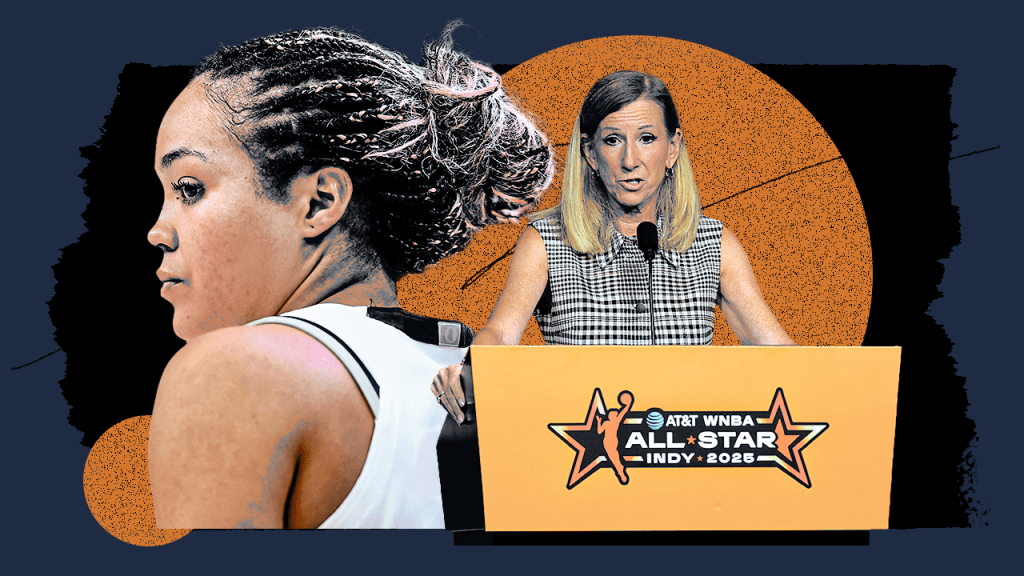
CBA negotiations between the WNBA and its players union could enter a new phase this weekend. While the two sides twice agreed to extend their negotiating period in the fall, it’s unclear if another temporary extension will come through before the latest deadline set for midnight Friday.
Both sides exchanged proposals in December—with a reported divide of roughly $50-75 million in total annual salaries for 2026 between the offered deals—followed by little apparent movement.
“There’s still time,” WNBPA president Nneka Ogwumike told ESPN Thursday. “But at this point it’s a question of if they’re willing to get a deal done. Because right now, it appears as though the evidence is showing that the league is trying to run out the clock.”
Even without a formal extension, both sides have committed to continue working toward a deal if they feel like progress is being made. In that scenario, the league would enter a “status quo” period, operating under existing terms while hammering out new deal points.
WNBA players have already authorized their union to initiate a strike, though one isn’t necessarily coming immediately. In the case of a work stoppage—either a strike or a lockout—the union has already established a network of training facilities players can access during the offseason, it announced on Thursday.
WNBPA VP Breanna Stewart said a new deal was not expected by Friday’s deadline.
“If they are not going to budge, we’re going to get to this point where we’re going to be at a standoff,” Stewart said during the preseason media day for 3-on-3 league Unrivaled. “That’s kind of where we’re at right now.”
The most recent proposal from players, according to past reports, would establish a $10.5 million salary cap budget, and grow from there, with athletes collectively receiving around 30% of the league’s gross revenue.
Alternatively, the W has proposed sharing a percentage of net revenue after accounting for expenses. Its most recent proposal would see average salaries of more than $530,000, according to a person familiar with the negotiations. Players would also receive money on top of their pre-set salaries if league revenues exceeded projections, the person said. The average WNBA salary in 2025 was roughly $120,000.
WNBA commissioner Cathy Engelbert has said that the W wants to ensure that team ownership remains a viable business model as the league expands.
“Our focus remains on reaching an agreement that significantly increases player compensation while ensuring the long-term growth of the business,” a league spokesperson said in a recent statement.
WNBPA VP—and Unrivaled co-founder—Napheesa Collier recently said that, if league leadership is unable to find a sustainable model in line with player requests, “they need to put people in place who can.”
In another sign of friction, the union profile photo on Instagram as of Friday morning was an hourglass. Time is ticking.
As the negotiation period continues to drag on, the WNBA’s offseason calendar remains frozen. January was set to host a free-agent frenzy, with most league veterans aligning their contracts to expire in advance of the new CBA. The WNBA also needs to conduct an expansion draft for teams in Portland and Toronto, as well as lock in playing dates at relevant venues. The season has traditionally started in May.
Beyond money, other issues expected to be hammered out in CBA talks include the length of the season, facility and travel standards, retirement benefits and changes to rookie deals.
While there have been close calls in the past—in 2003, then-NBA commissioner David Stern threatened to cancel the W’s season during a labor dispute—the W hasn’t lost games to a work stoppage in its 30-year history.