
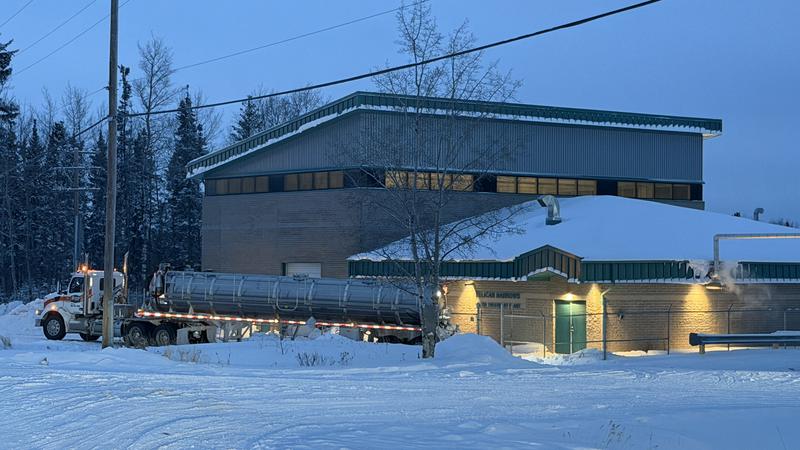
The issues first began Sunday night when the community experienced a loss of system pressure. On Friday, a temporary pumping system became operational to help supplement the water plant and the community’s needs.

“We’re drawing additional water through a hole cut in the ice,” said Ryan King, an AECOM engineer working with PBCN. “Compared to Tuesday night, we have a full reservoir now and the community is in good shape and there will likely be talk over the weekend about returning some of the facilities and the community back to some state of normalcy while we continue to work on the root cause of the problem.”
Specialized divers will swim to the bottom of Pelican Lake sometime this weekend to get a visual on what may be blocking the intake screen to the water line. King explained the original lake intake for the community of Pelican Narrows was implemented in 1981 and it’s been in place ever since. The 200-millimetre diameter line goes from the shoreline approximately 630 feet out into the lake and depending on lake levels, sits between 15 and 20 feet down. An intake pumphouse on the shoreline runs the raw lake water to the plant for filtration and disinfection.
“The intake line has a screen on it to prevent fish and other debris from entering it. The intake screen was replaced in 2007 with a modern stainless steel, robust structure. That’s the only known issue over the 40-plus years this lake intake has been in service. So, it’s been a very reliable, faithful water source for the community until Sunday.”
The ice presents some challenges in trying to accurately locate where the screen is, so in addition to drilling holes, sonars will be used before the drivers swim down to the intake screen and visually inspect it.
“It’s unsual for a lake intake to have a sudden obstruction like this, especially in winter because there’s no real moving water or anything that could impact it from above anyways.”
King said they’ve tried to think about what could be down there – like a tarp or piece of plastic that’s settled to the lake bottom and wrapped around the intake, but he said it’s anyone’s guess.
“If there’s nothing really obvious or visible on the intake screen, then we’re probably going to pivot to actually inspecting the 500 feet on the lake bottom itself of pipeline to see if its been impacted, kinked, or there’s some sort of damage that’s preventing flow through the pipeline.”
That will be done either by humans diving or with an underwater robot that has the potential to go longer distances.
King said they may also try doing a backflush on the intake line, which may dislodge something that’s obstructing flow.
In a worst-case scenario, King said needing to replace the equipment would be a ‘significant capital undertaking’ further challenged by the time of year and the remote location. He said that’s unlikely, but not off the table.
Until the problem is fixed, Custer said potable water will continue to be delivered to community members – something she’s been doing constantly since Monday morning.
“I’ve been on the ground since then,” she said. “So, I’ve seen firsthand how stressful and overwhelming the situation has been for everybody in the community.”
She said the community’s cooperation with water conservation has been critical and sincerely appreciated.
A boil water advisory remains in effect for Pelican Narrows, but Hiebert said it may be lifted in a few days. Until then, all water used for drinking, cooking, brushing teeth, and food preparation must be boiled for at least one minute or replaced with bottled water.
—
teena.monteleone@pattisonmedia.com