
Dust is everywhere in space. Even the emptiest parts of the universe are full of tiny grains that shape how stars form and how planets eventually come together.
For decades, scientists believed this dust needed a decent supply of heavy elements like silicon, oxygen, and iron. Without them, dust should be scarce or missing altogether.

But now, a small galaxy near the Milky Way is showing that dust can form even when almost all the usual ingredients are missing.
The discovery is changing how scientists think about the early universe and what it was capable of building with very little to work with.
The Sextans A galaxy
The galaxy is called Sextans A. It sits about four million light-years away and is tiny by cosmic standards.
What makes this galaxy special is how chemically simple it is – containing only about three to seven percent of the Sun’s metal content. In astronomy, a “metal” is anything heavier than hydrogen and helium.
Because Sextans A is so small, it cannot hold on to most of the heavy elements made by dying stars and exploding supernovae. Those materials escape into space.
That makes the galaxy a stand-in for galaxies that existed shortly after the Big Bang, before the universe had time to enrich itself.
Using NASA’s James Webb Space Telescope, astronomers took a closer look. What they found was not supposed to be there.
Clues from aging stars
Deep inside Sextans A are aging stars nearing the end of their lives. These stars swell up, cool down, and begin shedding material into space. In larger, richer galaxies, this stage usually produces familiar kinds of dust.
Webb’s mid-infrared instrument examined six of these stars and picked up chemical signals that told a different story. The dust did exist, but it looked nothing like what scientists expected.
Study lead author Elizabeth Tarantino is a postdoctoral researcher at the Space Telescope Science Institute (STScI).
“Sextans A is giving us a blueprint for the first dusty galaxies. These results help us interpret the most distant galaxies imaged by Webb and understand what the universe was building with its earliest ingredients,” said Tarantino.
 NASA’s James Webb Space Telescope’s image of a portion of the nearby Sextans A galaxy is put into context using a ground-based image from the Nicholas U. Mayall 4-meter Telescope at Kitt Peak National Observatory. Credit: NASA, ESA, CSA, STScI. Click image to enlarge.
One star stood out. It sits on the higher-mass end of a group known as asymptotic giant branch stars.
Under normal conditions, stars like this make silicate dust. Silicates need elements such as silicon and magnesium. Sextans A barely has those elements at all.
“One of these stars is on the high-mass end of the AGB range, and stars like this usually produce silicate dust. However, at such low metallicity, we expect these stars to be nearly dust-free,” said Martha Boyer, lead author of a companion study.
“Instead, Webb revealed a star forging dust grains made almost entirely of iron. This is something we’ve never seen in stars that are analogs of stars in the early universe.”
The finding shows that stars can fall back on a different method when the usual materials are missing.
Less massive stars in the same galaxy also produced silicon carbide dust, even though silicon is in short supply. Together, these results prove that solid grains can form in unexpected ways.
What early dust may have looked like
Dust today is often made of silicates that leave clear chemical fingerprints. Iron dust behaves differently.
“Dust in the early universe may have looked very different from the silicate grains we see today,” Boyer said.
“These iron grains absorb light efficiently but leave no sharp spectral fingerprints and can contribute to the large dust reservoirs seen in far-away galaxies detected by Webb.”
This helps explain why very distant galaxies appear dustier than models once predicted. The dust was there, just not in the form scientists assumed.
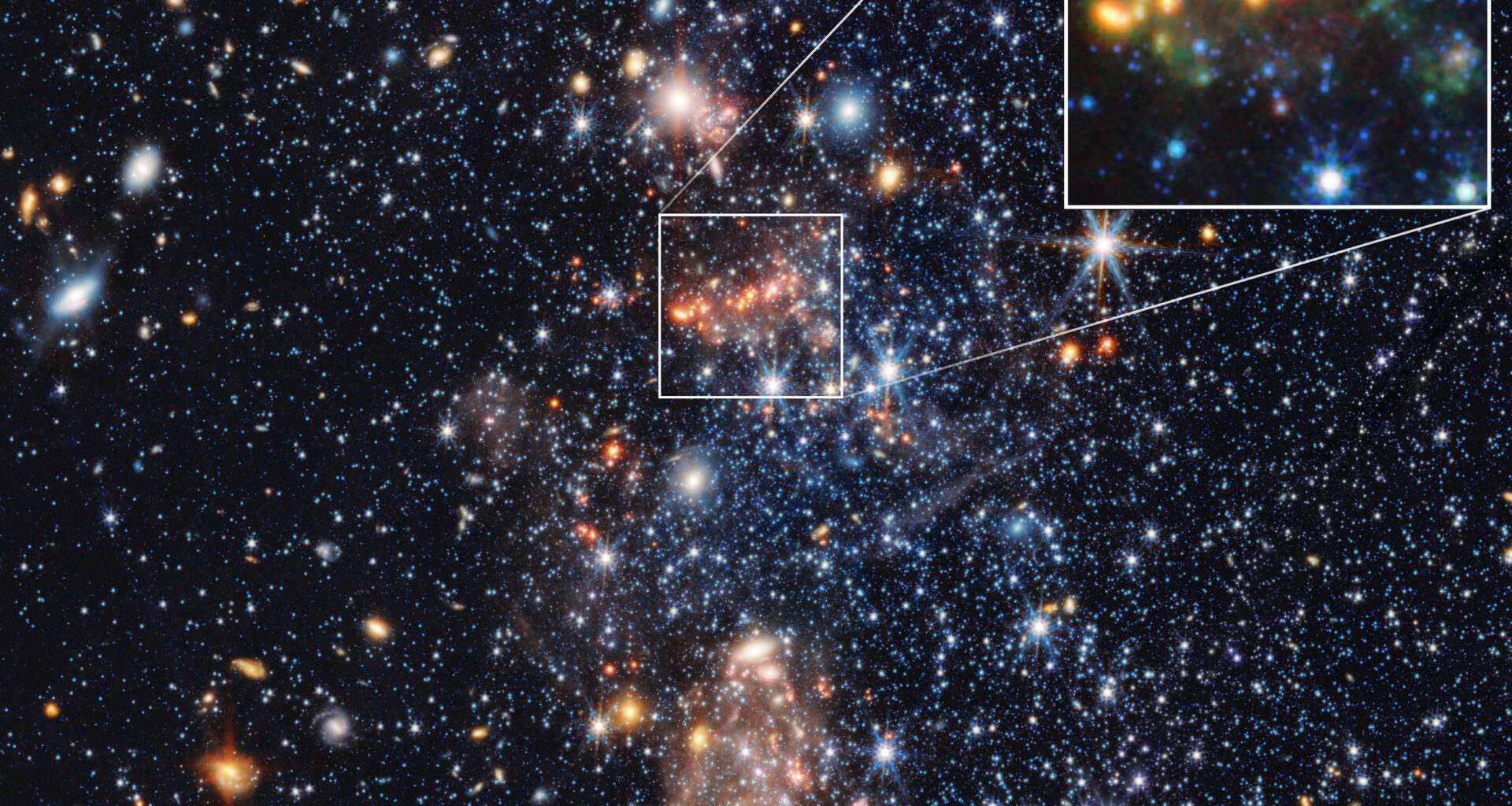
 Images from NASA’s James Webb Space Telescope of the dwarf galaxy Sextans A reveal polycyclic aromatic hydrocarbons (PAHs), large carbon-based molecules that can be a signifier of star formation. The inset at the top right zooms in on those PAHs, which are represented in green. Credit: NASA, ESA, CSA, STScI. Click image to enlarge.Tiny islands of complex molecules
Webb also looked beyond stars and into the space between them. There, it found small clumps of polycyclic aromatic hydrocarbons, or PAHs. These carbon-based molecules are among the smallest dust particles and glow in infrared light.
Sextans A is now the lowest-metallicity galaxy known to contain PAHs. Unlike larger galaxies, where PAHs spread out in wide regions, these molecules appear in tight pockets only a few light-years across.
“Webb shows that PAHs can form and survive even in the most metal-starved galaxies, but only in small, protected islands of dense gas,” said Tarantino.
The pockets likely form where gas is dense enough to shield the molecules from harsh radiation. This clears up a long-standing puzzle about why PAHs seemed to disappear in galaxies with very few heavy elements.
Lessons from Sextans A
Taken together, the discoveries point to a universe that was far more flexible than once thought. Dust did not rely on one recipe or one source. Stars found ways to build solid material even when conditions were rough.
“Every discovery in Sextans A reminds us that the early universe was more inventive than we imagined,” said Boyer.
“Clearly stars found a way to make the building blocks of planets long before galaxies like our own existed.”
Future observations will zoom in on these dusty pockets to study their chemistry in detail. For now, Sextans A stands as a reminder that the universe rarely follows simple rules, especially when it is young.
The study is published in The Astrophysics Journal.
—–
Like what you read? Subscribe to our newsletter for engaging articles, exclusive content, and the latest updates.
Check us out on EarthSnap, a free app brought to you by Eric Ralls and Earth.com.
—–