
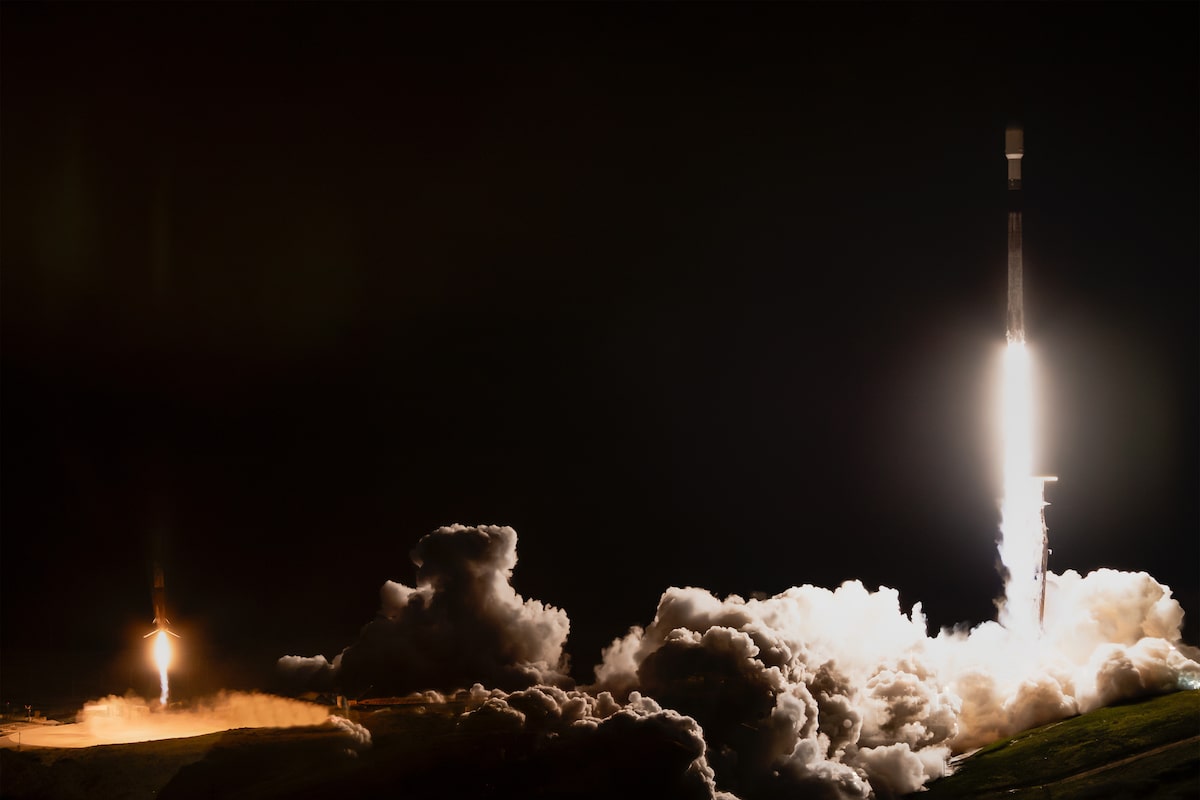
The Space X Twilight mission lifts off from Vandenberg Space Force Base in California early Sunday morning carrying 47 satellites that were later deployed into Earth orbit. Among the payloads were 10 satellites built by Canadian company Kepler Communications Inc. and NASA’s exoplanet observer called Pandora.SpaceX/Supplied
Toronto-based aerospace company Kepler Communications Inc. launched 10 satellites on Sunday, cementing its position as the operator of the largest fleet of Canadian-built spacecraft to date.
The cluster of 300-kilogram satellites – each one about the size of a large desk – were among 47 payloads carried into orbit on a Space X rocket that lifted off at 5:44 Pacific time from Vandenberg Space Force Base in California, about 250 kilometres northwest of Los Angeles.
Also hitching a ride on the same flight was Pandora, a NASA satellite built to analyze the atmospheres of planets orbiting distant stars.
Once the rocket achieved orbit, the deployment of satellites proceeded over the next 2½ hours, with confirmation of the final payload release at 8:19 a.m.
Three satellites built by Kepler prior to the launch of the Space-X Twilight mission. The streamlined outer shell, called a fairing, is closed for launch and is designed to protect the satellites during the rocket’s ascent through Earth’s atmosphere.SpaceX/Supplied
In what has increasingly become a routine procedure for Space X, about seven minutes after liftoff, the separated first stage of the Falcon 9 rocket steered itself to a controlled landing back at the launch site.
“It was absolutely amazing to watch,” said Mina Mitry, Kepler’s chief executive officer, who witnessed the launch together with other company representatives, including former Canadian astronaut Chris Hadfield.
Mr. Mitry said clear skies provided a spectacular view of the rocket ascending on a blaze of white flame followed by the separation, reignition and subsequent return of the lower stage.
The timing of the dawn mission, nicknamed Twilight, was deliberate. It puts Kepler’s satellites and others sharing the flight on a path directly above the line that separates day and night on Earth. Satellites occupying such an orbit have continuous access to sunlight for their solar arrays and consistent lighting on points of interest are in view below them.
Sunday’s launch was a crucial one for the Canadian company, which has pioneered the use of optical communications in space. Instead of radio signals, its satellites communicate with each other and with ground stations using laser light. Kepler’s satellites also carry significant computer power for speedier processing of data in orbit that improves real-time awareness of conditions around the globe.
Toronto-based Kepler vies for a spot in the global space-data race
As an example application, Mr. Mitry said the satellites carry a client’s thermal imagers that can scan the landscape below to detect and monitor the development of wildfires. The satellites’ AI-powered processing enables the information to be assessed and transmitted in real time, with the optical communication links between them enabling continuous coverage.
In contrast, NASA’s Pandora satellite is an orbiting telescope that will direct its gaze toward stars that have planets circling around them in order to better understand conditions on those alien worlds, including whether they have an abundance of water or other molecules that are necessary for life.
Elisa Quintana, who is principal science investigator for the mission at the Goddard Space Flight Center in Greenbelt, Md., said that after the launch, the mission will be operated out of a newly installed control centre at the University of Arizona in Phoenix.
She added that it should take about a month to put the satellite through its paces, after which astronomers involved with the mission, including in Canada, will be analyzing data from about 20 planets on Pandora’s initial target list.