
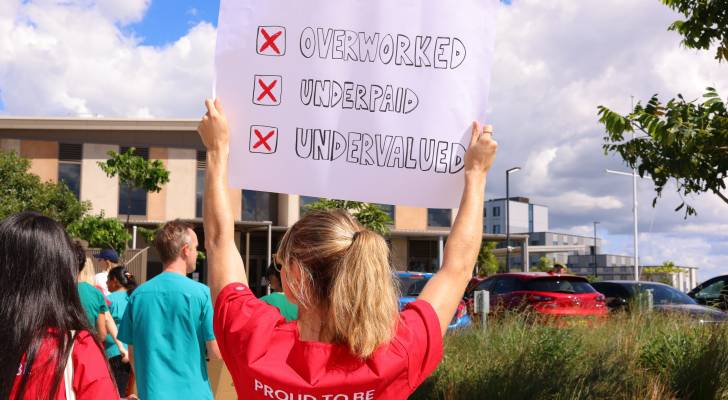
 Hospital staff take strike action demanding better pay and working conditions,, New South Wales, 2025
For millions of Canadians, the real financial stress isn’t a missed flight or a cancelled vacation — it’s the slow realization that their paycheque hasn’t kept pace with the cost of living.
Wages have grown in Canada, but not evenly. According to Statistics Canada (1), real average hourly wages barely kept up with inflation between 2021 and 2024, leaving many workers effectively running in place.
Labour disputes like the 2025 Air Canada flight attendants’ strike make headlines, but they also surface quieter truths about work, pay and power that apply far beyond unionized jobs.
Here are eight practical earning and negotiation lessons Canadians can use — whether they work in an office, a hospital, a classroom or in the gig economy.
In August 2025, after months of negotiations, 10,000 flight attendants at Air Canada walked off the job. The result was chaos at the country’s airports, with hundreds of flights cancelled and thousands of passengers stranded all over the world.
The strike quickly became a national talking point, sparking conversations about unpaid work, fairness and how to advocate for yourself. The flight attendants even ignored a federal government back-to-work ruling before opting to enter mediation.
One of the central complaints raised during the Air Canada dispute was unpaid labour — time spent boarding passengers, waiting out delays or performing safety checks without compensation.
The broader lesson: Many Canadians perform unpaid work without realizing it.
Examples include:
Regularly answering emails after hours
Arriving early or staying late without pay
Taking on “temporary” responsibilities that become permanent
The Canadian Centre for Policy Alternatives estimates that unpaid overtime costs workers billions annually in lost wages (2).
Action step: Track everything you do for two weeks. If your role has expanded, your compensation should too.
Flight attendants compared their wage increases with those received by other employee groups — and realized they were falling behind.
Here’s the thing: You can do the same.
Before accepting a new job, negotiating a promotion and raise or agreeing to annual pay increase :
Check comparable salaries on Job Bank (3)
Review private salary surveys (like Glassdoor and Payscale)
If unionized, look at union wage disclosures where available
Job Bank Canada wage data: https://www.jobbank.gc.ca/wagereport
Action step: Bring market data, not emotions, into pay discussions.
In recent years, inflation reshaped household budgets — but many salaries lagged behind.
Between 2021 and 2023, consumer prices rose faster than wages, according to Statistics Canada data (4).
The Canadian Union of Public Employees (CUPE), which represented the attendants, said that unpaid work meant Air Canada was paying below inflation, market value and even the federal minimum wage. “It’s really important for passengers to understand that we are flight attendants, we love our jobs, we belong in the sky,” flight attendant Henly Larden told Good Morning America (5). “We just need … pay to do our duties and ensure that we are compensated in a fair manner.”
The flight attendants were tired of not being compensated for time they spent boarding passengers, waiting on flight delays and cleaning cabins. This is a reminder for regular Canadians that knowing exactly what work you are getting paid to do can help prevent a sense of resentment towards your employer.
Action step: Frame raises as maintenance of purchasing power, not “extra money.”
Read more: Here are 5 expenses that Canadians (almost) always overpay for — and very quickly regret. How many are hurting you?
During the strike, public visibility mattered. Support grew as the financial realities of the job became clearer. Flight attendants in the U.S. showed support for their Canadian counterparts. “The inspirational fight of the Air Canada flight attendants is helpful and creates momentum,” Sara Nelson, international president of the Association of Flight Attendants, told Reuters (6).
Talking about money can still be seen as taboo, but sharing your financial struggles or successes can create community. This could involve something as straightforward as swapping budgeting tips with friends or taking a financial literacy course with people in your area.
For individual workers — particularly those in non-unionized jobs or working in the gig economy — silence can be costly:
A Harvard Business Review analysis found that employees who negotiate earn significantly more over their careers than those who don’t (7).
Action step: Treat negotiation as a normal part of employment — not conflict.
One national survey (8) taken shortly before the strike showed that almost 60% of Canadians were more likely to sympathize with the flight attendants amid any strike action, as opposed to 12% who sympathized with Air Canada.
“Maybe by giving the flight attendants what they wanted would have been a better idea for everyone,” said Montreal resident Rina Antonucci, whose family’s return flight to Canada from Europe was cancelled, when talking to CTV News (9).
While unions formalize what many workers lack, shared information, having discussions and talking openly about difficulties can help. Even outside unions, peer transparency helps:
Talking pay ranges with colleagues
Comparing benefits, vacation and flexibility
Sharing negotiation outcomes privately
Action step: Find trusted peers and compare notes before major job decisions. Research pay transparency using trusted resources, such as OECD (10).
The Air Canada dispute wasn’t only about hourly wages — it also centred on how time and effort were recognized.
Canadians often overlook:
Pension matching
Extended health benefits
Paid training
Flexible scheduling
According to Sun Life, benefits now account for roughly 20% to 30% of total compensation in many sectors (11).
Action step: Negotiate total compensation — not just salary.
The flight attendants remained on strike even after the Canada Industrial Relations Board declared the job action unlawful. Despite pressure from the government to return to work, the flight attendants held out for a better offer.
Standing up for yourself can be daunting, whether you are negotiating a salary or disputing a charge on your phone bill. But self-advocacy can help you secure a better financial deal.
Striking workers had leverage because they were organized and financially prepared.
For individuals, leverage comes from:
StatCan data shows nearly half of Canadians couldn’t cover an unexpected $500 expense, limiting their negotiating power (12).
Action step: An emergency fund is also a negotiation tool.
Some union leaders said they would be willing to go to jail rather than complying with the federal government’s return-to-work order. “We’re going to stay strong,” CUPE president Mark Hancock told The Guardian (13). “And if that means folks like me going to jail, then so be it.”
While it’s unlikely you’ll risk jail time ahead of your next big financial decision, sticking to your guns matters. That means walking away from bad employment contracts or added responsibilities without additional pay.
In essence, the Air Canada strike, and similar labour disputes force you to answer a hard question: Is this job structured to ever pay what it’s worth to me?
If the answer is “no” that doesn’t mean you have to quit immediately. Sometimes the answer is:
Workers who change jobs often see larger wage increases than those who stay, according to RBC Economics (14).
Action step: If negotiations stall, reassess the role — not your worth.
This year, the flight attendants rejected several Air Canada contract offers before going on strike and then eventually choosing to go to mediation.
While the strike caused disruptions to summer travel plans for thousands of Canadians, it also raised the issues of invisible work and fair pay.
The Air Canada strike wasn’t just about planes and paycheques. It highlighted something many Canadians are quietly discovering: earning power doesn’t improve on autopilot.
Knowing your value, documenting your work and being willing to advocate — or walk — are among the most powerful financial skills you can develop.
— with files from Grant Surridge
We rely only on vetted sources and credible third-party reporting. For details, see our editorial ethics and guidelines.
Statistics Canada (1); Canadian Centre for Policy Alternatives (2); Job Bank (3); Statistics Canada (4); Good Morning America (5); Reuters 6); Harvard Business Review (7); Abacus Data 8); CTV News (9); OECD (10); SunLife (11); Statistics Canada (12); The Guardian (13); RBC (14)
This article provides information only and should not be construed as advice. It is provided without warranty of any kind.